 Skip to content


B2B buyers are losing trust in traditional outbound outreach, and that lack of trust shows up as poor performance.
Reply rates are inconsistent. Meetings are harder to secure. And even when outreach lands, it often stalls because buyers don’t see immediate relevance.
The issue isn’t that outbound “doesn’t work.” It’s that many teams are still running it with outdated assumptions: broad lists, surface-level personalization, and rigid sequences that ignore what buyers are already doing on their own.
Today’s buyers are far more self-directed. They research independently, define shortlists early, and engage sellers later—often only when outreach adds real context or reduces decision risk. When outbound shows up too early, too generic, or disconnected from real initiatives, it feels like noise instead of help.
The data backs this up: Gartner found 61% of B2B buyers prefer a rep-free buying experience, and 73% actively avoid suppliers that send irrelevant outreach.
That’s why modern outbound lead generation strategies aren’t about doing more activity. They’re about tighter ICP definition, relevance to real business moments, and capturing engagement signals that tell you who’s worth prioritizing — and who isn’t.
In this article, we’ll break down why outbound struggles for experienced teams in 2026, and what actually improves performance once you’re past generic “add personalization” advice and focused on building outbound as a precise, measurable growth lever. 📏
Why outbound struggles in 2026 (and what to do about it)
Outbound often underperforms for three reasons: targeting drift, message irrelevance, and timing blindness.
1) Targeting drift: your ICP is too broad to be useful
Most “ICP” definitions are really market definitions. They’re big enough to make a TAM slide look good, but not sharp enough to produce consistent engagement.
Practical fix: define two ICP layers: fit and readiness.
- Fit signals: firmographics, tech stack, regulatory posture, data maturity, deployment model, and security constraints.
- Readiness signals: hiring patterns, leadership changes, new system rollouts, product launches, budget cycles, and consolidation initiatives.
Your outbound lead generation strategies should prioritize accounts where both layers are present. Even if it reduces volume, it typically improves engagement and makes attribution cleaner.
2) Message irrelevance: buyers punish generic outreach
Irrelevant outreach doesn’t just get ignored; it can damage future willingness to engage.
Practical fix: build outbound messaging around decision risks, not product features. Experienced buyers don’t need another list of capabilities. They need help making a safer decision.
- What tends to break during implementation?
- What’s the hidden cost center no one budgets for?
- What’s the vendor promise that doesn’t survive procurement?
- What does “good” look like 90 days after go-live?
When your outbound addresses risk, it feels like expertise instead of interruption.
3) Timing blindness: outbound fails when it’s disconnected from buyer motion
The best teams don’t just “run sequences.” They run outreach that aligns with when buyers are selecting, validating, or reevaluating solutions.
6sense’s Buyer Experience Report emphasizes that buyers still spend most of the journey in independent research, forming a preliminary preference before heavy seller engagement, and that the “front-runner” tends to win most of the time.
That changes the job of outbound. It’s less about forcing a meeting and more about shaping preference earlier with credible proof and useful perspective.
Outbound lead generation strategies that work for experienced teams
Let’s get tactical. These are strategies that consistently improve engagement rates and signal quality, especially in competitive SaaS categories.
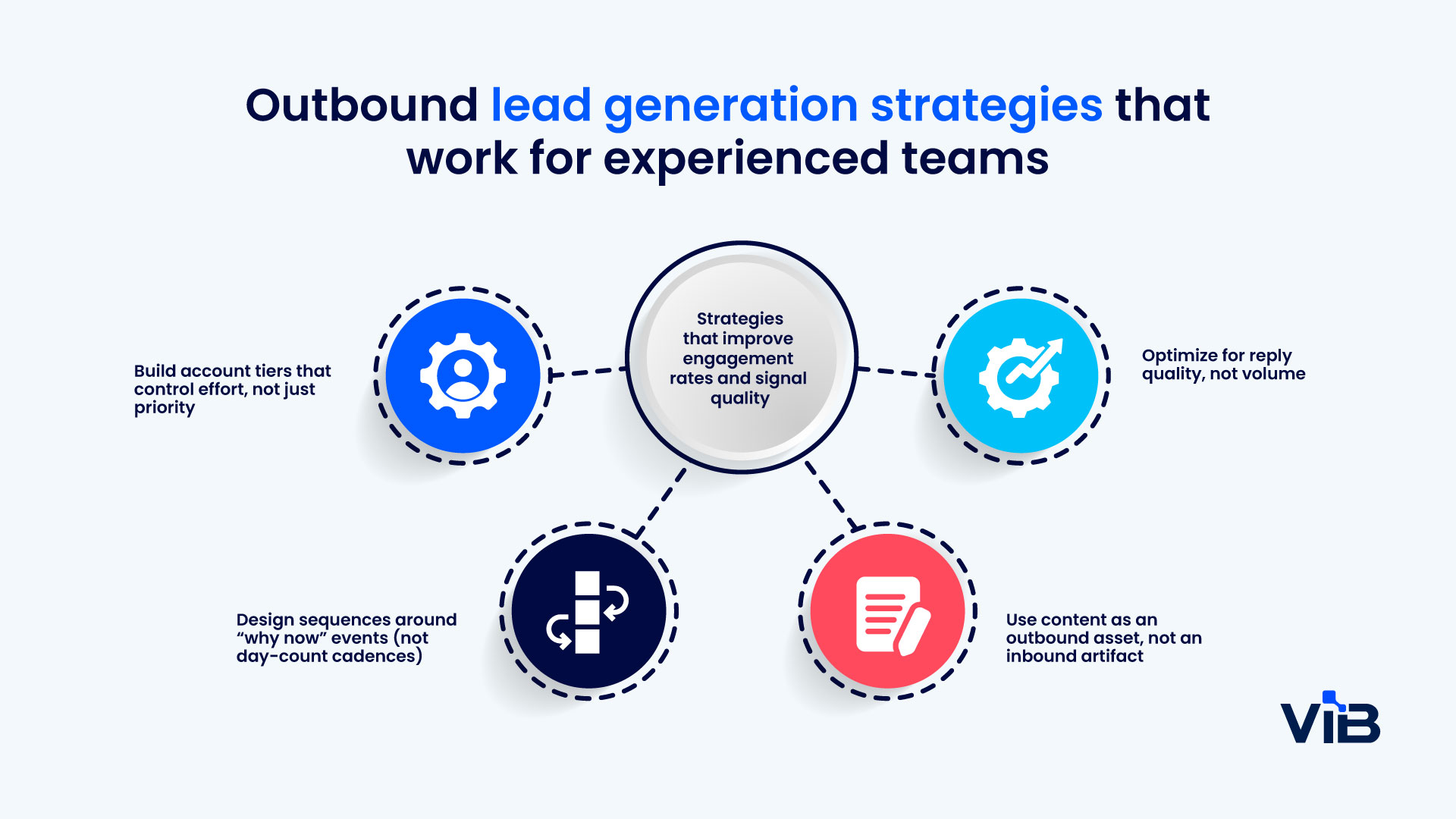
Build account tiers that control effort, not just priority
Many teams tier accounts, but still send the same sequence to everyone. That defeats the point.
Instead, tie tiers to research depth and multi-threading requirements.
- Tier 1: deep research, persona-specific angles, multi-thread from day one, custom proof points.
- Tier 2: moderate research, segment-specific angle, role-based variants, lighter multi-threading.
- Tier 3: minimal research, tighter filters, “test-and-learn” messaging, faster disqualification.
This structure stops you from over-investing in low-fit accounts while still keeping volume where it makes sense.
Design sequences around “why now” events (not day-count cadences)
Cadences are useful. But if your sequence logic is “Day 1 email, Day 3 follow-up,” you’re optimizing for your calendar, not the buyer’s situation.
Build plays around triggers, then attach channels to each trigger. Example triggers:
- New VP/head of function hired
- Security or compliance requirement changes
- Cloud migration milestone
- Tool consolidation initiative
- Hiring spike in a specific team (signal of project load)
Your messaging gets sharper because the “why now” is real. Your CTA gets softer because relevance does the heavy lifting.
This is also where a light touch can outperform a hard ask. A simple “Worth sharing a 2-minute benchmark?” often lands better than “Are you free Thursday?” 👍
Use content as an outbound asset, not an inbound artifact
Most outbound teams attach content as a credibility add-on. Strong teams use content as the core mechanism for engagement and signal generation.
The difference is intent. You’re not sending content to “nurture.” You’re sending it to learn.
- If they engage with a technical deep dive, route to technical champion outreach.
- If they engage with a risk/compliance piece, multi-thread into security and procurement.
- If they engage with an ROI/business case, bring in finance-friendly proof points.
This turns outbound into a feedback loop: every click, registration, or response helps you sharpen segmentation and next steps.
Optimize for reply quality, not volume
When it comes to cold email benchmarks, the trap is treating “any reply” as success. A “Not interested” with no context is noise. A “We’re solving this in Q3; who else have you seen do X?” is gold.
Practical fix: create a reply-quality rubric in your reporting.
- Tier A replies: clear initiative, timeframe, stakeholders, constraints, evaluation motion.
- Tier B replies: interest but vague; needs qualification through follow-up.
- Tier C replies: referral, rejection, or out-of-office with no buying info.
Then optimize messaging for Tier A/B reply share, not total replies.
Where most outbound programs leak performance
Even well-run teams hit predictable failure points. Fixing these usually creates a step-change in outcomes.
Leak 1: Your “personalization” isn’t tied to a hypothesis
Not all personalization is persuasive. A line about a prospect’s LinkedIn post isn’t strategic unless it supports a point.
Use personalization to validate a hypothesis:
- “You’re hiring X, which usually means Y is becoming a bottleneck.”
- “You just migrated to Z; teams often run into A during the first 90 days.”
- “You’re expanding into B; that tends to create C constraints.”
Now your outreach reads like a marketer who understands the business, not a rep who skimmed a profile.
Leak 2: Handoffs are built for speed, not context
If you’re generating engagement but sales follow-up feels generic, you lose trust fast.
Fix it by standardizing what “context” means at handoff:
- What did they engage with?
- Which pain/risk angle did we lead with?
- Who else in the buying group should be looped?
- What’s the next-best question to ask?
This is a marketing-owned problem as much as a sales-owned one. Your outbound lead generation strategies should include enablement artifacts, not just leads.
Leak 3: You’re underusing webinars as a signal engine
Webinars are often judged by registrant counts or attendance rates. That’s incomplete.
The higher-value lens is: did it identify accounts and personas showing active curiosity, pain urgency, or evaluation behavior?
When you design webinars for outbound, you’re not trying to “go viral.” You’re trying to create a structured interaction that produces follow-up context: poll answers, Q&A themes, role distribution, and account-level participation. That’s the stuff your SDRs can actually use. 🎯
A practical outbound operating system (what to run weekly)
If you want outbound to improve quarter over quarter, you need a simple operating cadence, not more meetings. Just better loops.
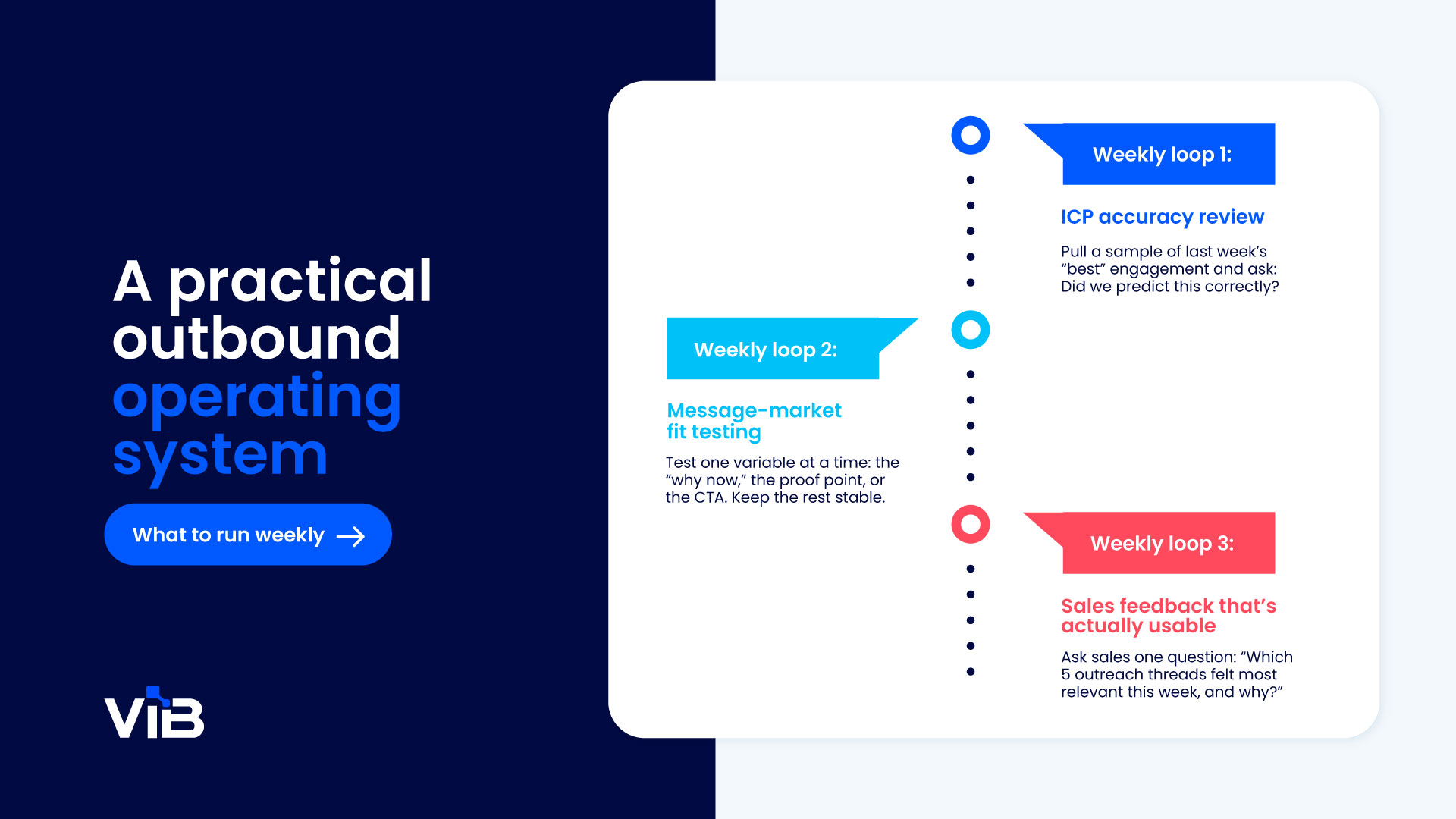
Weekly loop 1: ICP accuracy review
Pull a sample of last week’s “best” engagement and ask: Did we predict this correctly?
- Which segments over-performed?
- Which segments consumed content but didn’t reply?
- Which job levels engaged most?
Update your tiering rules with what you learned.
Weekly loop 2: message-market fit testing
Test one variable at a time: the “why now,” the proof point, or the CTA. Keep the rest stable.
Also, stop over-rotating on opens. Deliverability matters, but opens are noisy now. Use replies, content engagement, and meeting acceptance as the core indicators.
Weekly loop 3: sales feedback that’s actually usable
Ask sales one question: “Which 5 outreach threads felt most relevant this week, and why?”
Relevance patterns are more valuable than anecdotal objections.
Where ViB fits when you want more engagement and stronger buying signals
If your outbound lead generation strategies are already solid, the next bottleneck is often getting in front of the right people at the right time with the right context.
This is where solutions like ViB Webinars and ViB Deal Intent can support your strategy:
ViB Webinars: turn outbound topics into targeted engagement
Webinars work best in outbound when they’re built around a specific buyer problem and aimed at a defined audience segment.
ViB Webinars is a full-service solution designed to reach a targeted audience and capture attendee-level engagement signals (such as questions and poll responses) to make follow-ups smarter.
If your team is already strong on messaging and follow-up, this can help you scale the “engagement layer” of outbound without burning internal event resources.
ViB Deal Intent: add explicit “in-market” context to prioritization
One of the hardest parts of outbound is deciding what to do first. Not every good-fit account is ready.
ViB Deal Intent is designed to source intent data directly from prospects who are actively considering solutions, including context such as timing and stakeholders. It helps you spot and act on signals earlier in the journey and prioritize outreach toward accounts showing clearer near-term motion.
Bottom line
The outbound teams that win in 2026 aren’t louder. They’re more precise.
They build tiers that match effort to value. They anchor messaging in “why now” and decision risk. They use content and events to generate engagement and identify real buying signals, then they follow up with context.


