 Skip to content


When you’re under pressure to hit pipeline targets, it’s tempting to invest in third-party marketing list providers who promise thousands of “high-quality” contacts.
But in 2025, with data privacy laws tightening and buying behavior shifting, not all list providers are created equal — and some may be draining your budget more than they’re helping it.
That’s why marketers should evaluate list providers based on data provenance, verification, consent, segmentation, update frequency, and measurable engagement—not contact volume alone.
Let’s break down what’s working, what’s risky, and what actions B2B marketers should take now.
Why most marketing list providers still miss the mark
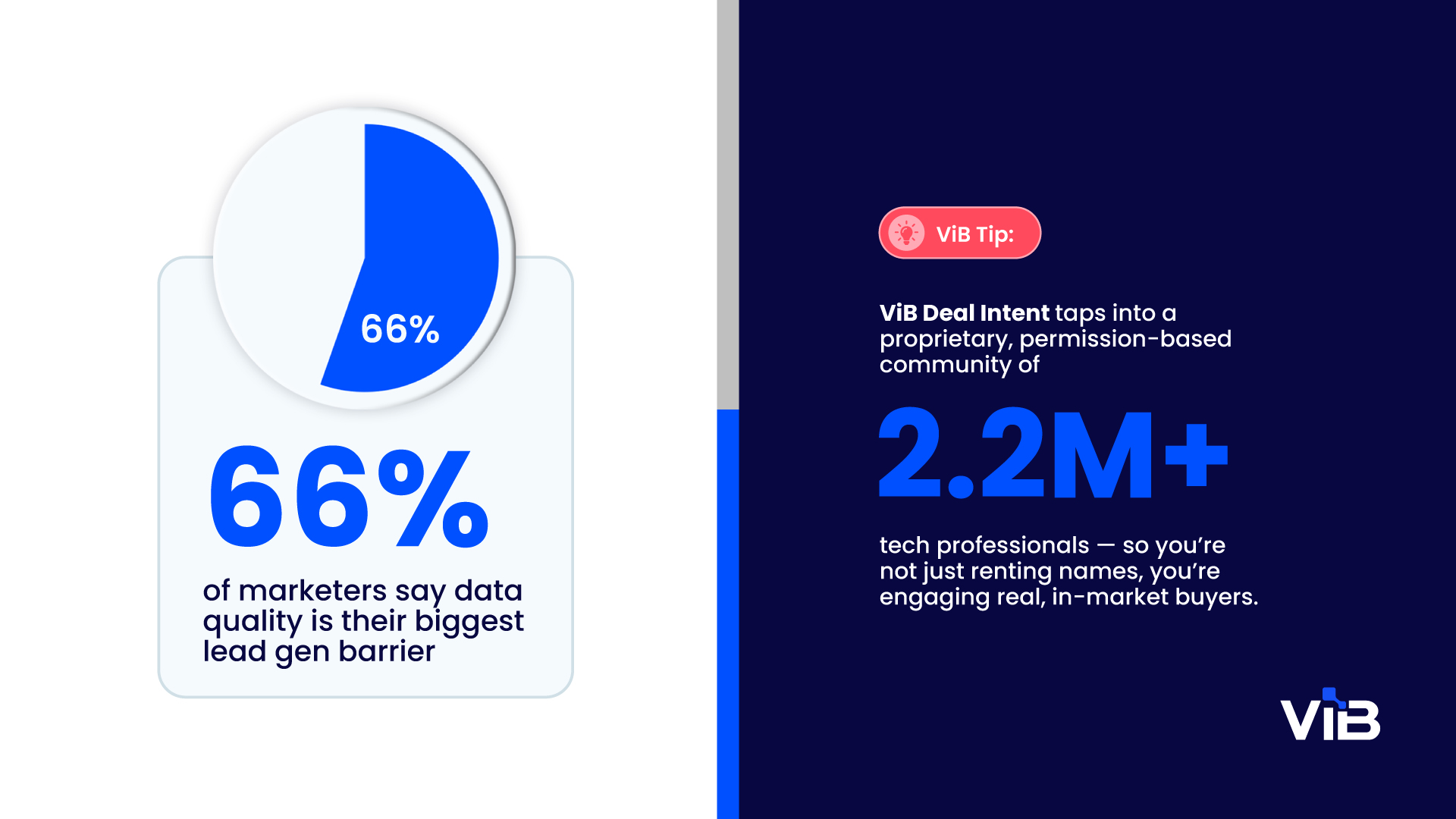
Here’s an important stat that sheds light on the current state of marketing lists in 2025:
66% of marketers say data quality is their biggest lead gen barrier
[Source: Demand Gen Report, 2025 Benchmark Survey]
Poor-fit leads, outdated contacts, or irrelevant job titles aren’t just annoying — they directly affect your ROI. While many marketing list providers promise volume, few deliver real engagement.
Despite big promises, many list providers fall short in five (5) key areas:
- Stale data (contacts no longer at the company)
- Lack of intent (they’re not in-market)
- Zero engagement (your emails go straight to spam)
- Poor segmentation (no filtering by title, industry, or company size)
- Compliance issues (no proof of opt-in or GDPR alignment)
If your team is spending time cleaning up lists, chasing dead ends, or seeing low open rates — that’s a sign your provider is hurting more than helping.
Practical tip: Ask every provider to document how contacts were sourced, how consent was obtained, when records were last verified, and which engagement signals are available. Recent activity may help prioritize outreach, but it should not be presented as proof that someone is ready to purchase.
How to vet marketing list providers in 2025
Use this simple 5-point checklist to evaluate a provider before signing the contract:
- Source of data: Where do contacts come from? Are they verified?
- Intent signals: Can they segment by behavior or buying stage?
- Privacy compliance: Do they meet GDPR/CCPA requirements?
- Engagement metrics: What’s the average open/click rate?
- Community-based?: Are contacts opting in voluntarily?
To get you started, let’s look at some actionable steps for each of these vetting criteria:
1. Ask providers where their data comes from — and how often it’s refreshed
Avoid providers that rely primarily on scraped data or outdated directories. Look for vendors that can document their first-party sources, permission standards, verification process, and update schedule. Ask for specific dates rather than accepting vague claims such as “regularly refreshed” or “real-time.
2. Test with a pilot campaign
Before you commit to a full program, run a test with a segment of the list. If your open rates are below 15% and bounce rates above 5%, it’s likely not worth the cost.
3. Confirm privacy compliance
Ensure the provider adheres to current GDPR and CCPA regulations. Request documentation demonstrating their compliance practices, including data processing agreements and privacy policy disclosures.
4. Request engagement benchmarks upfront
Ask providers for average email engagement rates from recent client campaigns. Providers with consistent open rates above 20% and click-through rates above 5% are typically worth considering.
5. Prioritize opt-in, community-based lists
Community-sourced leads consistently deliver higher engagement, response rates, and ROI compared to cold outreach—generating up to 2X reply rates. Because these leads voluntarily opt in, they’re already warm and intent-driven, making them significantly more likely to engage with your campaigns.
Red flags for marketing list providers
- Too-good-to-be-true pricing – Usually means the data’s unverified
- No targeting granularity – If you can’t filter by role, tech stack, or buying stage, you’ll waste budget
- Black-box delivery – You should know how your list was built, how often it’s updated, and where each contact came from

So… are marketing list providers worth it?
Sometimes—but only when the provider meets a high standard for accuracy, relevance, consent, transparency, and permitted use.
A marketing list should be treated as an audience input, not a collection of guaranteed opportunities. Even a well-matched contact may not be researching your category or ready to speak with sales.
Before investing, define how the data will support your content, email, event, or account-based marketing strategy. Then measure whether it contributes to relevant engagement and qualified progression—not simply how many records enter your CRM.
Final takeaway: Don’t just buy data. Invest in engagement.
When choosing between marketing list providers, ask yourself:
- Are you buying names or buying outcomes?
- Will these leads convert — or clog up your CRM?
- Do you want static data, or ongoing engagement?
The best marketing-list strategy balances data quality, permission, relevance, and useful content. Treat third-party contacts as a starting point for respectful engagement—not proof that someone wants to buy.
If a provider cannot explain where its data came from, how it was verified, or what contacts agreed to receive, it should not receive your budget.


