 Skip to content


Demand gen doesn’t fail because you “need more content.” It fails because your content is not designed to influence multiple stakeholders, build momentum over time, or show up consistently in the channels where buyers actually pay attention.don’t fully control.
The real question is how to make content do revenue work when buyers self-educate, buying groups get bigger, and attribution gets harder to track.
This post breaks down exactly how b2b content marketing supports demand generation in practice: where it tends to break, what to measure instead, and how to connect content to pipeline outcomes without turning everything into a gated PDF factory.
Why demand generation has outgrown the “lead gen content” playbook
Most teams still run content like it’s 2016: publish, gate, score, hand off, repeat. That approach collides with two inconvenient realities.
First, buyers do a lot of the journey without you. Google/CEB research shows buyers are often 57% through the purchase decision before engaging sales.
Second, even when your content is good, it may never reach the right accounts at the right time. The “best” asset can’t create demand if distribution is weak, targeting is broad, or the format doesn’t match the moment.
Content’s job in demand gen is to reduce decision friction
At an advanced level, content marketing supports demand generation by lowering the cost of getting to “yes.” Not just awareness.
That means content needs to do at least one of these jobs:
- Clarify the problem in a way your ICP recognizes immediately.
- Define evaluation criteria so buyers compare vendors on terms you can win.
- Build internal consensus across security, finance, IT, ops, and the business owner.
- De-risk the decision with evidence, implementation clarity, and tradeoff transparency.
Lead volume might go down when you do this well. Pipeline quality usually goes up.
How b2b content marketing supports demand generation across the buying group
A buying group doesn’t move as one unit. Each role has different anxieties, incentives, and “proof” thresholds.
This is why demand gen content that only speaks to one persona often underperforms. It might create individual engagement, but it won’t create account movement.
Map content to “jobs to be done,” not funnel stages
Funnel stages are internal. Buying “jobs” are external. In practice, your content should align to repeatable moments like:
- “We need to modernize this system without breaking compliance.”
- “Security will block this unless we have a clear control narrative.”
- “We can’t risk a 9-month implementation.”
When you design content around those moments, you’ll see fewer random downloads and more purposeful engagement patterns across multiple contacts at the same account.
Use “committee coverage” as a content KPI
Experienced teams track whether content is reaching enough of the buying group to create momentum.
Try simple coverage metrics:
- Role coverage: Did at least 3 key functions engage (e.g., IT + Security + Finance)?
- Depth of engagement: Are they consuming multiple assets tied to the same problem?
- Consistency: Is engagement sustained over 2–6 weeks (not one click and done)?
This is where content starts acting like demand gen, not just publishing.
The highest-leverage content for demand generation (that aren’t “more blog posts”)
You don’t need 200 assets. You need a few repeatable patterns that produce buying signals, teach the market, and move accounts forward.
1) Narratives that win the comparison before it happens
If buyers are already building specs early, your content has to influence what “good” looks like before the shortlist forms.
6sense research points out that a large share of buyers have already defined requirements before contacting a seller.
Practical move: publish “evaluation framework” content that’s vendor-neutral on the surface but opinionated in the criteria. Think: tradeoffs, red flags, integration realities, and what changes at scale.
2) Proof assets that unblock risk reviews
Late-stage content shouldn’t be “another case study.” It should be reusable proof that support internal justification.
Examples:
- Security and compliance explainers (controls, data flows, audit readiness)
- Implementation blueprints (timeline ranges, dependencies, resourcing)
- ROI models with assumptions clearly stated
When these exist, sales cycles shorten because buyers spend less time inventing the story internally.
3) Webinar programs designed for intent capture, not “thought leadership theater”
Webinars are one of the cleanest ways to generate first-party engagement signals at scale if you treat them as interactive experiences, not presentations.
ON24’s 2025 webinar benchmarks highlight how engagement and conversion lift when you combine digital experiences with personalization, including stronger conversion actions like demo requests.
Advanced webinar moves that actually support demand gen:
- Role-split Q&A: collect questions by persona so you learn what objections exist inside the account.
- Two-track content: one track for “why change,” one for “how to implement.”
- On-demand packaging: treat the recording like a product page with clear next steps and related assets.
And yes, a well-timed “here’s the recording” email can outperform the live invite. That’s not magic. That’s buyer control. 🙂

Distribution is the demand gen multiplier (and the part most teams underfund)
Great content with weak distribution is just internal validation.
CMI’s B2B research consistently shows marketers value content for awareness and demand/lead generation, but results vary widely based on how content is activated and measured.
Build a deliberate “capture and convert” distribution plan
For demand generation, distribution should do two things at once:
- Capture intent signals (topic-level interest, account-level engagement, buying-stage clues).
- Convert that attention into the next best action (subscribe, attend, request, reply, accept a meeting).
That’s why advanced teams design distribution around next steps, not channels. The channel is just the delivery mechanism.
Content syndication can work when it’s treated like targeting, not renting clicks
Content syndication gets a bad reputation when it’s run as a volume game. But it can be a strong demand gen lever if you operate it with ABM discipline.
The difference is whether syndication is optimized for:
- Account quality (ICP fit, tech stack, firmographics)
- Topic alignment (in-market themes, competitive swaps, trigger events)
- Buying group depth (multiple contacts per account, not single-lead spikes)
- Downstream outcomes (meetings, not just cost-per-lead)
If your syndication partner can’t talk about those levers, you’re probably buying names, not demand.
One practical option is a managed approach like ViB Syndication. It’s designed to connect strong content with the right people. These then translate into more sales-ready conversations.
Intent data: the bridge between content engagement and demand gen action
Content creates signals. Intent helps you interpret them and act without spamming everyone who downloaded one asset.
Intent data is broadly defined as behavioral signals that suggest a person or company is actively researching or moving toward a purchase.
Use intent to choose the next play, not just the next email
This is where content marketing becomes a demand gen engine:
- If an account shows rising intent on a problem category, you shift to educational comparison content.
- If intent spikes on implementation keywords, you shift to proof and rollout assets.
- If multiple personas engage, you trigger a buying-group nurture with role-based paths.
This avoids the common failure mode where marketing automation “nurtures” people into ignoring you.
Measure what matters: pipeline influence, not content vanity metrics
For experienced marketers, the most useful measurement shift is simple: stop asking “did this asset get downloads?” and start asking “did this asset create account progression?”
Strong demand gen content measurement usually includes:
- Account progression: engaged → marketing qualified account → sales accepted account
- Opportunity influence: content consumption by opportunity contacts in a time window
- Meeting creation rate: meetings per engaged account (not per lead)
- Time-to-next-step: days from first meaningful engagement to meeting/opportunity
If you can’t tie content to at least one of those, it’s hard to call it demand generation support.
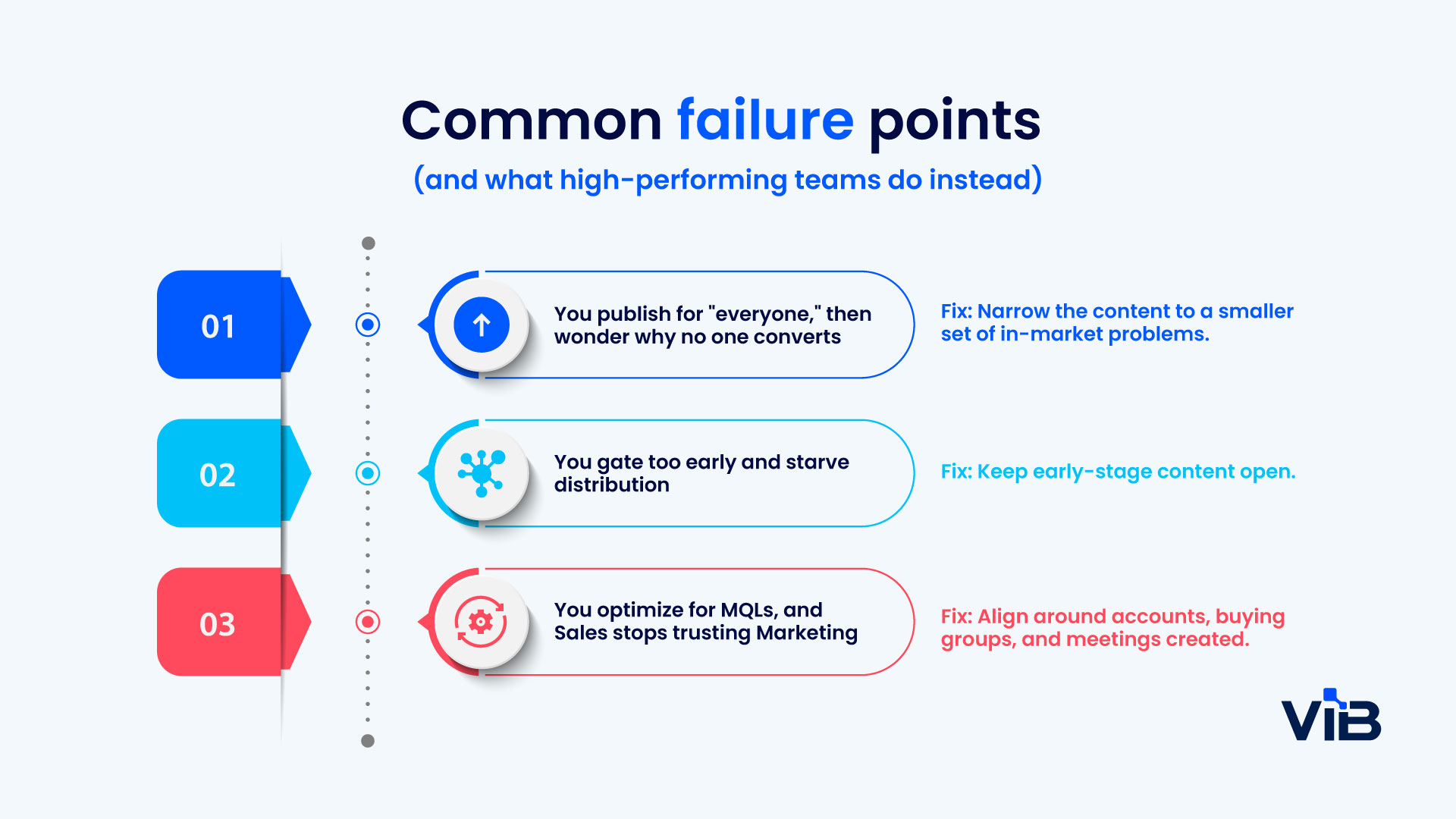
Common failure points (and what high-performing teams do instead)
Failure point: you publish for “everyone,” then wonder why no one converts
Fix: narrow the content to a smaller set of in-market problems. Then expand once you own those conversations. 🔍
Failure point: you gate too early and starve distribution
Fix: keep early-stage content open. Gate only when the value exchange is clear (benchmark data, templates, calculators, deep technical guidance).
Failure point: you optimize for MQLs, and Sales stops trusting Marketing
Fix: align around accounts, buying groups, and meetings created. Even if you still report leads, don’t let leads be the operating system.
Where ViB fits
If your strategy is solid but the outcomes are inconsistent, the gap is usually execution: getting the right content in front of the right accounts, capturing meaningful engagement signals, and converting that engagement into sales conversations.
This is where ViB can support a mature demand gen program, without changing your whole playbook:
ViB Syndication for targeted reach
Use syndication when you have strong assets but need predictable exposure inside ICP accounts. The goal is not “more leads.” It’s more of the right people at the right accounts engaging with content that matches active initiatives.
The takeaway: content supports demand gen when it’s built for movement
So, how does b2b content marketing support demand generation in 2026? It creates measurable account progress by shaping evaluation criteria, enabling internal consensus, and converting engagement into the next best action.
When you combine that strategy with disciplined distribution and intent-informed follow-up, content stops being a cost center and starts behaving like a pipeline system.
If you want to pressure-test your current approach, start with one question: “Can we point to a repeatable path from content engagement → buying group depth → meetings → pipeline?” If not, you don’t need more assets. You need a tighter engine. ✅


