 Skip to content


In the crowded world of cloud infrastructure and hosting services, getting in front of the right decision-maker at the right time is everything.
Web hosting providers sell to a deeply technical market. Your audience may include DevOps engineers, system admins, CTOs, and IT leaders—all expecting credible, insightful, and technically sound content.
On top of that, the sales cycle is often long, multiple stakeholders are involved, and decisions are based on trust more than impulse.
Consider some interesting data: The typical buying group for a complex B2B solution involves six to ten decision-makers, all of whom conduct their own independent research
Moreover, according to market research, B2B buyers are often 70% through their decision process before they engage a vendor, and 81% have a preferred vendor in mind by the time they start reaching out.
That means you must connect with your audience early, consistently, and credibly. For cloud and hosting providers, traditional “spray and pray” lead gen isn’t enough.
In this article, we’ll look at how content marketing agencies and appointment-setting companies can help web hosting providers get in front of the right buyers and close more deals. ⚡
Let’s start with content marketing, and then we’ll discuss appointment setting.
The benefits of a content marketing agency for hosting and cloud providers and what to look for
When it comes to web hosting, you’re not just competing for traffic; you’re competing for attention from highly technical, well-informed buyers.
Your content marketing strategy needs to reflect that. The right agency helps you build credibility, reach the right audience, provide value at every stage, and measure what really matters.
So, when evaluating a B2B content agency for web hosting, focus on the traits that truly matter in this niche. Here’s what to check:
- Industry expertise
Does the agency understand the hosting/infrastructure/IT ecosystem? Can they turn complex technical concepts—like uptime, scalability, and security—into content that resonates with IT decision-makers?
In B2B web hosting, reaching the right audience matters as much as producing content. Ask for examples of campaigns where the agency targeted your ideal customer profile (ICP) and delivered measurable results.
- Full-funnel support
You’ll need content for different stages: awareness (blogs, research reports), interest (webinars, white papers), and decision (case studies, gated assets). A good agency can help map content to the stages of your buyer journey.
- SEO, distribution, and content amplification
In hosting, you might compete on generic keywords (web hosting, cloud hosting, managed hosting), so the agency should have strong SEO chops. But beyond SEO, they should help distribute and amplify your content to the right audience via syndication, partnerships, tech communities, or intent-based channels.

What to ask a B2B content marketing agency for web hosting providers
- Can you show past work with hosting/IT infrastructure clients?
- What audiences can you reach (job titles, company size, industry)?
- How do you measure success (lead quality, downloads, pipeline influence)?
- What is your content distribution or syndication approach?
- How do you source and qualify leads?
- What is your pricing structure? Can you scale with my business?
Why ViB stands out as an alternative to B2B content marketing agencies
ViB Syndication isn’t your traditional content marketing agency. Rather than relying on paid media or generic lists, ViB distributes your assets through an engaged network of tech professionals who’ve opted in to hear from vendors like you.
Here’s how it works:
- You provide us with your asset (white paper, research report, ebook, etc.) and your targeting criteria
- We’ll create a dedicated page for your asset and actively promote it to members of our millions-strong ViB Community who match your ICP
- You only pay for leads that meet your criteria

Need help with the content creation stage?
How appointment setting turns warm leads into closed deals
For web hosting startups, every conversation counts. When you’re trying to carve out your space in a crowded market dominated by giants like AWS, Google Cloud, and DigitalOcean, getting face time with the right decision-makers can feel like an uphill battle.
That’s where a professional appointment-setting service for web hosting startups can completely change the game.
Instead of chasing cold leads or wasting ad spend on unqualified traffic, appointment-setting helps you start meaningful conversations with prospects already in-market for your services—so your sales team can focus on closing, not chasing.
What makes appointment generation different from traditional lead gen
Lead generation often focuses on volume. But appointment generation is much more outcome-oriented: it focuses on getting qualified meetings booked directly with decision-makers.
With traditional leads, you might get many unqualified contacts, duplicate entries, or people who are just browsing.
With appointment generation, you’re targeting a smaller set of high-intent prospects and orchestrating a specific outcome: a confirmed meeting.
For cloud and hosting firms, a qualified meeting might mean a conversation with an IT director, cloud architect, or infrastructure lead at a company with migrating workloads, data center consolidation, or hybrid cloud initiatives underway.
By shifting your focus from “how many leads” to “how many meetings with the right people,” you optimize conversations, not just contacts. That’s what drives real sales results.
6 proven strategies for better appointment generation for cloud and hosting providers 📈

Cloud and hosting services aren’t like selling a one-click consumer product. They involve long sales cycles, multiple stakeholders, and unique technical complexities.
Timing and intent also matter. If you engage too early or with the wrong person, you waste time. If you engage too late, you’re competing with other vendors who are already shortlisted.
Because of these factors, appointment generation for cloud and hosting providers must be targeted, intent-driven, and highly personalized.
Here are actionable strategies that work especially well for cloud & hosting providers:
1. Leverage intent and technographic data
Identify prospects using technologies you support (e.g., VMware, AWS, Azure) or whose stack suggests they’re going through change. Prioritize companies showing signs of migration, consolidation, or cloud strategy refresh.
Use that data to craft messaging: “We see you’re running VMware v7.0 and planning public cloud integration—let’s talk about how we can help you avoid vendor lock-in.”
2. Personalize based on business outcomes—not just features
Your outreach should highlight outcomes, like:
- “Scale 2× workloads while keeping security compliant”
- “Cut TCO of hosting by 20%”
- “Enable global expansion with one platform”
Reference industry pain-points like downtime, data gravity, egress costs, and hybrid cloud complexity.
3. Use a multi-channel approach
Email remains king: 73% of B2B buyers prefer email outreach. But don’t stop there: Combine email with LinkedIn outreach, content syndication, intent-list targeting, and even warm event-based engagement.
Engage prospects with value-driven assets, such as case studies, migration whitepapers, or ROI calculators.
4. Schedule meetings directly—don’t wait for a form fill
Your goal is a confirmed calendar slot with the prospect. Whether your team or a partner sets the appointment, have logistics built out: calendar link, meeting agenda, decision-maker list, etc.
Provide the prospect with a clear reason to meet and what they’ll get out of it (for instance, a short audit, a peer benchmarking session, or a roadmap conversation).
5. Align outreach timing with buying cycles
Recognize when your ideal buyers are actively evaluating. For cloud and hosting, budget cycles, infrastructure refreshes, end-of-support events (e.g., VMware end-of-life), and geographic expansion can trigger interest.
Use data signals such as job postings (e.g., for a cloud architect role), vendor contract expirations, and public statements of transformation.
6. Measure meetings and follow-through, not just pipeline
Track how many meetings are booked, how many progress to the next step (e.g., solution design), and which eventually convert to engagements.
Pay attention to metrics like “meeting held with decision-maker within 45 days of outreach” rather than “form filled.”

How an appointment-setting service for web hosting startups can help
In the web hosting business, you’re not just selling technology; you’re selling trust, uptime, security, and scalability.
That’s why most prospects won’t engage with your sales team unless they already know who you are.
That’s where B2B appointment-setting steps in to bridge the gap between awareness and sales.
With the right partner, you can:
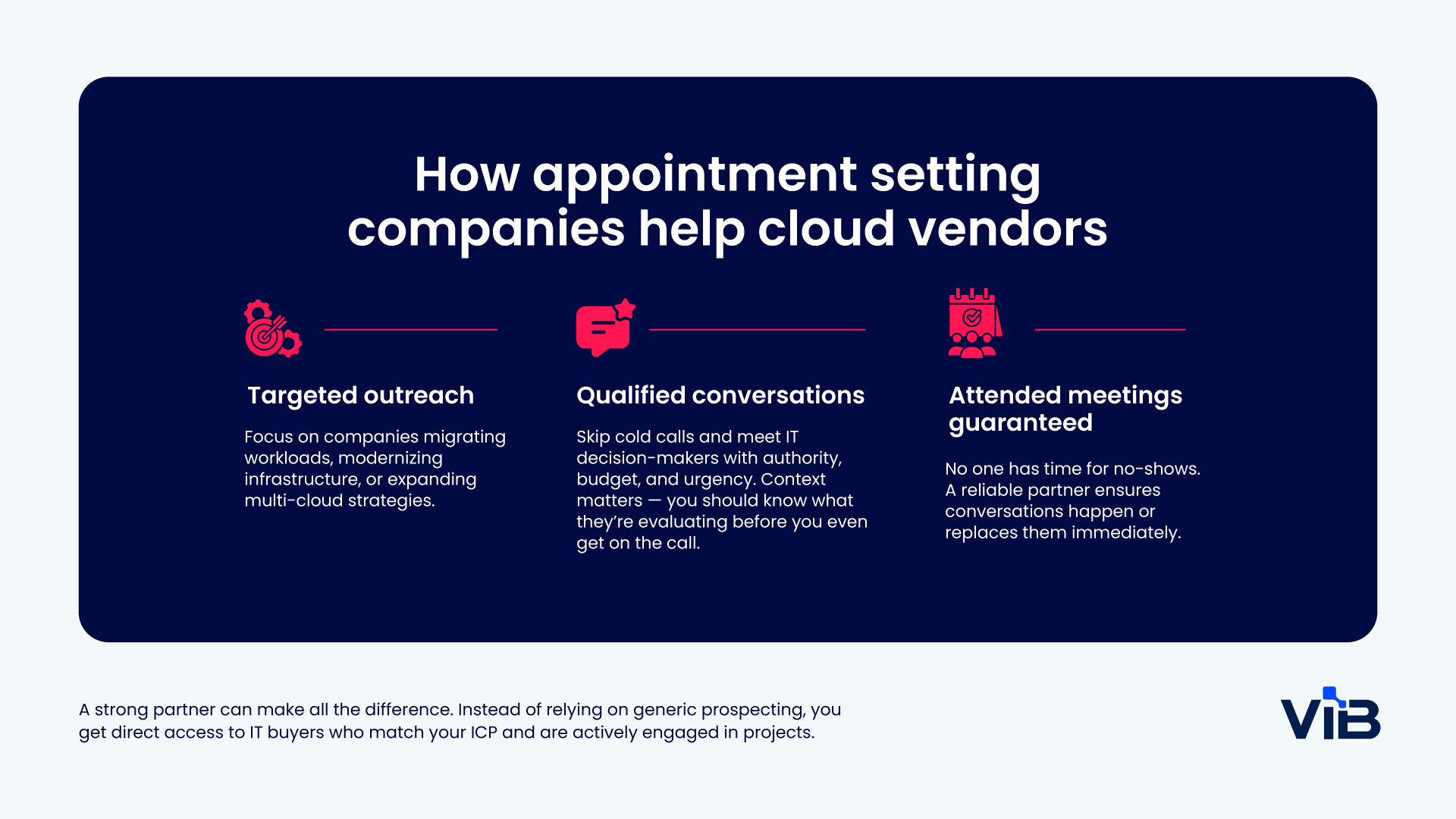
- Fill your calendar with high-quality meetings, not random form fills.
- Target your ideal customer profile (ICP), from IT infrastructure managers to DevOps leaders.
- Keep your sales team focused on high-intent buyers instead of prospecting endlessly.]
- Reduce SDR overhead by outsourcing qualified meeting generation to specialists who already know your market.
For web hosting startups, this means more traction in less time — and a faster path to recurring revenue.
Why traditional appointment setting doesn’t work for SaaS hosting sales
SaaS hosting deals aren’t like standard B2B software transactions. They often involve multiple stakeholders, from DevOps engineers to IT directors and CIOs, and require a detailed technical evaluation before a single purchase decision is made.
That means your buyers don’t respond well to high-volume, low-context outreach.
The problem is that traditional appointment-setting vendors tend to focus on hitting activity metrics: the number of calls, meetings booked, or “leads generated.” The problem is that those metrics rarely tell you whether the meetings were actually worth taking.
In a survey from Gartner, 73% of B2B buyers said they “actively avoid suppliers who send irrelevant outreach.” And in a specialized market like SaaS hosting, relevance and personalization are all the more critical. When your offering involves complex infrastructure or cloud migration solutions, surface-level targeting just doesn’t cut it.
If your vendor’s incentives are tied to quantity, not quality, you’re already at a disadvantage.
Enter pay-for-performance appointment setting
At its core, pay-for-performance appointment setting for SaaS hosting companies removes the guesswork and shifts accountability back where it belongs: on the vendor delivering the results. Instead of paying retainers, setup fees, or “per-lead” charges, you pay only for confirmed meetings 🗓️ that meet your qualification criteria.
That distinction matters because it aligns your partner’s success directly with yours. When vendors are compensated only for qualified meetings, they’re far more motivated to find and engage the right people.
Think of it as outcome-based marketing. You’re no longer buying “potential” leads—you’re investing in tangible conversations with buyers who fit your ICP and have shown genuine intent to engage.
Key benefits of pay-for-performance appointment setting for SaaS hosting companies
The pay-for-performance model is uniquely suited to SaaS hosting marketing. Here’s why:
- Niche and highly technical audience
You’re not selling to just any B2B decision-makers; you’re reaching developers, infrastructure engineers, and CTOs who evaluate vendors through a technical lens. Generic appointment-setting campaigns often miss these audiences entirely—or worse, bring in mid-level contacts who can’t move deals forward.
- Long-term client relationships
SaaS hosting solutions are often subscription-based, which means every new customer relationship is both high-value and long-term. Each meeting needs to count—not just for pipeline goals, but for revenue retention and customer lifetime value.
- Flexibility
Budgets can scale up or down based on performance, allowing your team to manage spend strategically without locking into long-term retainers.

What to look for in a pay-for-performance appointment-setting partner
Not all “pay-for-performance” vendors deliver equal value. Some use the term loosely, charging reduced retainers upfront or counting unqualified meetings as “performance.”
When evaluating pay-for-performance appointment setting for SaaS hosting companies, it helps to look beyond the marketing pitch and dig into how they define and measure success.

Here are four signs you’re working with a credible partner:
- Deep industry familiarity. Your vendor should understand SaaS hosting inside and out—who the buyers are, what pain points matter most, and how to speak their language. A partner who doesn’t grasp the technical side won’t be able to qualify prospects properly.
- Verified data sources.✅ Look for partners that use verified contact databases or engaged communities rather than purchased lists. Data hygiene directly affects appointment quality.
- Transparent performance metrics. Ask how they define a “qualified meeting.” Do they share conversion-to-meeting and meeting-to-opportunity rates? If not, that’s a red flag. (Also, make sure you won’t be on the hook for cancelled meetings or last-minute no-shows.)
- Flexible campaign structure. True pay-for-performance models should scale with your results. You shouldn’t be locked into rigid monthly minimums or multi-month contracts.
A quick test: If your vendor charges setup fees before any performance data is shown, it’s probably not a real pay-for-performance model.

How ViB Appointments helps cloud and hosting providers connect with real buyers 🚀
For SaaS hosting marketers who want to drive predictable, high-quality meetings without financial risk, ViB Appointments offers a community-driven approach that delivers results without the guesswork.
We connect you with our ViB Community—a vetted network of millions of verified tech professionals across countless tech niches. These are decision-makers who have already opted in to engage with vendors like you, meaning every meeting begins with intent and context.
Unlike traditional agencies, ViB doesn’t rely on cold calling or broad outbound campaigns. Instead, it combines first-party data and content-driven engagement to match your offer with in-market buyers who fit your ICP.
And you only pay for meetings that actually happen.
Our model works because it aligns incentives. When you win, we win—simple as that.

Wrapping it all up
Cloud software sales are fiercely competitive. Every IT leader receives a ton of pitches from hosting providers, SaaS vendors, and cloud platforms. 🌐
For web hosting startups, growth isn’t just about having a great product; it’s about connecting with the right people, at the right time, with the right message.
Instead of spending months building lists and chasing cold leads, you can focus on what matters most: demonstrating your value and winning customers who stay for the long haul.
ViB can help you get there.


