 Skip to content


Email marketing for B2B is less forgiving than it was even 18 months ago.
Inbox providers are tightening rules, buying groups are doing more research without talking to reps, and your list is probably a blend of true ICP, adjacent roles, and “looked-right-at-the-time” leads. So the bar is higher: you need relevance, signal capture, and clean execution—not just a higher send volume.
In this guide, we’ll focus on what’s working now: building an engagement engine that generates usable intent signals and improves ICP fit over time, while protecting deliverability and brand trust.
Why email marketing for B2B is getting harder (and why it still matters)
Two realities are shaping modern B2B email performance.
First, many buyers prefer to self-serve. Gartner reports that 61% of B2B buyers prefer a fully rep-free buying experience, and 73% actively avoid suppliers that send irrelevant outreach. That’s not an email problem. That’s a relevance problem.
Secondly, inbox providers are enforcing stricter sending standards. Google and Yahoo’s 2024 bulk sender requirements put authentication (SPF/DKIM/DMARC), one-click unsubscribe, and complaint-rate discipline at the center of deliverability. If you ignore these, your targeting and copy won’t matter because fewer messages will land in the inbox.
So why keep investing in email marketing for B2B? Because it’s still one of the most efficient channels for turning anonymous interest into identifiable engagement. Litmus’ 2025 ROI analysis shows many organizations still see strong returns from email, up to $36 for eveyr $1 spent.
The solution is clear: You need an email program that earns attention early, captures signals, and improves downstream routing. Now, let’s get into how to build one.
Start with the real goal: generate signals, not just clicks
Most B2B email programs still over-optimize to surface metrics.
Open rate is increasingly noisy. Clicks are useful, but they’re only one form of intent. And “form fills” are often a lagging indicator, especially for bigger deals and committee-driven decisions.
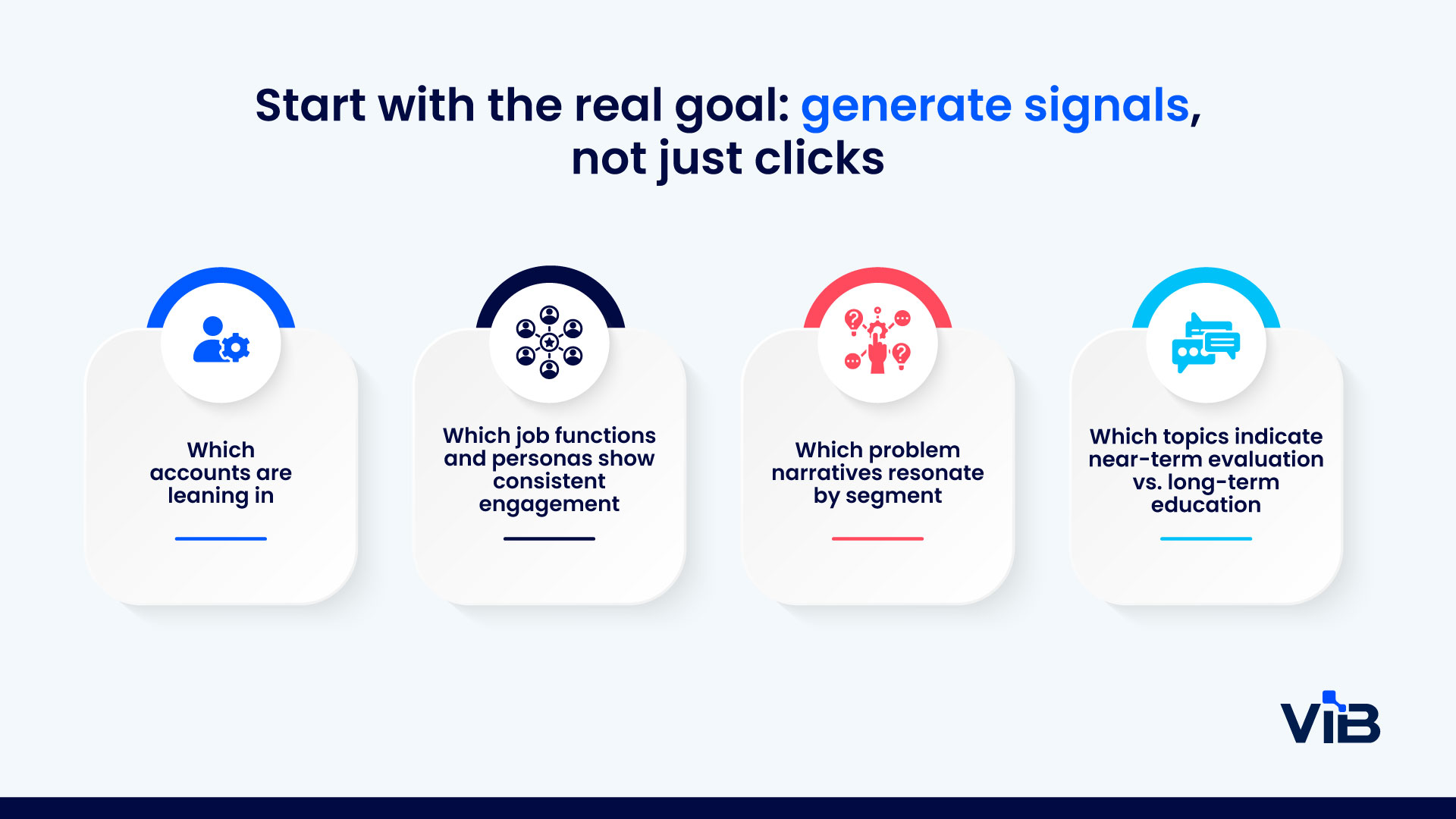
Instead, treat email as a controlled environment for signal generation. You’re trying to learn:
- Which accounts are leaning in (and which ones are quietly disengaging)
- Which job functions and personas show consistent engagement
- Which problem narratives resonate by segment
- Which topics indicate near-term evaluation vs. long-term education
Those signals can inform everything from segment strategy and paid audience refinement to SDR prioritization, retargeting content, and even product messaging.
Deliverability is now a strategy constraint (not a technical checklist)
If you send at scale, deliverability is no longer something you “set and forget.” The rules changed, and the enforcement is real.
What the new bulk sender rules mean for B2B teams
Google and Yahoo require bulk senders to authenticate email (SPF and DKIM), publish DMARC, support one-click unsubscribe, and keep spam complaints low.
Even a great B2B email strategy will struggle if your list hygiene, authentication, or complaint controls aren’t solid. This is especially true if your program blends newsletter, nurture, partner mail, and event pushes.
Advanced deliverability moves that actually protect performance
You don’t need a 40-page deliverability playbook. You need consistent habits.
- Segment by engagement tier: Stop blasting your entire database. Protect your most engaged audience first, then cautiously test reactivation.
- Separate mail streams: Don’t mix webinar reminders, newsletters, and high-frequency promotions under the same cadence assumptions.
- Make unsubscribing frictionless: One-click unsubscribe is mandatory for many bulk-sending scenarios, and it also reduces complaints.
- Use complaint rate as a guardrail: Google has referenced keeping spam rates below 0.3% (ideally below 0.1%). Monitoring should be part of your weekly routine.
None of this is glamorous, but it’s what keeps your best messaging from getting filtered out.
Segmentation that maps to buying groups (not just personas)
In B2B tech, you’re rarely persuading one person. You’re earning confidence across a buying group with different concerns and different definitions of “risk.” So segmentation should reflect how committees evaluate, not just how you store leads in your CRM.
Build segments around “evaluation jobs,” not titles
Try grouping contacts by the work they do in an evaluation:
- Economic owner lens: cost, outcomes, risk reduction, and time-to-value.
- Technical validator lens: architecture, security, integrations, and implementation.
- Day-2 operator lens: workflows, adoption, administration, and ongoing effort.
- Champion lens: internal narrative, rollout plan, and stakeholder alignment.
Then create email tracks that answer their questions in a sequence that feels natural. This tends to lift engagement because you’re speaking to the reader’s decision role, not their demographic label.
Small but meaningful upgrade: add a preference center or a lightweight “what are you trying to solve?” capture in your content flow. That gives you self-declared segmentation without adding friction. ✅
Content that earns attention in 2026 inboxes
The biggest reason B2B emails get ignored is that they read as if they were written to satisfy internal stakeholders rather than to help the reader make progress. If you want email marketing for B2B to drive consistent engagement, shift from “announcements” to “decision support.”
Use a “point of view + proof + next step” structure
For experienced marketers, this is the fastest way to make emails skimmable while still valuable:
- Point of view: a specific take on what’s changing (deliverability rules, evaluation patterns, implementation pitfalls)
- Proof: one strong example, a short clip, or a single metric you can stand behind
- Next step: a content asset that matches intent (not always “book a demo”)
This format also makes performance analysis cleaner. You can see which POVs produce repeat engagement and which offers attract the wrong audience.
Stop forcing “the” CTA
In buying groups, intent shows up unevenly. One person might scour three emails and never click. Another will click once and forward internally.
Consider offering two clear paths in mid-funnel emails:
- Learn: a guide, benchmark, teardown, or short webinar.
- Validate: a technical brief, checklist, security overview, or implementation plan.
This is how you keep engagement high without forcing the reader into a decision they’re not ready to make.
Measurement that senior marketers actually trust
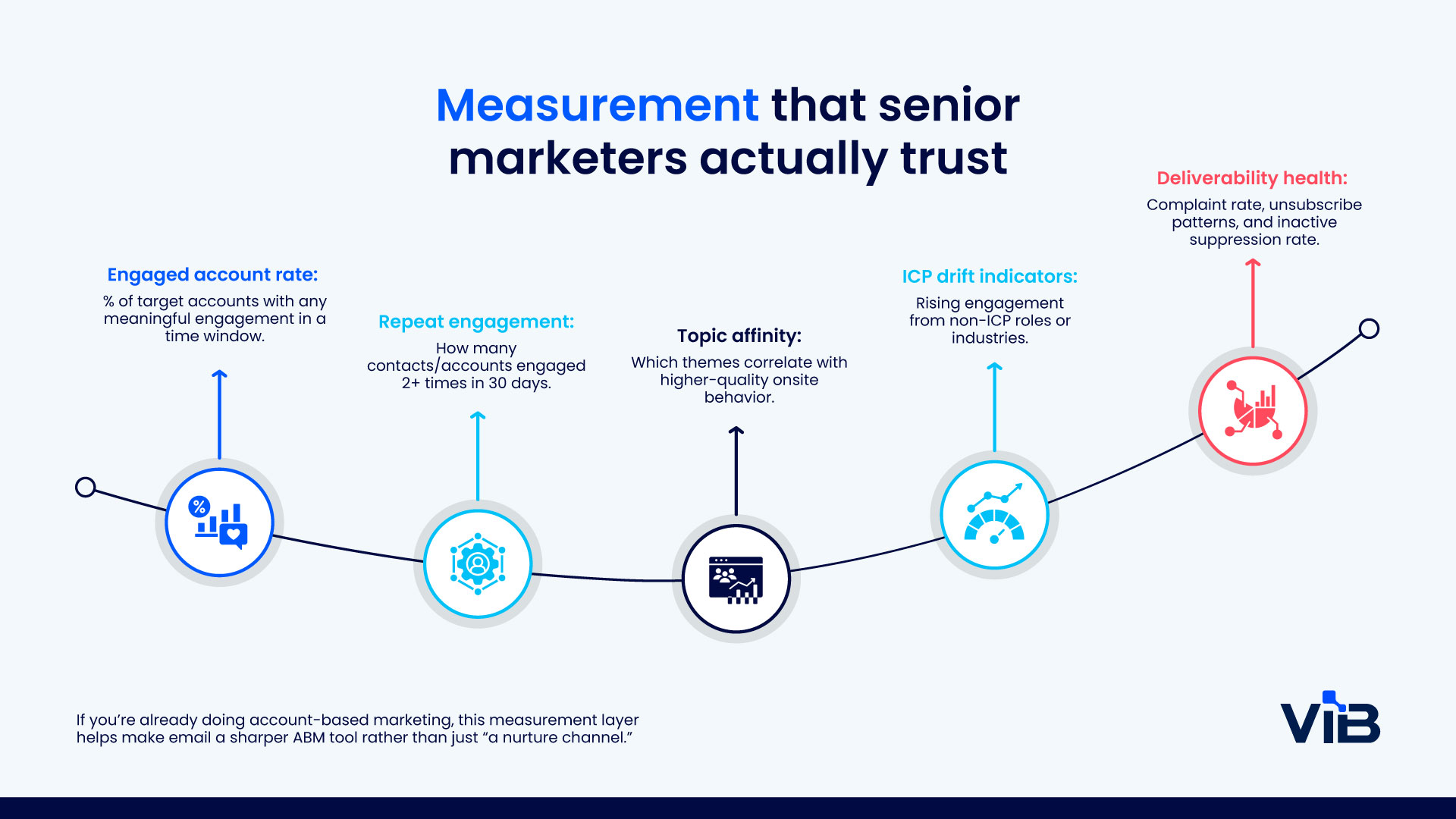
Email metrics should help you make allocation decisions, not just report activity. For B2B teams, the more actionable measurement model usually includes:
- Engaged account rate: % of target accounts with any meaningful engagement in a time window
- Repeat engagement: how many contacts/accounts engaged 2+ times in 30 days
- Topic affinity: which themes correlate with higher-quality onsite behavior
- ICP drift indicators: rising engagement from non-ICP roles or industries
- Deliverability health: complaint rate, unsubscribe patterns, and inactive suppression rate
If you’re already doing account-based marketing, this measurement layer helps make email a sharper ABM tool rather than just “a nurture channel.”
Where B2B email fits in a self-serve buying world
If buyers prefer self-service, your email program should feel like a helpful guide, not a chase sequence. Email marketing for B2B should prioritize:
- Clarity: what you do, who it’s for, and when it’s a fit.
- Confidence: proof points that reduce perceived risk.
- Continuity: steady, relevant contact that keeps your brand in the consideration set. 📩
This is also where your webinar, research, and content programs become fuel for your email marketing. Email doesn’t need to carry the whole load; it just needs to orchestrate attention.
One practical note: Teams that treat webinars and research as “events” often miss the bigger value. The real win is what those interactions reveal about intent and fit.
(If you’ve run a high-performing webinar program, you’ve probably seen this firsthand: the most useful outcome is often the follow-up segmentation, not the live attendance rate.)
A realistic way to scale engagement: research-led email plus intent signals
Scaling email marketing for B2B usually breaks when teams try to scale volume rather than relevance.
A more durable pattern is research-led programming:
- Publish a strong point of view (survey results, benchmark analysis, or expert interviews).
- Package it into multiple email angles by persona and evaluation job.
- Use engagement to identify which accounts are leaning in.
- Feed those signals into retargeting, SDR prioritization, and next-best content.
How ViB supports email marketing for B2B
If the strategy above resonates, the next question is execution: how do you consistently create high-fit engagement moments and capture usable signals, week after week?
ViB Emails can help extend and support your outreach while staying focused on audience fit and engagement quality.
This can be useful when you want to:
- Capture and use engagement patterns to improve segmentation and follow-up prioritization
- Expand reach into a defined ICP segment without blasting low-quality lists
- Test which topics generate the strongest engagement signals by role or industry
Conclusion: make email your engagement and signal engine
Email marketing for B2B is still one of the best ways to earn attention and learn what your market cares about. But the playbook has changed.
Winning teams treat deliverability as a strategic constraint, segment around buying-group “jobs,” and measure what matters: repeat engagement, account-level signals, and ICP fit over time.
When you pair that strategy with research-led content, webinars, and tighter distribution, email stops being a channel you “use.” It becomes the system that helps your go-to-market team focus on the right accounts, with the right message, at the right time.


