 Skip to content


If you’re an experienced B2B tech marketer, you don’t need another “run ads, send emails, host webinars” checklist.
You need a demand generation process that works with how buying actually happens today: non-linear, research-heavy, and full of anonymous activity that doesn’t show up as a form fill.
Demand Gen Report’s 2024 B2B Buyer’s Survey makes that shift hard to ignore. Buyers start with web search (66%) and vendor websites (45%), then pull in peers and experts early as well.
So the goal of a modern demand generation process isn’t to force a linear path. It’s to earn attention, drive repeat engagement, and capture signals that indicate which accounts and personas are leaning in.
This post lays out a step-by-step demand generation process you can implement and iterate on, with a clear place for email, syndication, webinars, intent, and appointment-setting—without pretending that any one tactic is a magic switch.
Why the demand generation process has to be signal-led now
Most teams still talk about “stages,” but buyers don’t experience them the way we plan.
Gartner’s work on the B2B buying journey describes buyers looping through “buying jobs” rather than moving cleanly from one step to the next. The implication for marketers is simple: if your programs don’t help buyers complete tasks, engagement stalls.
Forrester’s buyer enablement research points in the same direction: buyers are more self-guided, and they complete many tasks independently. That means your demand generation process needs strong digital and hybrid touchpoints that support self-service learning.
In practice, “signal-led” doesn’t mean “buy more data.” It means your planning, channel mix, and measurement all revolve around observable evidence of interest and fit.

Step 1: Define the ICP and buying group coverage (not just personas)
Start your demand generation process by tightening two definitions: who you’re for (ICP) and who shows up when buying happens (buying group).
Demand Gen Report’s buyer research highlights that buyers bring in team members to help with research, seek peer input, and evaluate fit with existing partners as part of the purchase timeline. That’s buying group behavior, not single-lead behavior.
What “ICP” needs to include for demand gen planning
At minimum, document ICP in a way your channels can use:
- Firmographics: industry, employee range, region, and constraints (for example, regulated vs non-regulated).
- Technographics and environment: what they run today, what they integrate with, and what must be replaced vs complemented.
- Triggers: events that reliably create urgency (new leadership, audits, re-platforming, security incidents, M&A).
- Disqualifiers: the “hard no” attributes that waste spend and sales time.
This is also where you decide what “coverage” means. Is your goal to engage 30 named accounts per quarter, or to expand reach across a broader segment and let intent filter it down?
Buying group coverage: define roles by jobs-to-be-done
Instead of listing generic titles, map roles to the questions they own. Examples:
- Economic owner: “What’s the risk and ROI?”
- Technical evaluator: “Will this work in our stack?”
- Security/compliance: “What’s the exposure?”
- Day-to-day operator: “Will this reduce effort or add steps?”
- Procurement: “What’s the pricing model and flexibility?”
This structure will drive your content plan and your webinar programming later in the process.
Step 2: Build a message map that supports buyer tasks
Once ICP and buying group coverage are defined, your next step is to decide what you want to be known for in a way that helps buyers make progress.
Gartner’s buyer journey framing is useful here because it forces you to stop thinking “top/middle/bottom.” Instead, you think: “What does a buyer need to do next, and what information would reduce uncertainty?”
A simple message map format that works for demand gen
For each key pain or trigger, create three layers of messaging:
- Context: what changed in the market, regulation, or stack that makes the problem harder now.
- Impact: what breaks operationally, financially, or from a risk standpoint.
- Decision criteria: what “good” looks like, including constraints and tradeoffs.
This gives you language you can reuse across ViB Emails, ViB Syndication, webinars, and intent-led follow-up without rewriting from scratch every time.
Step 3: Design your channel mix around engagement loops
Now you build the repeatable loop: reach → engage → re-engage → capture signals → prioritize → deepen engagement.
It’s important that you plan for more than one type of touchpoint. Demand Gen Report’s data show that buyers notice online ads during research (57%) and rely heavily on digital sources like search and vendor sites.
Where emails fit in the demand generation process
Email is still one of the most controllable ways to build consistent engagement with the right audience, especially when it’s segmented by role and anchored on one clear buyer task per send.
Use to run sequences like:
- Problem framing: one point of view, one “what to watch for,” one asset.
- Decision criteria: a checklist or brief that helps buyers compare options.
- Proof-building: customer story, benchmark, or webinar Q&A recap.
Operationally, treat email as the backbone for re-engagement, not your only source of new attention.
Where syndication fits (and how to use it well)
Syndication works best when you treat it as targeted distribution of one or two assets built for a specific buyer task.
Use syndication to expand reach in your ICP, then measure success by:
- ICP match rate (by firmographics and role)
- Asset-to-next-touch engagement (did they consume, then engage again?)
- Downstream account lift (more visitors, more webinar registrations, more repeat email engagement)
Where webinars fit (and why they’re still worth the effort)
Webinars are one of the few formats that can engage multiple buying group roles at once.
Data show that 65% of buyers consider webinars/digital events valuable formats for decision-making.
The practical takeaway: don’t run webinars as product tours. Run them as “decision support.” Pick one buyer job, then build the agenda around what a buying group needs to align internally.
Step 4: Instrument your signal capture (first-party + third-party)
This is the step most demand gen teams under-build. They can run campaigns, but they can’t reliably answer: “Which accounts are showing meaningful interest this month?”
Start with a shared definition of “signal”
Signals should be observable actions that correlate with consideration, not just clicks. Create a simple signal framework:
- Light: first engagement (single asset view, first webinar registration).
- Medium: repeat engagement (multiple assets, returning visits, webinar attendance).
- Strong: buying-group pattern (multiple roles engaging, competitive/comparison content, pricing/security content engagement).
Demand Gen Report’s buyer timeline explicitly calls out anonymous research first, then later engagement with vendor reps and demos. Your signal model should reflect that reality.
Use intent data to spot in-market research behavior
Third-party intent data is commonly used to understand which accounts are researching a category across the web.
The key is not treating intent as “ready to buy.” Treat it as a prioritization input for where to focus engagement next.
Step 5: Create a weekly prioritization routine (the engine of the process)
A demand generation process becomes real when it has a cadence.
Set a weekly 30–45 minute routine where marketing and SDR/BDR leaders review:
- Top engaged accounts (first-party engagement)
- Emerging intent clusters (third-party intent surges)
- Buying group coverage gaps (are you only seeing one role?)
- Next-best action by account (email sequence, webinar invite, targeted content, or direct outreach)
This is also where you keep your content honest. If you can’t answer “what task does this help a buyer complete,” it probably won’t drive meaningful engagement.
Step 6: Turn strong signals into higher-touch engagement
This is where many teams either go too early (burn the account) or too late (miss the moment).
Your rule of thumb: when you see repeat engagement, role diversity, and high-intent topics, shift to a more direct conversation offer.
Where intent data fits
Intent data can help identify active leads in your intent category and verify readiness to adopt.
In your demand generation process, that’s most useful as a “signal confirmation” layer. It helps you decide where to invest higher-touch engagement, and which message angle is most relevant for the first direct outreach.
Where appointments fit
Appointments are a handoff moment, so they should come after you’ve earned enough context to make the outreach helpful.
In this process, appointments should only come after after you’ve:
- Confirmed ICP fit
- Seen repeat engagement or intent-aligned activity
- Identified a likely pain area or buyer task
- Prepared a role-relevant conversation outline (not a generic demo pitch)
Step 7: Measure what the process is supposed to produce
If you measure only lead volume, your process will drift toward easy-to-capture actions that don’t correlate with real buying work.
Instead, measure the health of the demand generation process itself.
Practical KPIs that map to engagement and ICP fit
- ICP engagement rate: engaged accounts ÷ total targeted accounts.
- Buying group depth: number of distinct roles engaging per account.
- Repeat engagement: accounts with 2+ meaningful interactions in 30 days.
- Signal-to-action speed: time from strong signal to a relevant next touch.
- Content usefulness proxies: webinar attendance rate, post-webinar Q&A, asset completion, reply rate on role-based email sends.
These metrics help you improve targeting, messaging, and channel orchestration without relying on a single conversion event as “the truth.”
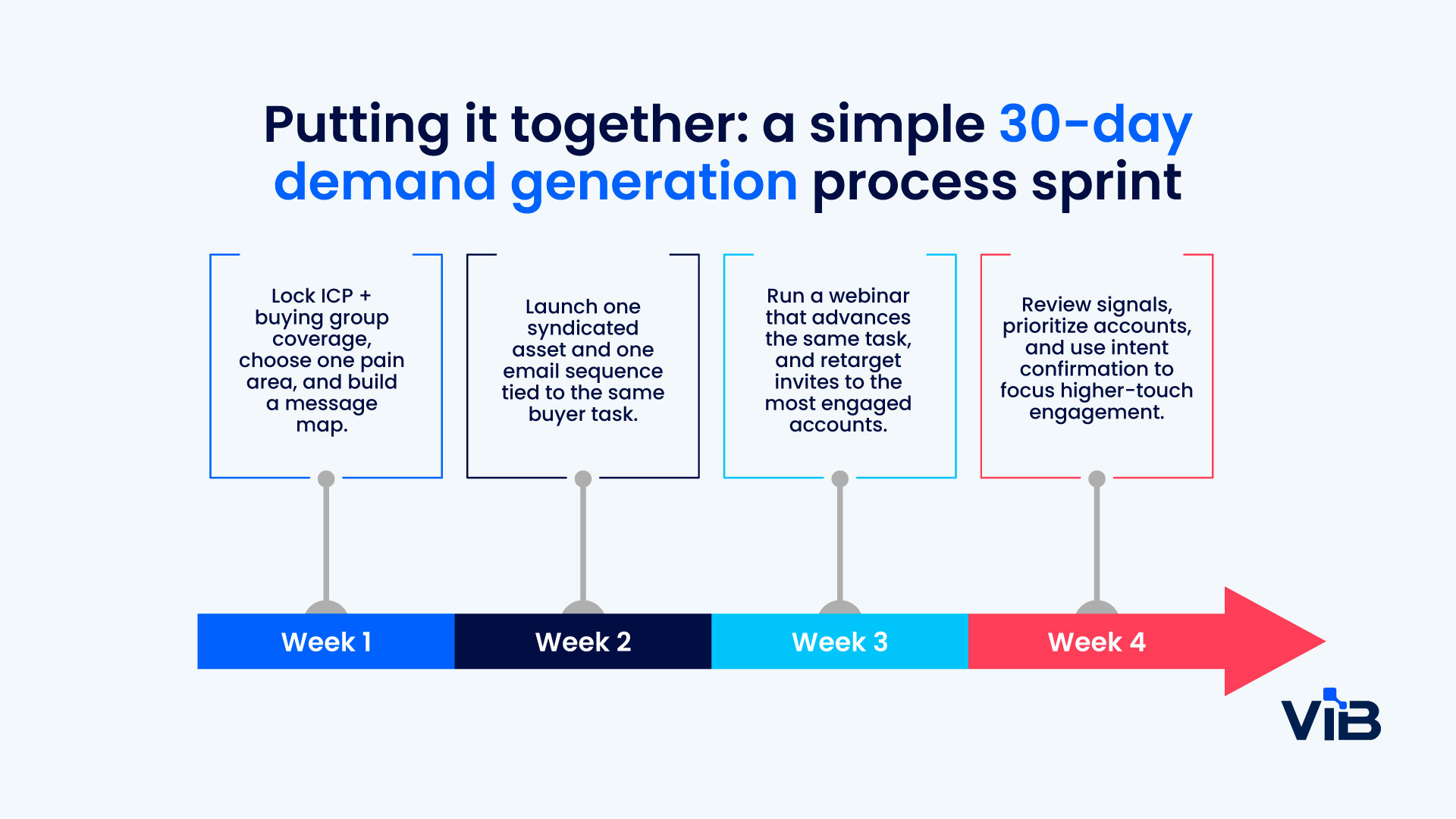
Putting it together: a simple 30-day demand generation process sprint
If you want to operationalize fast, run this as a 30-day sprint before you scale.
- Week 1: lock ICP + buying group coverage, choose one pain area, and build a message map.
- Week 2: launch one syndicated asset and one email sequence tied to the same buyer task.
- Week 3: run a webinar that advances the same task, and retarget invites to the most engaged accounts.
- Week 4: review signals, prioritize accounts, and combine first-party engagement with permission-based intent data from trusted sources to focus higher-touch engagement, including appointments where appropriate.
After 30 days, you’ll have evidence about what messages resonate, which roles engage, and which accounts show the strongest buying-group behavior.
How ViB supports this demand generation process (without overpromising)
If your team is already strong on strategy, ViB is most valuable as an execution partner that helps you run the engagement loop consistently, then turn engagement into usable signals.
Here’s how the solutions map cleanly to the process you just read:
- ViB Emails: sustain role-based engagement and re-engagement with consistent messaging.
- ViB Syndication: expand reach within your ICP with focused assets aligned with specific buyer tasks.
- ViB Webinars: engage multiple buying-group roles in a single session and create high-quality follow-up segments.
- ViB Appointments: support the move from strong signals to a helpful, well-timed conversation.
Conclusion: Make the process the product
The best demand generation process isn’t a set of disconnected campaigns. It’s a repeatable system that creates ICP engagement, captures signals, and helps buyers complete the decision-making process.
If you build it around buying-group tasks, instrument it for signals, and run it on a weekly cadence, your channels stop competing. They start compounding.
And when you’re ready to scale execution across email, content syndication, webinars, and qualified appointments, ViB can serve as a practical layer that helps keep the system running and measurable.


