 Skip to content


B2B demand generation is one of the most misunderstood concepts in modern marketing.
Most teams believe they are running demand generation because they publish content, run ads, or capture leads. In reality, those are inputs, not a system.
True B2B demand generation is about creating sustained buying readiness across an account, not chasing individual conversions. And that distinction is why many programs feel busy but underperform.
Let’s break down what B2B demand generation actually means, where teams go wrong, and how high-performing marketers build demand that reliably turns into real conversations and meetings. 👇
What is B2B demand generation, really?
At its core, B2B demand generation is the practice of creating, shaping, and capturing buying intent across a defined audience over time. In practice, a strong demand generation framework connects buyer education, intent signals, and engagement into one coordinated system.
- It is not a single campaign.
- It is not a content calendar.
- And it is not synonymous with lead generation.
Demand generation is a system designed to educate buying groups before they self-identify, build confidence and relevance across multiple stakeholders, and convert latent interest into active engagement.
That system spans channels, formats, and timeframes.
If your strategy starts and ends with “get more leads,” you are likely skipping the hardest and most important part: preparing buyers to want to talk to you.
How is demand generation different from lead generation?
Lead generation focuses on capturing a moment.
Demand generation focuses on influencing a journey.
Lead gen asks, “Who filled out the form?”
Demand gen asks, “Who is becoming more ready to buy, and why?”
In B2B, buying decisions rarely happen in isolation. They involve multiple stakeholders, long evaluation cycles, and internal alignment hurdles.
That means a single conversion event tells you very little.
Strong demand programs measure progress through signals, not just submissions. They track repeated engagement from the same account, topic alignment over time, and movement from passive consumption to active intent.
Lead generation is a tactic. Without a defined demand generation framework, teams rely on disconnected tactics that fail to compound over time. It is the operating model that makes those tactics work together.
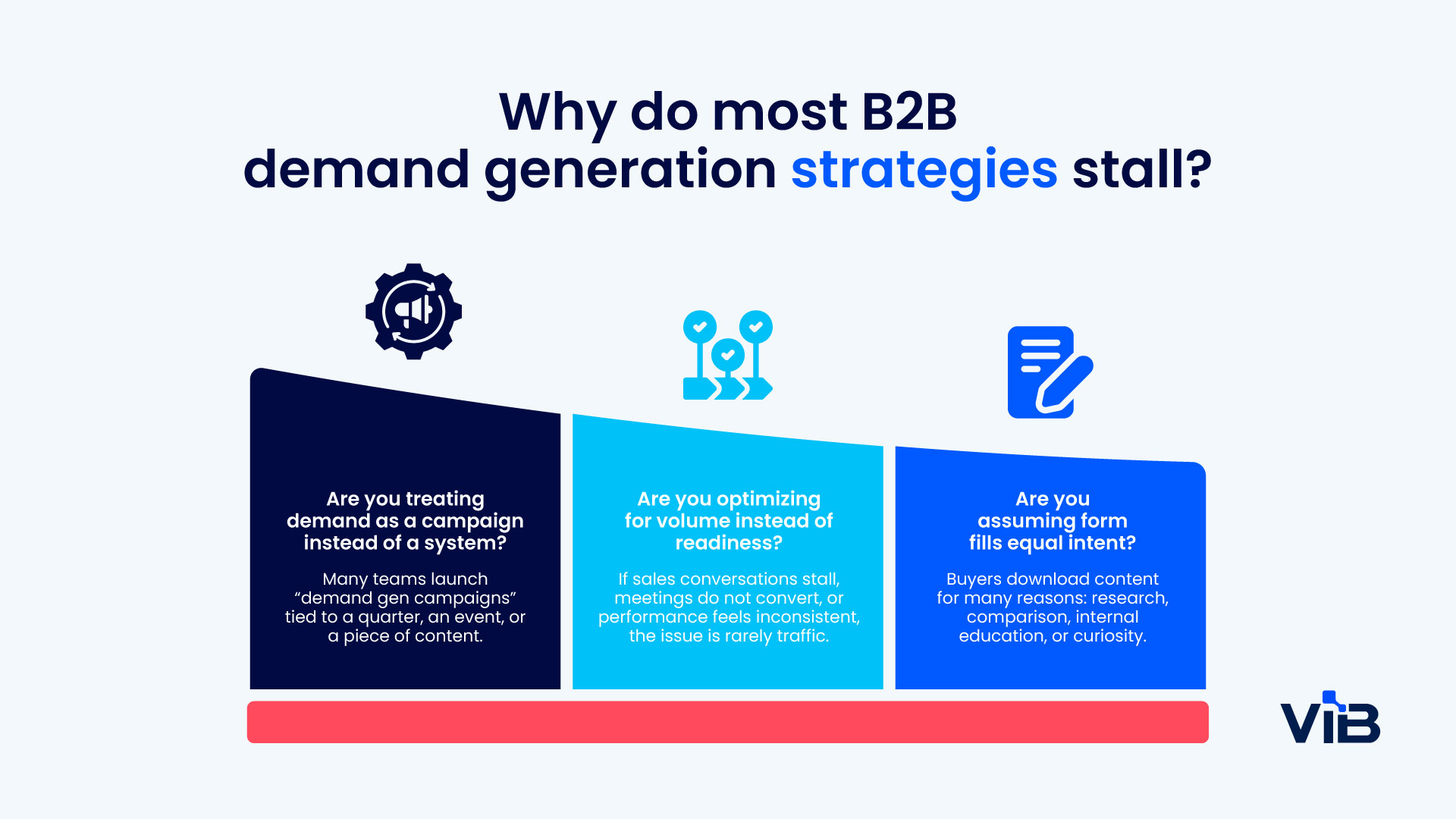
Why do most B2B demand generation strategies stall?
Most programs do not fail because teams lack effort. They stall because the strategy never becomes a true system.
When demand generation is treated as a set of isolated tactics, content, ads, events, or email, momentum resets constantly. Each activity is measured on its own instead of contributing to shared progress.
Without a clear demand generation framework, teams struggle to connect early engagement to real buying readiness. Signals get lost, handoffs feel rushed, and sales conversations happen before buyers are prepared.
The result is familiar: lots of activity, inconsistent outcomes, and pressure to “fix” execution when the real issue is structural.
Are you treating demand as a campaign instead of a system?
Many teams launch “demand gen campaigns” tied to a quarter, an event, or a piece of content.
When the campaign ends, so does the momentum.
Demand generation only works when each activity reinforces the next. Content, ads, events, and outreach should feel connected, not episodic.
If every quarter feels like a reset, demand never compounds.
Are you optimizing for volume instead of readiness?
High lead volume can mask weak demand.
If sales conversations stall, meetings do not convert, or performance feels inconsistent, the issue is rarely traffic. It is relevance and timing.
Demand generation prioritizes who is ready over how many responded.
This shift often requires fewer actions, better signals, and more patience.
Are you assuming form fills equal intent?
A form submission does not automatically signal buying interest.
Buyers download content for many reasons: research, comparison, internal education, or curiosity.
High-performing teams look beyond the form. They ask what topics an account engaged with before and after, how frequently they return, and whether multiple stakeholders interact with similar themes.
Intent is cumulative. Treating it as binary leads to missed opportunities and premature outreach.
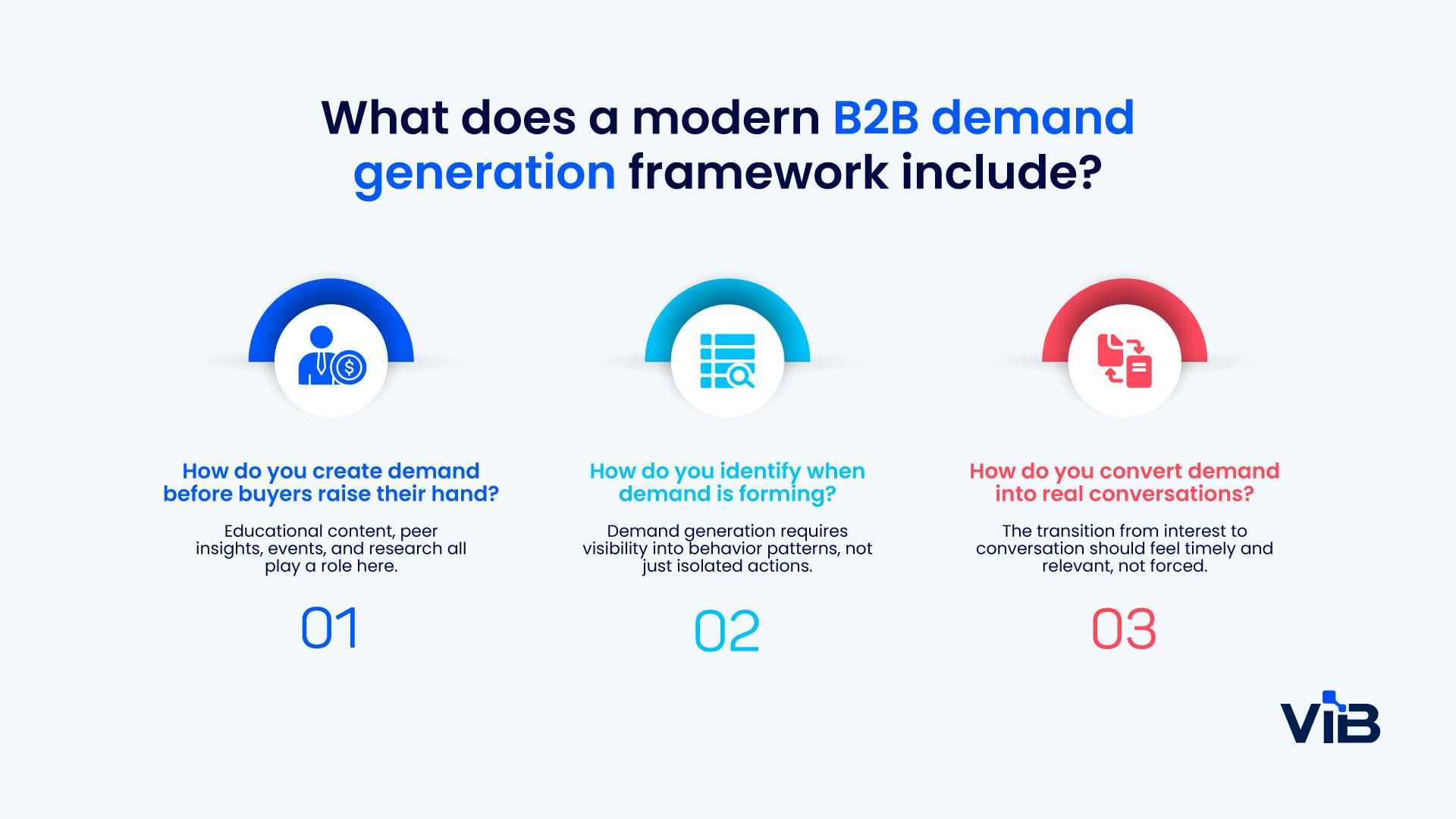
What does a modern B2B demand generation framework include?
Strong demand generation frameworks are built around progression, not funnels.
They focus on helping accounts move from awareness to readiness in a way that feels natural and buyer-led.
1) Create demand before buyers raise their hand
Most buyers are researching long before they want to talk to sales.
Demand generation meets them there. This means investing in content and experiences that address real operational challenges, help buyers frame the problem, not just the solution, and support internal consensus building.
Educational content, peer insights, events, and research all play a role here. The goal is familiarity and trust, not conversion.
2) Identify when demand is forming
This is where many teams struggle. Demand generation requires visibility into behavior patterns, not just isolated actions.
Signals that demand may be forming include increased engagement frequency from the same account, repeated interaction with solution-adjacent topics, and multiple stakeholders consuming similar content.
These signals are rarely captured by a single channel. Without a way to connect them, intent stays invisible.
3) Convert demand into real conversations
Demand only matters if it leads to engagement.
The transition from interest to conversation should feel timely and relevant, not forced. This is where many programs break. Outreach happens too early, too late, or without context.
High-performing teams align outreach with observable readiness, not static scoring models.
When buyers feel understood, meetings feel helpful, not intrusive. 😊
What metrics actually indicate demand generation success?
Demand generation metrics look different from lead gen dashboards. Instead of celebrating raw volume, advanced teams focus on momentum and quality.
Key indicators include account-level engagement trends over time, meeting acceptance rates, sales feedback on conversation quality, and progression velocity from engagement to meeting.
These metrics help teams understand whether demand is forming and converting, not just being captured.
Why aligning demand generation with sales matters more than ever
In modern B2B buying, sales often enters the conversation later than teams expect. By the time buyers want to talk, they are already informed and opinionated. That makes alignment critical.
Demand generation should equip sales with context, not just names. When sales understands what the account has engaged with, which challenges resonate, and where interest is strongest, conversations start faster and progress more smoothly.
Demand generation is not about replacing sales. It is about making every interaction more effective.
How does appointment-driven demand generation change the model?
This is the point where a demand generation framework either becomes operational or breaks down entirely.
Appointment-driven models focus on translating demand signals into qualified conversations, not just contacts.
Instead of pushing every engaged account into the same flow, teams prioritize accounts showing sustained intent, time outreach based on behavior rather than assumptions, and book meetings when buyers are most receptive.
This approach respects the buyer journey while still driving measurable outcomes.
How ViB Appointments fits into a modern demand generation strategy
Once demand is forming, teams need a way to act on it without disrupting momentum.
This is where ViB Appointments fits naturally into the demand generation system. ViB Appointments helps teams engage accounts already showing buying signals, reach the right stakeholders at the right moment, and turn demonstrated interest into scheduled, qualified meetings.
Rather than cold outreach or reactive follow-up, appointments are driven by intent and relevance. That makes meetings more productive for sales and more valuable for buyers.
For teams looking to connect demand generation strategy to real conversations, ViB Appointments acts as the execution layer that bridges the gap.
What high-performing B2B demand generation teams do differently
The strongest programs share a few common traits.
They treat demand generation as a system, not a campaign. They measure readiness, not just responses. They align marketing and sales around buyer behavior. They convert demand into conversations with intention.
They do less chasing and more listening.
And as a result, they create demand that actually converts. 🚀


