 Skip to content


For B2B marketers, a solid go-to-market (GTM) strategy is indispensable.
Consider that SaaS buyers are typically highly informed and cautious. In fact, 73% of B2B buyers now expect a personalized, consultative sales experience before making a decision.
A well-thought-out GTM plan ensures that your product reaches the right audience at the right time with the right message.
And demand generation plays a critical role in a strong GTM strategy. Without it, even the most innovative SaaS product can struggle to stand out.

This blog provides a simple, actionable demand generation B2B SaaS go-to-market checklist to help you get your product in front of the right buyers, craft the right messaging, and close deals.
But first, let’s look at why demand generation plays a key role in B2B SaaS marketing.
The importance of demand generation in B2B SaaS
SaaS companies often face tough challenges when scaling: long sales cycles, multiple decision-makers, and intense competition. Research shows that the average B2B buying process involves six to ten stakeholders and can take months to finalize.
This complexity means that simply creating awareness around your product is not enough. You need a strategy that engages potential buyers at every stage of their journey.
That’s where demand generation comes in—it builds interest, educates prospects, and nurtures them toward conversion.
In fact, companies that prioritize demand generation strategies see 50% higher conversion rates and 33% lower acquisition costs than those that don’t.
By aligning content, campaigns, and data-driven targeting, demand generation helps SaaS businesses cut through the noise, build trust, and turn engaged leads into loyal customers.
Your B2B SaaS demand generation checklist: 5 key steps
To drive demand generation success, your go-to-market (GTM) strategy needs structure and precision. Here’s a five-step checklist to guide you:
1. Define your buyer personas
Your GTM strategy starts with understanding your audience. Who are your ideal customers, and what problems do they face?
- Segment them by industry, job role, and pain points.
- Use data to identify trends in customer behavior.
- Align each persona with specific campaigns for better results.
For example, a product manager may look for efficiency, while a CTO wants security. Tailor your messaging to address their unique needs.
2. Audit and align sales and marketing teams
Sales and marketing alignment is essential. Without it, your demand generation efforts will likely miss the mark.
- Sync messaging and goals between teams.
- Use tools like CRM systems to track lead progression.
- Hold regular meetings to ensure collaboration.
When sales and marketing collaborate, leads move faster through the pipeline. Aligned teams have been shown to achieve 24% faster revenue growth and 27% faster profit growth annually.
On the other hand, misalignment only creates confusion and missed opportunities.
3. Build a multi-channel content strategy
One size doesn’t fit all. A strong GTM plan leverages multiple channels to engage your audience.
- Use email campaigns, webinars, content syndication, and ABM (account-based marketing).
- Personalize your outreach based on the buyer’s journey.
- Invest in high-quality content that informs and solves problems.
For example, whitepapers work well for top-of-funnel leads, while case studies are perfect for decision-makers closer to buying.

4. Measure demand generation ROI
Data is your best friend when it comes to demand generation. Without tracking ROI, your demand generation efforts are flying blind.
- Track KPIs like lead quality, pipeline contribution, and CAC (customer acquisition cost).
- Monitor real-time performance for agile decision-making.
- Use analytics tools to identify what’s working and what’s not.
The key is not just generating leads but ensuring they convert into paying customers.
5. Leverage demand generation tools and solutions
The right tools and solutions can transform your GTM strategy from good to great.
- Use marketing automation platforms for email and campaign management.
- Rely on CRM systems to track and nurture leads.
- Tap into analytics dashboards to gain actionable insights.
- Outsource to demand generation companies, like ViB, to connect with highly qualified leads.
Keep in mind that demand generation isn’t a one-time effort—it’s a continuous process. By following this checklist and refining your strategies, you can achieve sustainable growth and outpace competitors.
Why partnering with experts can make all the difference
Demand generation is all about expertise. Partnering with professionals allows you to tap into data-driven strategies and proven methodologies tailored for SaaS success. Experts understand the nuances of SaaS markets, from handling long sales cycles to engaging multiple decision-makers effectively.
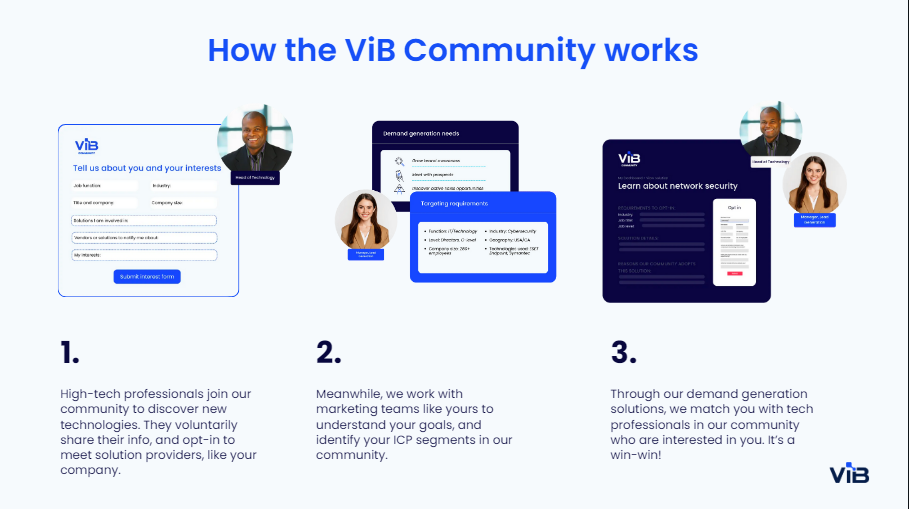
At ViB, we help SaaS organizations execute their go-to-market (GTM) strategies faster and more effectively. Our scalable solutions deliver high-quality leads, improve ROI, and drive growth.
With our community-driven approach, you connect with pre-qualified tech professionals who are ready to engage 🙌.
When success matters, having the right partner makes all the difference.
🚀 Ready to level up your SaaS strategy?
A strong demand generation B2B SaaS strategy can change the game. It’s not just about leads—it’s about sustainable growth. Follow this demand generation B2B SaaS go-to- market checklist and see the difference.
Ready to experience professional-grade demand generation?
Try ViB’s services today and see the results firsthand.


