 Skip to content


Cybersecurity webinar marketing is rarely limited by content quality.
Most teams already invest in strong topics, experienced speakers, and well-structured presentations.
The real challenge is ensuring those webinars reach the right audience and generate meaningful engagement. Many B2B teams generate registrations, yet struggle to convert those attendees into engaged prospects or qualified conversations.
The issue is not the webinar format itself. It is how those webinars are positioned, promoted, and distributed.
Cybersecurity buyers are highly selective about the content they spend time with. Security leaders, practitioners, and IT stakeholders are constantly filtering through vendor messaging, industry noise, and overlapping event invitations. That means even strong webinar topics can struggle if promotion and targeting are not aligned correctly.
Without the right approach, even highly relevant topics can attract the wrong audience or fail to generate sustained engagement.
To improve webinar lead generation cybersecurity programs, marketers need to focus less on raw registration counts and more on audience relevance, engagement quality, and distribution strategy.
Why is webinar lead generation harder in cybersecurity?
Cybersecurity audiences operate differently from broader B2B segments, and that directly impacts how webinars should be promoted.
They are more skeptical of promotional messaging, more technical in how they evaluate information, and more cautious about engaging with vendors early in the buying process. At the same time, the cybersecurity market is saturated with webinars covering similar themes such as ransomware, identity security, compliance, and AI-driven threats.
This creates several challenges:
- Buyers ignore generic webinar messaging quickly
- Internal email lists often become oversaturated
- Registration volume does not always reflect real interest
- Security buying groups involve multiple stakeholders with different priorities
As a result, webinar lead generation cybersecurity strategies require much more precision than standard B2B webinar programs.
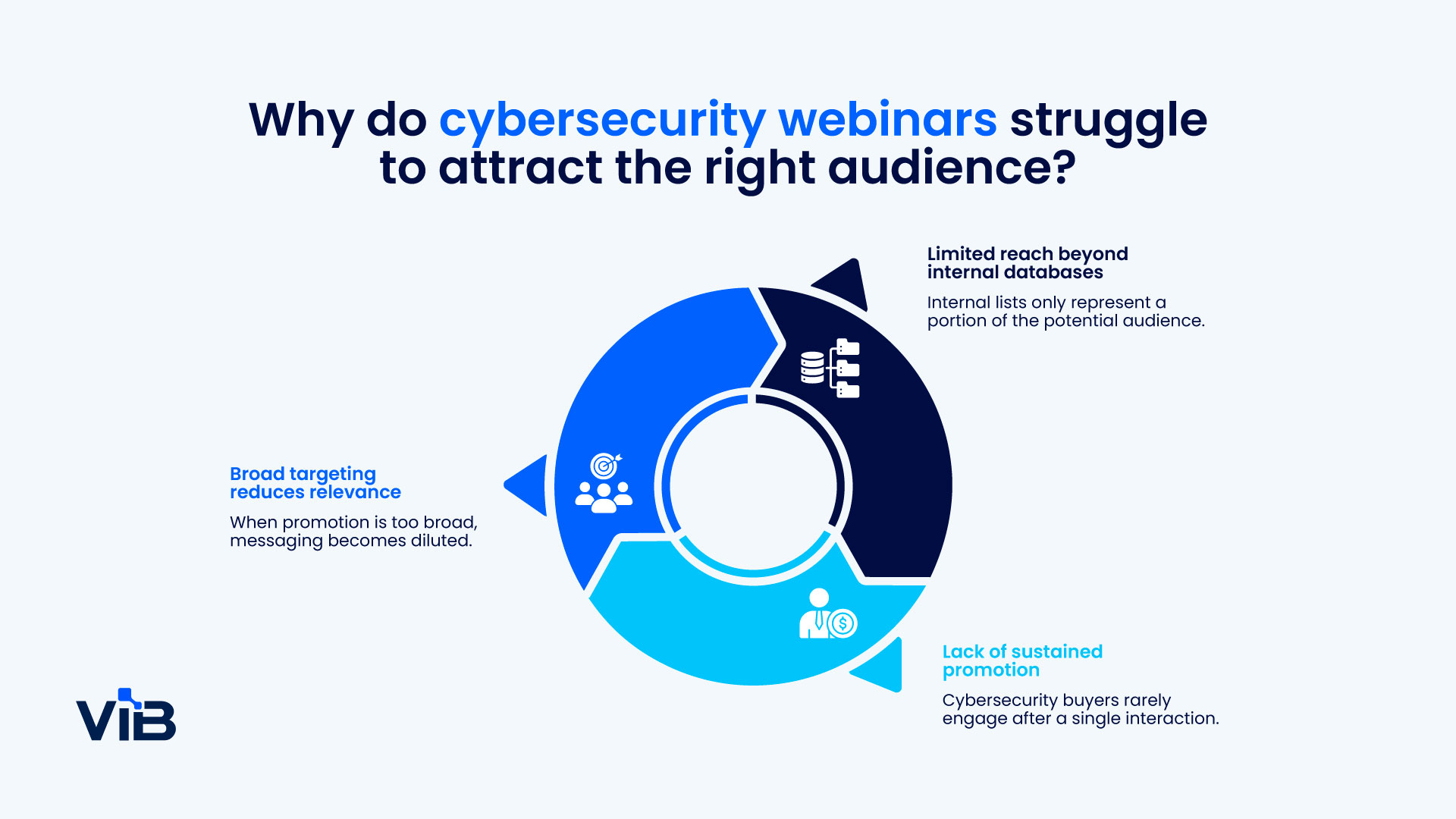
Why do cybersecurity webinars struggle to attract the right audience?
Many webinars underperform not because of content, but because of how they are promoted.
Broad targeting reduces relevance
When promotion is too broad, messaging becomes diluted. This leads to lower engagement even when registration numbers appear strong.
Limited reach beyond internal databases
Internal lists only represent a portion of the potential audience. Without external distribution, visibility remains constrained.
Lack of sustained promotion
Cybersecurity buyers rarely engage after a single interaction. Without repeated exposure, even relevant webinars are easy to overlook.
These issues compound, making it difficult for webinars to gain traction even when the topic is strong.
What defines a high-quality cybersecurity webinar lead?
Not every registration should be treated equally.
A strong cybersecurity webinar lead is not simply someone who fills out a form. High-quality leads usually demonstrate some combination of audience fit, topic relevance, and active engagement during the webinar experience.
The most effective teams evaluate webinar leads based on:
- Alignment with specific roles such as CISOs, security engineers, and IT leaders
- Engagement signals during and after the webinar
- Relevance to current cybersecurity challenges
- Potential to influence or participate in buying decisions
- Signals that indicate active research or evaluation
This is important because cybersecurity buying cycles are often long and involve multiple decision-makers. Strong lead generation focuses on identifying meaningful engagement early rather than forcing premature sales conversations.
How should cybersecurity webinars be positioned to generate better leads?
Topic positioning directly impacts lead quality.
Many cybersecurity webinars fail because they are framed around the vendor instead of the operational challenge. Security professionals are more likely to engage when webinars help them understand risks, evaluate approaches, or respond to emerging threats.
Focus on practical operational problems
Topics tied to real-world security issues tend to outperform broad thought leadership.
For example:
- Incident response workflows
- Threat detection gaps
- Cloud security misconfigurations
- Identity and access management challenges
These topics create clearer alignment with day-to-day priorities.
Target specific roles and responsibilities
Different roles within cybersecurity have different priorities. Tailoring promotion to these roles increases relevance and improves lead quality.
Avoid overloading the webinar with product messaging
Security buyers disengage quickly when webinars become product demonstrations disguised as educational sessions.
The strongest programs build trust first and position solutions naturally within the discussion rather than making them the center of the presentation.
Which channels best support webinar lead generation cybersecurity programs?
No single channel consistently drives high-quality cybersecurity webinar leads on its own. The most effective programs combine multiple channels to create repeated exposure over time.
Email remains one of the strongest channels because it allows direct communication with targeted audiences. However, relying only on internal lists limits reach and often creates audience fatigue.
Social channels like LinkedIn help extend visibility, though performance depends heavily on timing and network reach.
Industry communities and third-party platforms are often where cybersecurity professionals actively engage. These channels introduce webinars to new audiences who may not be reachable through owned channels alone.
Consider incorporating industry newsletters and communities, partner and co-marketing campaigns, and content distribution networks into your channel mix.
The key is consistency. Cybersecurity buyers rarely register after seeing one promotional touchpoint.
Why does distribution matter more than webinar volume?
In cybersecurity webinar promotion, distribution often has a greater impact than the topic itself.
Many cybersecurity teams produce valuable webinar content but underinvest in promotion. As a result, webinars attract audiences that are either too broad or not aligned with the intended buying group.
Even highly relevant webinars can underperform if they are not placed in front of the right audience. Distribution ensures that content reaches professionals who are more likely to engage, rather than relying on chance discovery.
This is especially important in cybersecurity, where buyers rely on trusted sources and curated content.
Effective distribution improves webinar lead generation cybersecurity programs by:
- Expanding reach beyond internal audiences
- Increasing visibility across multiple touchpoints
- Reinforcing messaging across multiple touchpoints
- Introducing topics to professionals actively researching related challenges
- Increasing the likelihood of registration over time
When distribution is consistent, webinars become part of an ongoing conversation rather than a one-time event.
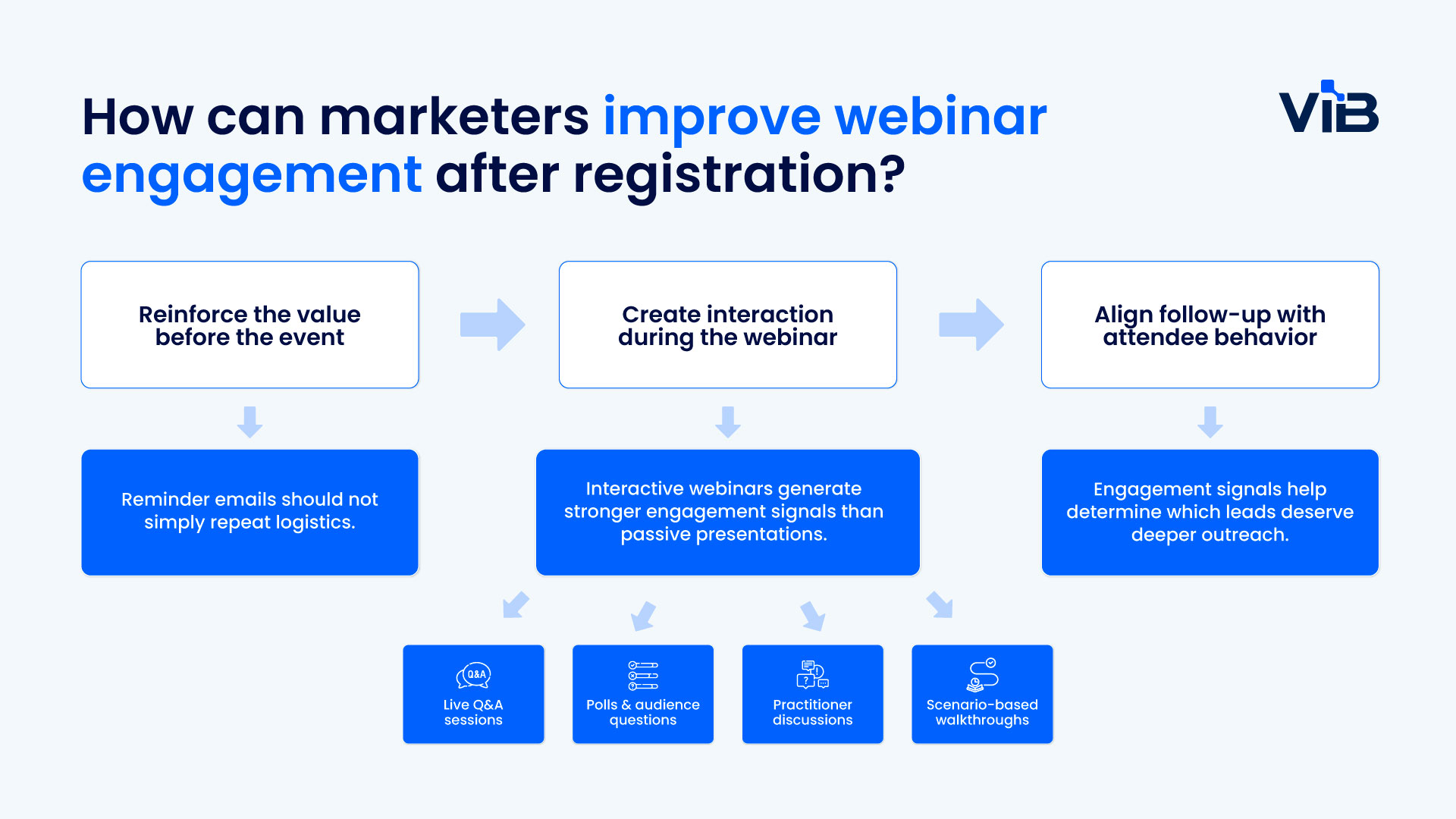
How can marketers improve webinar engagement after registration?
Registration is only the beginning of the engagement process.
Many teams focus heavily on driving sign-ups but fail to sustain interest from registration to attendance. This leads to low participation rates and weaker downstream engagement.
Reinforce the value before the event
Reminder emails should not simply repeat logistics. They should continue building interest around the topic and explain why the conversation matters.
Create interaction during the webinar
Interactive webinars generate stronger engagement signals than passive presentations.
This can include:
- Live Q&A sessions
- Polls and audience questions
- Practitioner discussions
- Scenario-based walkthroughs
These interactions help identify which attendees are actively engaged versus those who are casually registered.
Align follow-up with attendee behavior
Not every attendee should receive the same follow-up sequence. Engagement signals such as attendance duration, poll participation, and question activity help determine which leads deserve deeper outreach.
What role does audience targeting play in webinar success?
Targeting determines whether a webinar reaches the right audience or simply a larger one.
In cybersecurity, precision matters more than scale. A smaller, highly relevant audience often drives better engagement than a broad, unfocused one.
High-performing teams typically define clear audience segments before promotion begins. They align messaging with each segment’s priorities and ensure distribution reflects those differences.
This approach leads to more meaningful engagement and stronger downstream impact.
How can marketers improve conversion of webinar leads?
Generating leads is only part of the equation. Converting those leads into meaningful engagement requires additional focus.
Improving engagement during the webinar
Interactive elements such as Q&A sessions, polls, and live discussion help identify which attendees are actively interested. These signals provide valuable insight into lead quality.
Aligning follow-up content
Post-webinar communication should reflect the topics discussed and the interests expressed by attendees. Generic follow-up emails often reduce engagement.
Prioritizing leads based on behavior
Not all attendees should be treated equally. Engagement signals such as attendance duration, participation, and content interaction help identify which leads are most valuable.
By focusing on engagement rather than just registration, teams can improve the effectiveness of their webinar programs.

Where does ViB Webinars fit into a webinar lead generation cybersecurity strategy?
Up to this point, the focus has been on strategy and execution principles. Running those programs consistently, however, often requires greater reach and operational support than internal teams can provide on their own.
ViB Webinars helps cybersecurity marketers strengthen webinar lead generation by combining targeted audience distribution with full-service webinar execution. Instead of managing separate systems for promotion, hosting, and registration, teams can run coordinated webinar programs designed to reach relevant B2B tech professionals.
This supports several important areas of webinar performance.
Expanding reach to targeted cybersecurity audiences
ViB Webinars promotes webinars through the ViB Community, helping marketers reach professionals based on role, industry, geography, and company size. This extends visibility beyond internal databases and existing followers.
Supporting consistent promotion
Cybersecurity webinar lead generation depends on repeated exposure. ViB Webinars helps reinforce visibility across multiple touchpoints, improving registration consistency and audience alignment.
Guaranteeing event attendance
Meet your targeted registration or attendance goal easily, through our community of qualified tech professionals who are eager to be part of your webinar to explore new technologies.
Reducing operational overhead
Managing webinars internally often requires coordination across marketing, operations, and sales teams. ViB handles setup, hosting, promotion, and tracking so teams can focus more heavily on messaging and content quality.
Improving lead quality through audience alignment
Because webinar promotion is targeted toward relevant B2B technology audiences, marketers can improve not just registration volume, but engagement quality as well.
Rather than replacing internal webinar programs, ViB Webinars acts as a distribution and execution extension that helps cybersecurity marketers run more scalable and audience-aligned webinar campaigns.
What should marketers prioritize when promoting cybersecurity webinars?
Improving lead quality requires a shift in focus from volume to alignment.
The most effective programs prioritize:
- Reaching the right audience rather than the largest audience
- Aligning topics with current cybersecurity challenges
- Maintaining consistent promotion across channels
- Evaluating leads based on engagement, not just registration
These principles help ensure that webinar leads contribute to meaningful outcomes rather than just reporting metrics.
Final thoughts
Webinar lead generation cybersecurity programs work best when they are treated as engagement systems rather than registration campaigns.
As cybersecurity audiences become more selective and difficult to reach, distribution, targeting, and engagement quality become increasingly important. Teams that align these elements effectively are more likely to generate webinar leads that contribute to meaningful pipeline outcomes.
For cybersecurity marketers, success is not about attracting the largest audience. It is about attracting the right one.


