 Skip to content

If you’re a B2B cybersecurity marketer, you already know the hard part isn’t “running a webinar.”
The hard part is consistently attracting the right audience, creating engagement that means something, and turning webinar behavior into useful next-step signals for your go-to-market team.
This is what most people mean when they search for cybersecurity webinar lead generation. They’re not looking for webinar software tips. They’re looking for a repeatable way to earn attention from security buyers and prove ICP fit with real actions.
Below is a practical playbook for experienced B2B tech marketers. It focuses on targeting, programming, promotion, and post-event signal design.
Why cybersecurity webinar lead generation fails (even with good content)
Most underperforming webinar programs don’t fail because the topic is “bad.” They fail because the program design doesn’t match how security buyers evaluate risk and prioritize time.
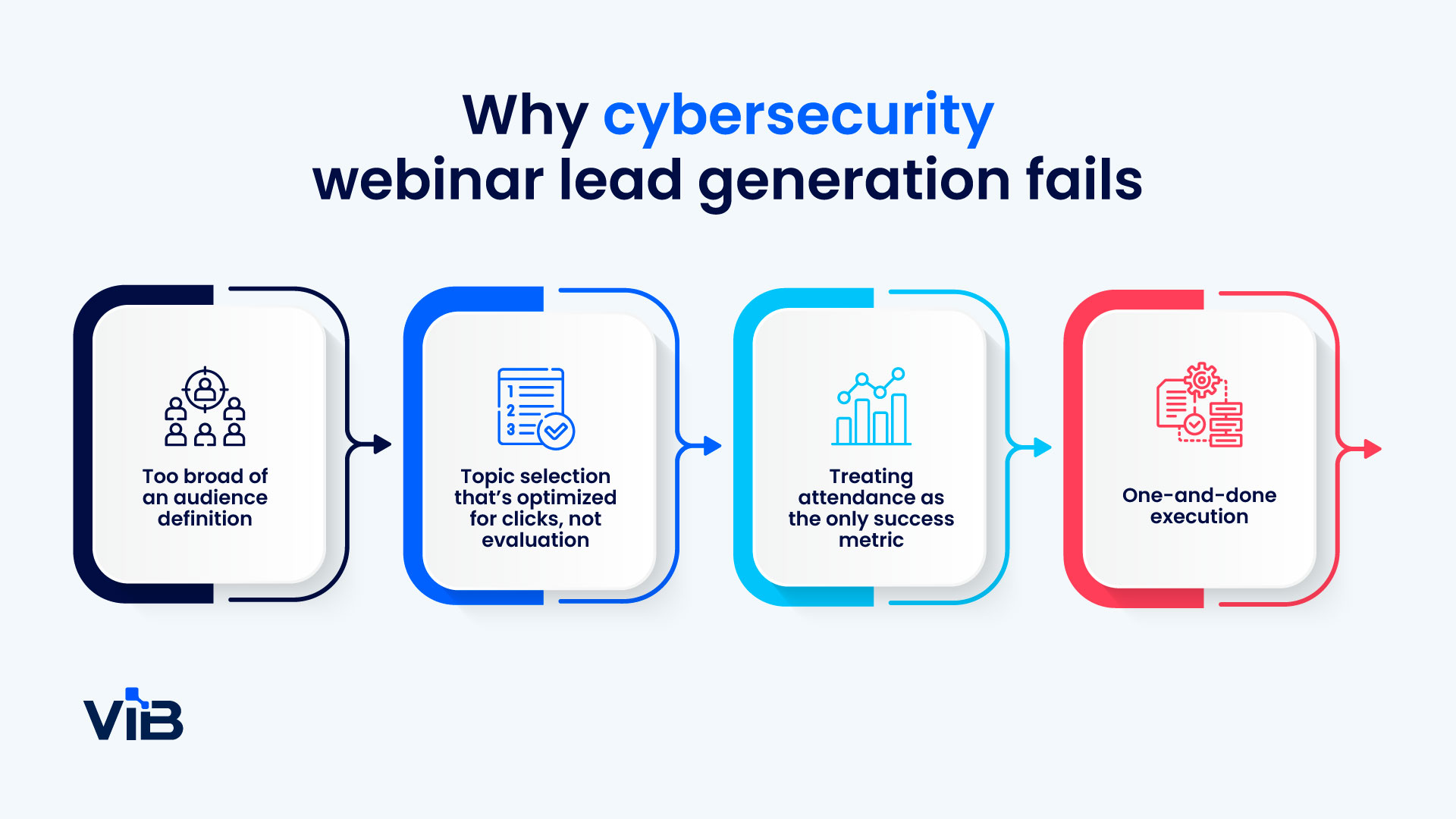
In practice, I see four common failure modes.
1) Too broad of an audience definition
“Cybersecurity leaders” isn’t an ICP. It’s a category.
If your invite list includes everyone from IT managers to appsec engineers to governance leaders, your copy gets generic fast. That lowers registration quality and weakens engagement signals later.
2) Topic selection that’s optimized for clicks, not evaluation
Security audiences are allergic to fluff. If the abstract reads like marketing, they won’t show up.
Strong webinar lead generation topics in cybersecurity usually map to a concrete evaluation moment: reducing uncertainty, comparing approaches, or learning what “good” looks like.
3) Treating attendance as the only success metric
Attendance is a useful operational metric. It’s not the goal.
What you really want is a trail of high-quality intent signals: what they watched, what they asked, what they downloaded, and whether the behavior aligns with your ICP and use case.
4) One-and-done execution
A single webinar rarely creates enough data to learn what’s working. The best teams run webinars like a product: iteration, instrumentation, and distribution.
Benchmarks that matter for cybersecurity webinars
Benchmarks are only useful if you apply them to decisions. Still, it helps to know what “normal” looks like so you can spot issues early.
ON24 has reported an average webinar conversion rate (registrations to attendees) of around 57% in its 2025 webinar benchmarks takeaways.
Separately, NetLine highlights that on-demand webinar registrations grew 46.2%.
Two takeaways for cybersecurity webinar lead generation:
- If your registrant-to-attendee rate is far below typical ranges, you likely have a targeting and relevance issue (or your reminders and calendar friction are hurting you).
- If you’re still treating “on-demand” like leftovers, you’re leaving a lot of engagement on the table. On-demand is often where the best-fit buyers self-qualify quietly.
Build a cybersecurity webinar strategy around intent signals, not just MQLs
Security buying committees are complicated. Your webinar program should acknowledge that by capturing multiple kinds of buyer intent, not forcing everyone into the same follow-up.
Think about webinar outcomes in three layers.
Layer 1: Fit signals (are they your ICP?)
Fit signals come from firmographics, role, and environment. In cybersecurity, the environment is often the difference-maker.
Examples: cloud posture, regulatory pressure, tooling landscape, maturity level, and whether they’re centralized or federated.
Layer 2: Interest signals (do they care about this problem?)
Interest signals are behavioral. They show what the person leaned into during the event.
Examples: staying for Q&A, clicking into a framework download, or watching the on-demand replay past the “setup” slides.
Layer 3: Readiness signals (are they evaluating solutions now?)
Not everyone is in-market. You can still create value by capturing readiness indicators without forcing a demo ask too early.
Examples: asking “what do you see replacing X tool,” requesting implementation guidance, or downloading an evaluation checklist.
Sales teams ignore lists without context, so you need engagement indicators tied to the event itself.
Topic design for cybersecurity webinars: pick angles that drive evaluation behavior
Experienced marketers don’t need “how to choose a topic.” You need topic patterns that reliably attract the right roles and trigger meaningful questions.
Here are topic angles that tend to work well for cybersecurity webinar lead generation, especially when your goal is engagement and ICP-fit signals.
Angle 1: The “decision framework” webinar
Build a webinar around how to make a decision, not why your category exists.
Examples: “A practical framework to evaluate XDR for hybrid environments” or “How to scope an IAM modernization project without breaking audit requirements.”
Angle 2: The “what good looks like” teardown
Security teams love specifics. Do a teardown of a policy, a reference architecture, or a response workflow.
Make it vendor-neutral in the core content. Use your product POV only where it clarifies tradeoffs.
Angle 3: The “prove it” operational webinar
Pick a measurable outcome and walk through how teams operationalize it.
Examples: “Reducing false positives without missing critical alerts” or “How to design access reviews that actually finish on time.”
Angle 4: The “change pressure” webinar
Pressure creates urgency, and urgency creates engagement.
Pressure can be regulatory, architectural (cloud migration), organizational (M&A), or operational (tool sprawl).
If you have access to intent inputs, you can also use them to validate topic demand. (If you don’t, you can still approximate with search trends, SDR call notes, and win/loss themes.)
Promotion that doesn’t wreck lead quality
For cybersecurity webinar lead generation, promotion is where quality is won or lost.
You can hit a registration number with broad targeting. You can’t fake engaged attendance from the right accounts.
Start with a “must-have” targeting checklist
Before you launch, define the minimum viable audience definition. Not the ideal. The minimum.
- Roles: the 2–4 job families you actually want
- Account profile: employee range, industry set, region coverage
- Environment qualifiers: cloud, compliance, stack, maturity
- Exclusions: students, consultants (unless you want them), and unrelated industries
Make your abstract pass the “security skim test”
Security leaders skim. They decide fast. Your landing page should earn trust in the first few lines.
Three practical rules:
- Lead with the problem in plain English.
- Show what they’ll be able to do differently after.
- Be specific about who it’s for (“SOC leads in mid-market SaaS,” not “anyone interested in security”).
Use the right “conversion lever” for each channel
Email works when the relevance is tight, and the reminder sequence removes friction (calendar holds matter).
Paid social works best when you pre-qualify with the creative. If the creative is vague, you’ll pay for mismatched registrants.
Partner promotion can be strong, but only if you align on the audience definition up front.
Format choices that increase engagement without adding chaos
Live webinars can be great, but they’re fragile. Speaker schedules slip, demos break, and the “one shot” pressure reduces iteration.
For teams trying to build a repeatable cybersecurity webinar lead generation engine, consider adding a simulive motion to your mix.
Simulive webinars as a way to run a webinar using pre-recorded content while still supporting live interaction. That can reduce effort while keeping a live event feel.
A reliable structure for security audiences
If you’re optimizing for engagement signals, structure matters more than slides.
- 0–5 min: what’s changing, and why it matters now
- 5–20 min: framework or model (how to think)
- 20–35 min: application (examples, teardown, workflow)
- 35–45 min: tradeoffs and failure modes (what goes wrong)
- 45–60 min: Q&A designed to surface evaluation intent
Notice what’s missing: a long company intro and a “features tour” that starts at minute 7.
Post-webinar follow-up that turns behavior into next steps
Most follow-up programs are too blunt. Everyone gets the same email, and sales gets a flat list.
You’ll get better outcomes if you segment follow-up by what people did, not just whether they attended.
Use a three-path follow-up model
This keeps things simple while still respecting the buyer stage.
- Path A: High engagement (asked a question, stayed late, clicked key assets). Send a short “based on what you engaged with” recap and offer one relevant next resource.
- Path B: Light engagement (attended briefly, no actions). Send the on-demand link with timestamps and one core takeaway.
- Path C: No-show (registered only). Send the replay plus a one-question “what were you hoping to learn?” prompt to capture fit and intent.
Design your webinar to create segmentation inputs
If you want better follow-up, you need better inputs.
Add 1–2 intentional “signal moments” to the webinar, such as a poll that clarifies the environment (“Where are you running most workloads?”) or a choice that indicates the stage (“Are you evaluating tools this quarter?”).
Keep it respectful. Security audiences will answer if the question is clearly relevant.

How ViB Webinars supports cybersecurity webinar lead generation (without the heavy lift)
Once your strategy is sound, execution becomes the constraint.
ViB Webinars is designed to remove operational drag while keeping the focus on what matters to experienced marketers: audience quality, event execution, and engagement signals you can actually use.
Three practical ways experienced cybersecurity marketers use a service like this:
- Scale a webinar series without overusing SMEs: Simulcast a proven recording as a scheduled live experience to keep momentum.
- Expand reach to your intended audience: Use ViB’s promotion and managed execution to extend beyond your house list when you need net-new engagement.
- Standardize capture of event intent signals: Treat each webinar as a consistent source of engagement data, rather than an isolated campaign.
If you’re exploring this route, keep the evaluation criteria marketer-first:
- Can we control who the webinar is for and exclude who it isn’t for?
- Can we run the same quality bar across multiple events?
- Will we get engagement details we can route into our scoring and nurture?
- Can we quickly reuse the content in on-demand form?
Conclusion: A better way to think about cybersecurity webinar lead generation
Cybersecurity webinar lead generation works when you stop treating webinars like isolated events and start treating them like an engagement system.
That system has a few non-negotiables: tight audience definition, topics that map to real evaluation moments, formats that reduce execution risk, and follow-up that’s driven by behavior.
If you already have strong content but your team can’t run enough high-quality events to learn and iterate, ViB Webinars can be a practical next step. It’s built to help you promote and host webinars at scale, including simulcasting proven recordings into live experiences, while keeping the focus on the right engagement and fit signals.


