 Skip to content


If you’re looking for a cybersecurity content syndication network, you’re probably not simply looking for “more leads.” You’re looking for a partner that can reliably create the right engagement signals across the right accounts, without polluting your CRM or wasting SDR cycles.
In this guide, we’ll go deep on how cybersecurity syndication networks work, what to measure, and which networks are actually available right now, including ViB Syndication.
For cybersecurity specifically, the “fit” depends on your category maturity. A well-known segment (MDR, SASE, IAM) can benefit from high-intent editorial ecosystems. A newer segment (AI security posture, identity threat detection, DSPM) often needs more education and better ICP matching.
Available cybersecurity content syndication networks (with practical pros and cons)
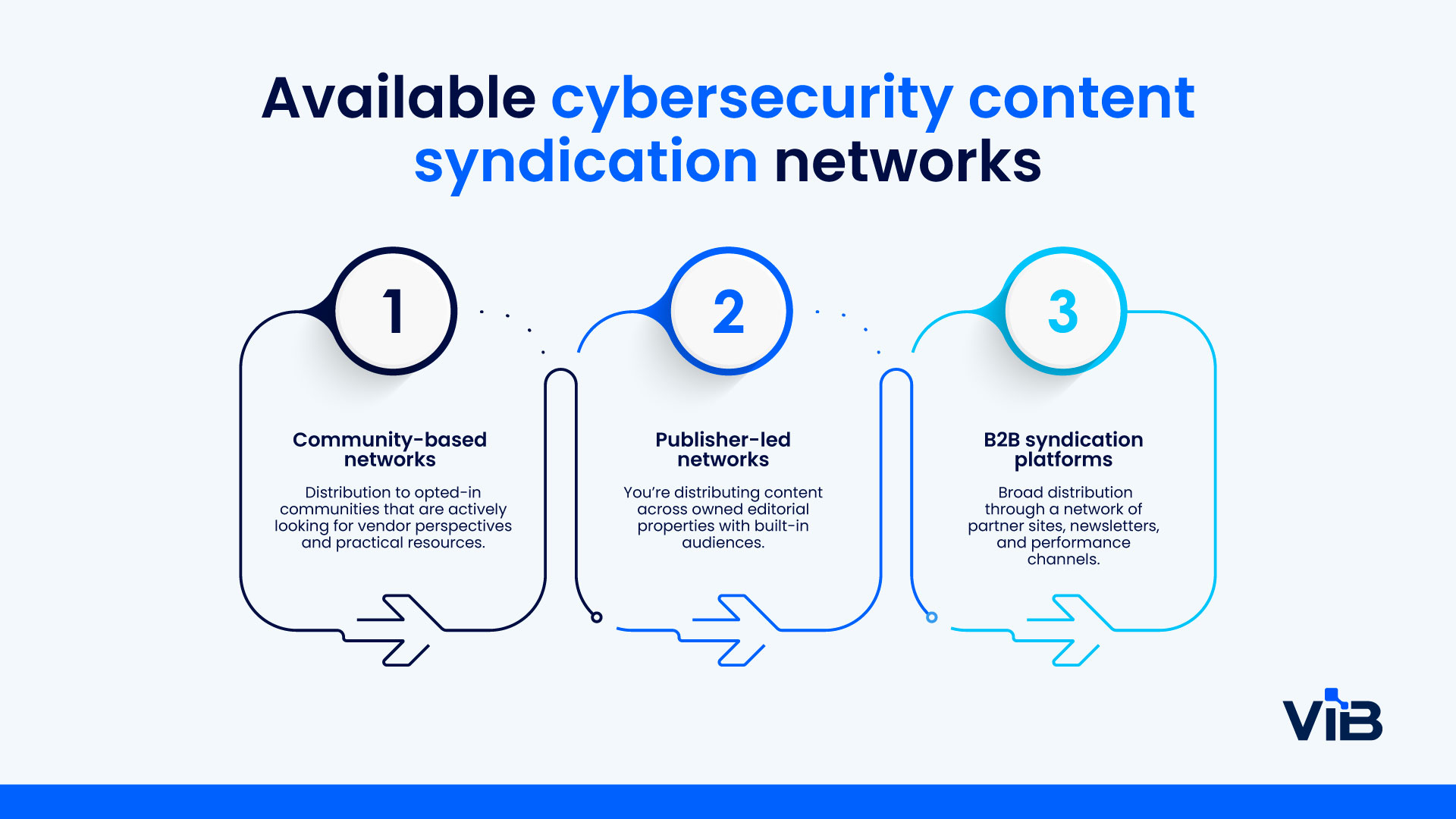
In practice, cybersecurity content syndication networks tend to fall into three buckets:
- Community-based networks: Distribution to opted-in communities that are actively looking for vendor perspectives and practical resources.
- Publisher-led networks: You’re distributing content across owned editorial properties with built-in audiences (often strong for IT/security research behaviors).
- B2B syndication platforms: Broad distribution through a network of partner sites, newsletters, and performance channels (often optimized for volume and CPL control).
Below is a marketer-focused list of cybersecurity syndication networks you can actively evaluate. This isn’t exhaustive, but it covers many of the networks cybersecurity teams regularly shortlist.
ViB Syndication
ViB Syndication distributes your top assets to our millions-strong opt-in community of technology professionals. It allows for targeting by attributes such as job titles, seniority, geography, company size, industries, and even ABM lists.
In practice, this tends to work well when you’re trying to validate messaging, build net-new engagement with the right profiles, and generate consistent top-of-funnel consumption from accounts you care about.
Pros
- ICP-focused targeting (including ABM list support) and promotion designed to put assets in front of your ICP.
- Lead quality controls via a qualified download guarantee and vetting against targeting specs (useful when you’re trying to keep your CRM clean).
- Works well for security categories where you’re trying to build engagement before conversion happens in other channels.
Cons
- Not a “set it and forget it” fix. You still need a strong nurture and account follow-up motion to translate engagement into downstream outcomes.
- Creative and offer strategy matters. If your asset is too product-heavy, your engagement signals will be weaker and your learnings less useful.
Best-fit use cases
- Reaching net-new security practitioners and leaders who match your ICP, especially when organic reach is capped.
- Testing which topics drive the strongest early engagement before you scale paid social or events.
- Supporting ABM coverage by putting high-value assets in front of named accounts and tracking consumption signals.
Informa TechTarget
Informa TechTarget’s content syndication is closely tied to its editorial ecosystem and intent signals, with a focus on reaching buying team members who are actively researching relevant topics.
Pros
- Strong for IT/security research behavior and contextual alignment, especially for established security categories.
- Intent-driven workflows can support account prioritization and messaging refinement.
Cons
- Can skew toward “research mode.” That’s useful, but it may require more patience and better nurturing to realize full value.
- Packaging can be complex if you’re trying to unify intent, syndication, and downstream activation across tools and teams.
Best-fit use cases
- Enterprise cybersecurity targeting where buying groups do deep third-party research.
- Teams running account-based plays that need account-level intent context to inform distribution and follow-up.
NetLine
NetLine is a long-standing B2B content syndication and lead gen network, reaching over 125 million unique visitors and generating 700K leads per month across 300 industry sections.
Pros
- Large distribution reach and broad category coverage (helpful when you need scale).
- Operational flexibility, including self-serve options and performance-based syndication programs.
- Integrations and partner ecosystem (for example, NetLine appears in the Demandbase partner marketplace).
Cons
- Quality variance is real at scale. You’ll want strict filters, validation rules, and a clear rejection workflow.
- Offer-content matching matters. Broad networks can underperform if you push niche assets without tight targeting.
Best-fit use cases
- Scaling cybersecurity awareness assets across multiple segments (SMB, mid-market, enterprise) with tailored targeting per segment.
- Filling specific nurture tracks with net-new opted-in contacts and measuring lift in downstream engagement.
Foundry
Foundry provides demand gen solutions that can include content syndication as part of broader programs, often tied to intent and editorial ecosystems across its portfolio.
Pros
- Strong publisher roots and access to tech audiences, which can help with credibility and contextual fit.
- Good option for integrated programs where syndication is one part of a coordinated mix.
Cons
- Less “single knob” control if you want a pure-play syndication motion with highly specific optimization.
- Results depend heavily on package design and how your content aligns with where readers are in their research.
Best-fit use cases
- Cybersecurity marketers who want publisher adjacency and brand-safe environments for high-trust categories.
- Teams combining intent, media, and content offers across a single partner.
Madison Logic
Madison Logic ABM Content Syndication around guiding buying groups and deepening account engagement, often paired with broader ABM approaches.
Pros
- ABM-aligned approach that’s easier to map to account coverage, buying-group reach, and orchestration goals.
- Emphasis on transparency and lead validation, which helps when stakeholders are skeptical of syndication.
Cons
- Heavier planning lift if you’re early in ABM maturity or don’t have tight account lists.
- Requires solid content mapping to buying stages, or engagement signals will be noisy.
Best-fit use cases
- Enterprise security teams running account-centric programs and needing consistent engagement across buying groups.
- Marketers who want syndication to connect more directly to account prioritization and follow-up.
DemandScience (content syndication + intent layers)
DemandScience positions its content syndication around opt-in leads, ICP targeting, and layered intent to reach likely buyers.
Pros
- Intent and ICP layering are helpful in crowded security categories where “interest” is easy to fake but harder to sustain.
- Clear expectations on delivery mechanics, like guaranteed CPL and defined lead volumes (useful for planning).
Cons
- You still need a strong nurture design to turn early intent into meaningful downstream actions.
- Be careful with over-reliance on “guarantees”. Focus on lead definitions, validation, and signal transparency, not just volume.
Best-fit use cases
- Teams that want a structured, measurable top-of-funnel program with defined ICP filters.
- Cybersecurity marketers combining syndication with ABM orchestration and intent-driven follow-up.
How to evaluate cybersecurity syndication networks beyond CPL
If you’re choosing syndication partners using only CPL and lead volume, you’re going to repeat the same problems most teams complain about: low acceptance, weak follow-up rates, and sales frustration.
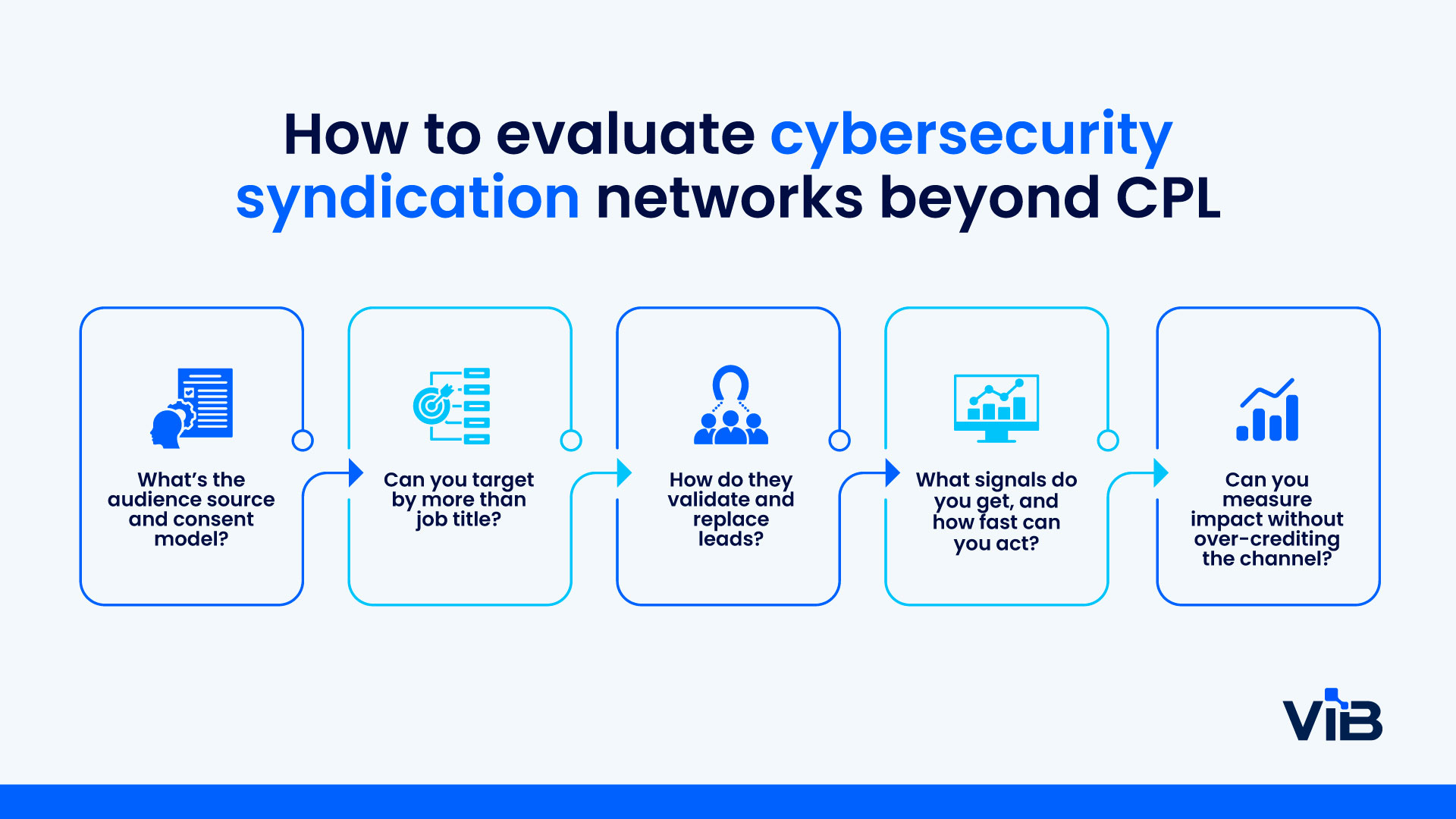
Instead, evaluate networks using five operational questions that map to real outcomes.
1) What’s the audience source and consent model?
Ask where contacts come from and how permission is captured at the point of conversion. Some vendors emphasize “permissioned” audiences and additional consent at form submission, which matters for compliance and downstream nurture performance.
For cybersecurity audiences, this can be the difference between “someone downloaded a PDF” and “someone actually expects to hear from vendors.”
2) Can you target by more than job title?
Cybersecurity buying groups are messy. Titles are inconsistent, and “Security Engineer” can mean anything from endpoint operations to detection engineering to cloud security.
Prioritize networks that support layered targeting, such as seniority, company size, industry, geography, and technographics, and apply exclusions you care about (e.g., students, consultants, competitors, very small firms, and so on).
3) How do they validate and replace leads?
Lead validation is not an admin detail. It changes how confident you can be in nurture and sales follow-up.
At a minimum, you want clear definitions of what counts as “qualified,” a replacement policy, and visibility into the reasons for rejections.
4) What signals do you get, and how fast can you act?
Experienced teams don’t just want names. They want signals they can operationalize in near real time: topic interest, asset engagement, intent surges, and account clusters.
5) Can you measure impact without over-crediting the channel?
Content syndication is often an earlier-journey channel. That’s not a weakness, but it does mean measurement needs to focus on what it’s good at: qualified engagement, ICP coverage, buying-group penetration, and nurture lift.
If your attribution model only “counts” last-touch demo conversions, you’ll undervalue syndication and overvalue retargeting.
Practical strategy: How experienced cybersecurity teams make syndication actually work
Most syndication programs don’t fail because the vendor is “bad.” They fail because the strategy is under-specified.
Here are the tactics that separate “random lead flow” from consistent ICP engagement.
Build a 3-asset stack, not a one-off PDF
Cybersecurity buyers don’t move in straight lines. If you syndicate only one asset, you can’t tell whether you have a topic fit problem, a format problem, or an audience problem.
A practical stack looks like this:
- Asset A (category clarity): What “good” looks like for the problem space.
- Asset B (operational depth): Frameworks, checklists, threat-modeling guidance, or implementation considerations.
- Asset C (proof): Case study, technical brief, or buyer’s guide that supports internal consensus.
Use rejection reasons as a targeting feedback loop
Don’t treat lead rejections as a vendor problem. Treat them as a dataset.
If you’re rejecting for “wrong company size,” your filters are too loose. If it’s “wrong function,” your persona definition is probably too broad. If it’s “consultants,” add an exclusion rule and move on.
Score syndication with engagement KPIs, not just form fills
Syndication is strongest when it produces durable signals you can use elsewhere.
In addition to MQL acceptance rates, track:
- Account coverage: how many target accounts are engaging at least once per month.
- Buying-group breadth: number of distinct roles engaging per account.
- Nurture lift: email engagement and return visits from syndicated cohorts vs. other sources.
- Sales follow-up health: connect rate and “right meeting” rate, not just meeting count.
Conclusion: Pick cybersecurity syndication networks based on signals, not promises
The best cybersecurity syndication networks don’t just “deliver leads.” They help you earn attention from the right accounts, learn what messaging lands, and create engagement signals your team can act on.
If you evaluate vendors on audience source, consent model, validation, targeting depth, and signal transparency, you’ll end up with a syndication motion that supports real buyer journeys instead of fighting them.
And if you’re comparing options, keep the shortlist simple: start with the network type that matches your goals, run a tightly scoped pilot, and hold every partner accountable to ICP fit and usable engagement data.


