 Skip to content


Cybersecurity demand gen has a specific problem: you can hit your lead target and still feel like nothing’s moving.
Not because your team can’t execute, but because your “qualified” definition often ignores how security buying actually happens. It’s multi-threaded, risk-heavy, and spread across more people than most revenue teams want to admit.
Forrester’s research on buying networks finds that an average of 13 internal stakeholders and nine external participants influence a B2B purchase decision. That complexity shows up fast in cybersecurity, where technical validation and risk sign-off are non-negotiable.
Plus, Security teams rarely “discover, evaluate, and decide” in one tidy arc. They pause for audits, budget cycles, incident response priorities, procurement steps, and internal risk approvals.
That’s why a single spike in first-party engagement can be misleading. It may represent curiosity rather than active evaluation.
This article is about building cybersecurity MQL leads you can trust by combining ICP fit with verified intent signals, then activating those signals with the right content and channel choices.
Why cybersecurity MQL leads break down in real programs
When teams complain about lead quality, it’s usually because the MQL logic rewards isolated actions (a webinar, an ebook) over evidence of a real buying motion (sustained research, solution comparison, stakeholder spread).
Plus, while cybersecurity urgency is real, it also creates lots of non-buying engagement. Vulnerability news, breach coverage, and compliance updates make people consume content without having a funded initiative.
For context, Google’s threat research has reported dozens of exploited zero-days tracked and patched in a single year. That kind of environment drives research behavior across many teams, even when they’re not in-market.
If you want cybersecurity MQL leads that hold up, qualification has to be anchored to two things: fit and intent.
And for cybersecurity, “intent” needs to be more than “they clicked.”
Start with an ICP that reflects security reality, not SaaS averages
Cybersecurity ICP fit is rarely just about firmographics. It’s also about environment complexity and risk posture.
Useful ICP dimensions for qualification:
- Security maturity signals: Presence of a CISO or security leadership layer; dedicated AppSec/CloudSec roles; public hiring trends
- Regulatory exposure: Healthcare, financial services, critical infrastructure, or any org with strong audit requirements
- Tech environment: Multi-cloud, identity sprawl, large endpoint footprint, legacy + modern stack mix
- Change triggers: M&A, rapid hiring, cloud migration, compliance deadlines, vendor consolidation initiatives
This is how you avoid “qualified” leads that are curious, but structurally unlikely to buy.
A practical qualification framework for cybersecurity MQL leads
You need a model that reflects real buying patterns and forces discipline in what gets called “qualified.”
Use three gates: Fit, intent, and engagement depth
Here’s a framework experienced teams can implement without rebuilding their entire stack.
- Fit gate (account): The account matches ICP; exclude known bad-fit segments and “tourist” industries
- Intent gate (account): The account shows sustained research in your problem space (not just broad security news)
- Engagement gate (person + account): Meaningful first-party actions that map to evaluation, not awareness
Only when all three are true should you treat the outcome as a cybersecurity MQL lead worth prioritizing.
Define “evaluation engagement” in plain terms
Most teams put too much emphasis on content downloads. In security, you’ll get better results by giving more weight to actions that suggest internal sharing and vendor evaluation.
Examples of evaluation-aligned engagement:
- Repeated visits to implementation, integration, or architecture pages
- Viewing compliance mappings (SOC 2, ISO 27001, HIPAA, PCI, etc.)
- Returning to pricing or packaging pages multiple times over a two-to-four-week window
- Multiple people from the same account engaging within a short period
- Consumption of “comparison-style” assets (build vs buy, vendor comparison guides)
This shifts your cybersecurity MQL leads from “someone raised their hand once” to “the account is building a case internally.”
How to activate intent signals without spamming the market
Once you’re capturing intent, the next question is what to do with it.
The mistake is treating intent like a switch that justifies aggressive outreach. Intent is better used as a prioritization layer for messaging, channel mix, and content sequencing.
Build “intent-to-content” mapping by topic cluster
Create 5–8 topic clusters that represent how cybersecurity buyers frame problems. Then map each cluster to specific proof points and assets.
Example clusters that often work well:
- Identity and access risk (IAM, MFA fatigue, privileged access)
- Cloud posture and misconfiguration risk
- Endpoint and lateral movement containment
- Third-party/vendor risk management
- Data loss and insider risk
- Security operations efficiency (alert fatigue, tooling overlap)
When intent spikes for “cloud posture,” don’t send generic security messaging. Send content that helps a buyer validate the approach, deployment impact, and risk-reduction logic.
Sequence by stakeholder role, not by funnel stage
Security purchases stall when stakeholders can’t align. Your job is to make alignment easier.
Think about it this way:
- CISO/security leader: risk framing, consolidation rationale, and governance
- Security engineer/architect: deployment patterns, integrations, and operational impact
- IT ops: resourcing, rollout, and change management
- Procurement/finance: commercial structure, vendor risk, and cost justification
If your cybersecurity MQL leads don’t include the technical validator, your program will struggle to sustain momentum.
Use “account saturation” as a health metric
One of the best leading indicators for cybersecurity MQL leads is whether engagement is spreading inside the account.
Track metrics like:
- Number of engaged contacts per target account
- Role coverage (security leader + technical evaluator + adjacent stakeholders)
- Repeat engagement within a defined timeframe
- Intent trend direction (rising, steady, fading)
This keeps your team focused on engagement quality and ICP fit rather than vanity conversion spikes.

Channel and program plays that tend to work in cybersecurity
Cybersecurity audiences are overloaded. The winning programs usually feel respectful and specific.
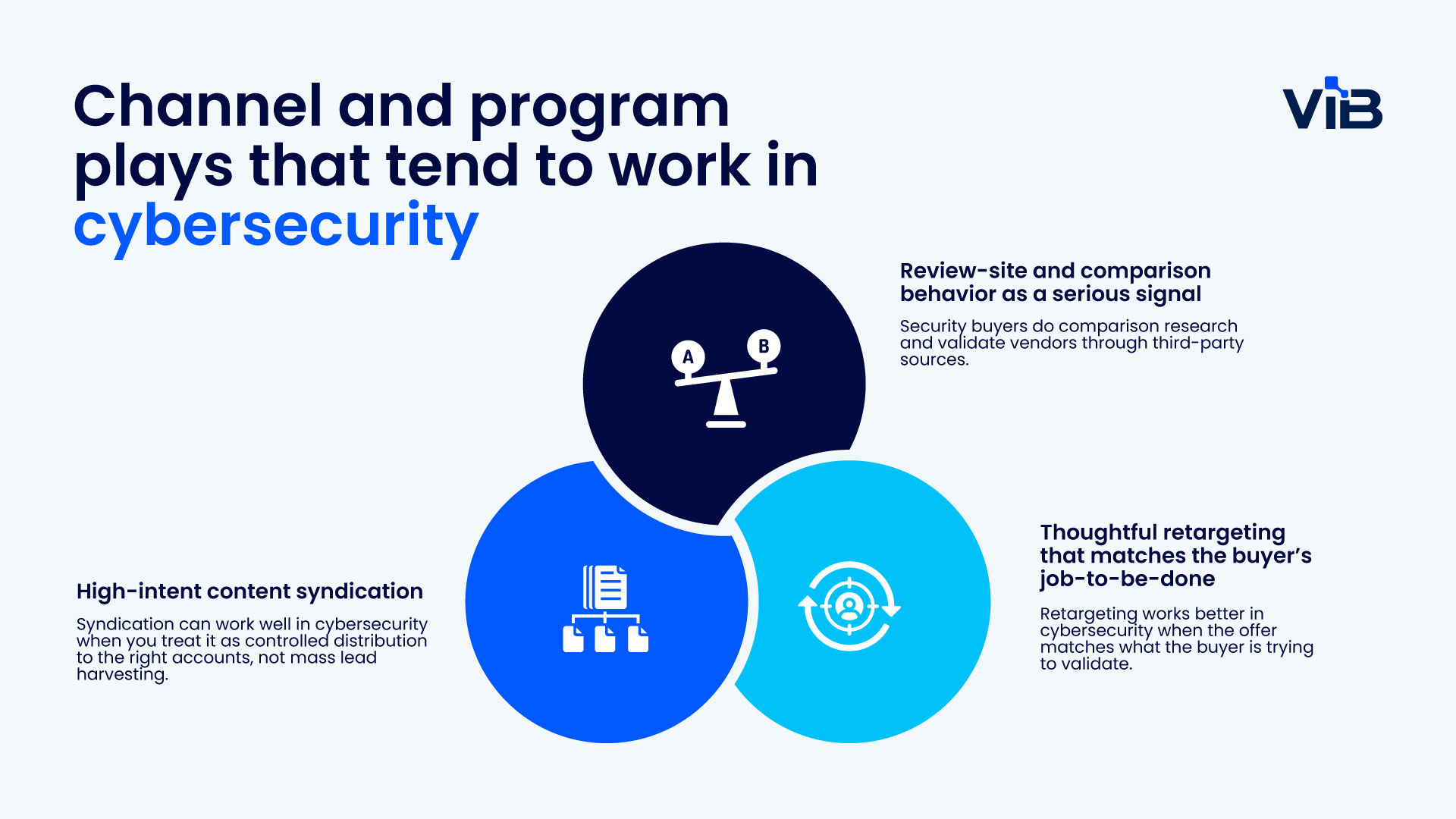
High-intent content syndication (done with strict controls)
Syndication can work well in cybersecurity when you treat it as controlled distribution to the right accounts, not mass lead harvesting.
The practical controls that matter most:
- Account list governance (named accounts or tightly defined ICP segments)
- Topic alignment to intent clusters (not generic “security trends”)
- Role targeting and exclusions (avoid student/research traffic patterns)
- Frequency caps and recency rules (avoid burning the list)
Review-site and comparison behavior as a serious signal
Security buyers do comparison research and validate vendors through third-party sources.
If you can incorporate review-site and comparison activities into your qualification approach, you’ll usually improve your mix of cybersecurity MQL leads.
Thoughtful retargeting that matches the buyer’s job-to-be-done
Retargeting works better in cybersecurity when the offer matches what the buyer is trying to validate.
Instead of pushing demos, rotate assets like:
- Implementation checklists
- Integration guides by ecosystem (SIEM, EDR, cloud providers)
- Security and compliance documentation hubs
- Clear “how it works” explainers that respect technical scrutiny
How intent signals can support stronger cybersecurity MQL leads
If your strategy depends on fit, intent, and meaningful engagement, the operational bottleneck is usually signal quality and speed.
Intent signals can support this process by helping marketers identify and prioritize accounts showing credible interest, then use those insights to guide targeting and messaging earlier in the buyer journey.
Practical ways to use it:
- Prioritize ICP accounts that are actively researching your topics, so your budget follows demand signals
- Route intent-qualified accounts into role-specific nurture streams, based on the topic cluster driving interest
- Improve MQL definitions by adding an account-level requirement (intent + fit) before someone becomes an MQL
- Measure engagement spread inside target accounts, so you can see whether interest is concentrated or expanding
Conclusion: Build cybersecurity MQL leads that your team can stand behind
The strongest cybersecurity MQL leads come from disciplined qualification, not more volume.
When you combine ICP fit with account-level intent and evaluation-grade engagement, you get leads that map to real buying behavior. You also get cleaner reporting and better internal trust.
For experienced B2B marketers, the opportunity isn’t to redefine MQLs in a new spreadsheet. It’s to operationalize intent so your programs surface the right accounts, at the right time, with messaging that helps buying groups align.


