 Skip to content


If you’re searching for a cybersecurity marketing email list (which we’re assuming you are, since you ended up here), you’re probably trying to solve one of three problems:
- You need more cybersecurity buyers at the top of your funnel than inbound is giving you.
- You’re launching a new offer (webinar, report, event) and need reach fast.
- You’re tired of “big list, small results” and want a cleaner way to target the right roles and accounts.
This article is for experienced B2B tech marketers who want a practical, current view of list options—including what’s worth paying for, where lists fall short, and what to use when “more emails” isn’t the real constraint.
What people mean by “cybersecurity marketing email list” (and why it matters)
A cybersecurity marketing email list can mean very different things depending on who’s selling it.
Some vendors sell bulk contact data exports (names, emails, and firmographics). Others sell access to a database with filters. Others bundle contacts with intent signals, content consumption, or targeting overlays that help you reach people earlier than a form fill.
Before you compare providers, decide which of these you’re actually buying:
- A raw list export (CSV-style): Usually cheapest, with the highest deliverability risk if you mail it directly.
- A contact database subscription (search + export): Better for ongoing prospecting and enrichment.
- An intent + contacts workflow: Higher cost, potentially higher relevance, but you still need good activation.
- An “email to someone else’s audience” placement: You don’t own the list, but you borrow trust and targeting.
That last category is where many cybersecurity teams end up when they want to scale without inheriting list hygiene issues, compliance headaches, and reputation risk.

The non-negotiables: Compliance and consent basics for email outreach
If you’re buying or renting anything that looks like a cybersecurity marketing email list, you need to anchor on the basics and align with your legal team.
In the U.S., the CAN-SPAM Act sets rules for commercial email, including requirements around deceptive headers, subject lines, identifying the message as an ad where applicable, including a physical address, and honoring opt-out requests. The FTC’s compliance guide is a solid starting point.
In the U.K., GDPR and related ePrivacy rules change how you think about lawful basis, transparency, and what’s considered acceptable for B2B outreach. “Legitimate interest” is often discussed for B2B marketing, but how it’s applied depends on your situation and jurisdiction.
Practical takeaway: When a vendor says “compliant,” don’t stop there. Ask what data they provide (business vs. personal), how they source it, how often it’s refreshed, and what suppression/opt-out handling looks like.
Why cybersecurity email lists often underperform (even when the data is “good”)
In cybersecurity, list performance usually breaks down for reasons that have nothing to do with your copy.
Job changes and org churn hit security teams hard
Security orgs restructure constantly. Titles shift, reporting lines change, and people move. That makes data decay feel faster than in some other categories.
Catch-all domains and “valid” emails that still bounce
Even verified emails can be risky at scale. Some mail systems accept everything and bounce later, which can hurt sender reputation if you’re not careful with verification and throttling.
Over-targeting the same tiny pool
Cybersecurity buyers are heavily prospected. If your provider’s data overlaps with everyone else’s, you’re paying for the same fatigue your prospects are already feeling.
“Security decision-maker” isn’t one persona
In many orgs, budget influence and technical evaluation are split across multiple roles. If your cybersecurity marketing email list strategy assumes one buyer, your targeting will look “right” but still miss.
If you’ve seen flat engagement before, it’s often because the list didn’t map to the buying group, the message didn’t match the moment, or both.
Top cybersecurity marketing email list providers (and what each is best for)
The goal here isn’t to crown a single winner. It’s to give you a shortlist of credible routes marketers use to build or access a cybersecurity marketing email list, plus the “best-fit” use case for each.
Apollo.io (broad B2B coverage, self-serve list building)
Apollo is commonly used as a self-serve B2B database for finding and exporting contacts with filters (role, seniority, company attributes). Apollo positions its database as large-scale and highlights verified contact data and enrichment.
Best for: building targeted segments quickly, testing ICP hypotheses, and filling gaps in your CRM.
Watch-outs: You still own deliverability. If you’re activating via cold email, you’ll want verification, suppression, and careful ramping.
Cognism (compliance-forward positioning, strong EMEA narrative)
Cognism emphasizes compliance and governance in its data approach, including GDPR and CCPA-oriented messaging, and also highlights manual validation for some mobile data.
Best for: teams with strong EU/UK go-to-market motion who want a vendor that leads with compliance posture.
Watch-outs: Compliance posture doesn’t automatically equal performance. You still need a segmentation strategy and a reason to engage.
LinkedIn Sales Navigator (not a list seller, but often the cleanest targeting layer)
Sales Navigator is not a cybersecurity marketing email list provider in the classic sense. It’s a prospecting tool that helps teams find leads and accounts using LinkedIn’s graph and filters.
Best for: defining and validating the buying group, refining title/role assumptions, and building account lists before you export any emails elsewhere.
Watch-outs: You’ll still need a step to map profiles to email addresses for email-based activation, and a process to keep it current.
Informa TechTarget Priority Engine (intent + buying-group context)
If your issue is timing, not volume, intent-led options can be more useful than a static list. Informa TechTarget offers intent data based on observed content research. It includes Priority Engine access and integrations.
Best for: prioritizing accounts showing active research behavior and shaping outreach around what they’re consuming.
Watch-outs: Intent signals still need smart activation. If your follow-up looks generic, the advantage disappears fast.
Bombora (company-level intent signals you can operationalize)
Bombora is well-known for company-level intent and its “Company Surge” positioning. It describes intent derived from its data cooperative of publishers and providers.
Best for: account selection, segmentation, and aligning paid, email, and SDR activity around shared topic signals.
Watch-outs: It’s not a turnkey contact list. You’ll still need contacts and a workflow to turn signals into engagement.
6sense and Demandbase (ABM platforms that combine data + intent for orchestration)
Demandbase and 6sense both use intent and account intelligence to identify and engage accounts earlier, then orchestrate multi-channel programs. Demandbase gathers intent by observing content consumption via its network, emphasizing early interest discovery.
Best for: mature ABM teams that want a system for account selection, segmentation, measurement, and coordinated activation across channels.
Watch-outs: These platforms can be heavy lifts. If your core problem is that you can’t get the right security audience to engage, you may not need a full orchestration layer first.
A simple evaluation framework for any cybersecurity marketing email list
When you’re comparing cybersecurity marketing email list providers, the usual feature checklists miss what matters.
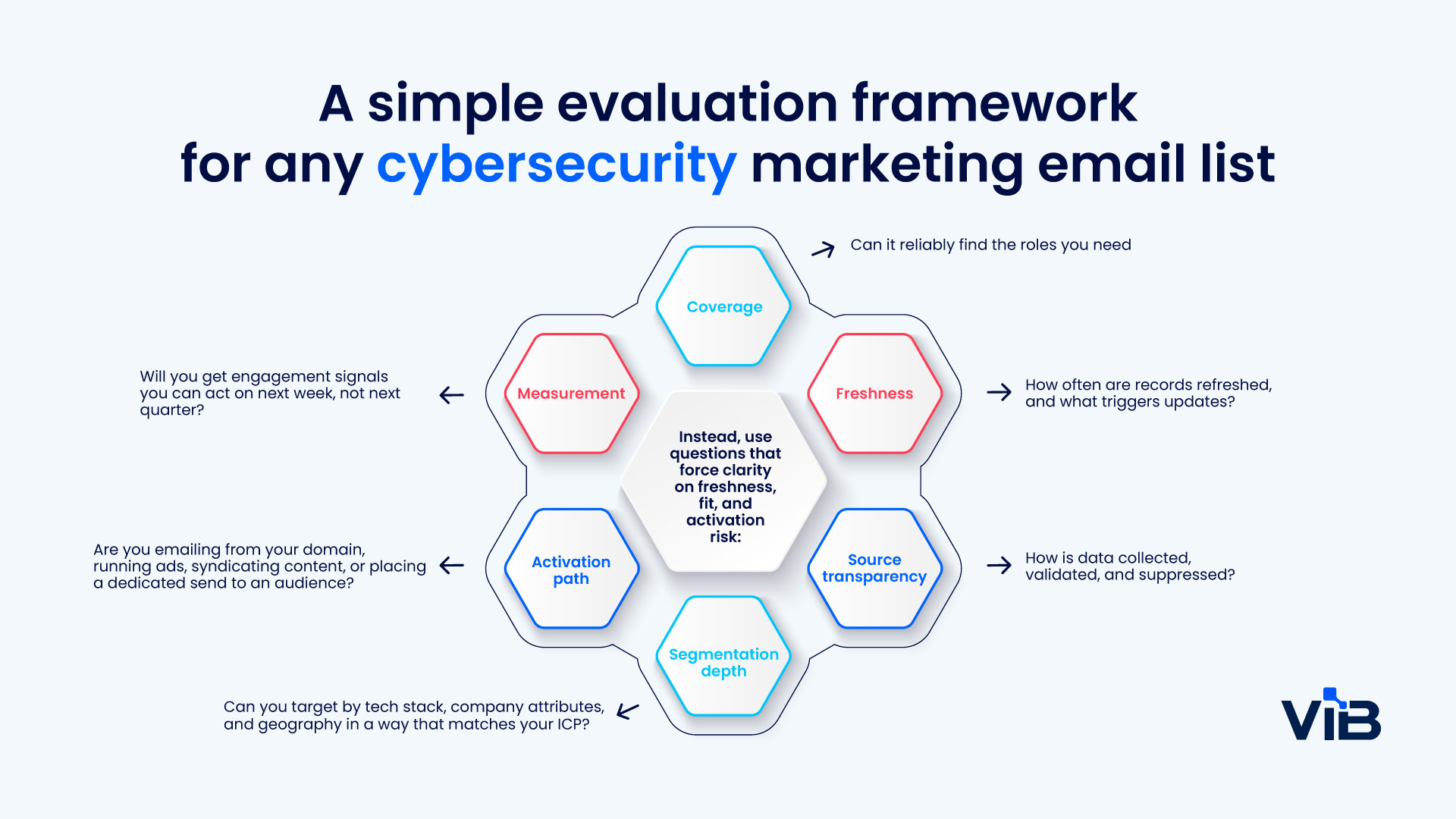
Instead, use questions that force clarity on freshness, fit, and activation risk:
- Coverage: Can it reliably find the roles you need (security leadership, practitioners, adjacent IT, risk/compliance)?
- Freshness: How often are records refreshed, and what triggers updates?
- Source transparency: How is data collected, validated, and suppressed?
- Segmentation depth: Can you target by tech stack, company attributes, and geography in a way that matches your ICP?
- Activation path: Are you emailing from your domain, running ads, syndicating content, or placing a dedicated send to an audience?
- Measurement: Will you get engagement signals you can act on next week, not next quarter?
That last point matters a lot in cybersecurity. If you can’t turn engagement into next-step targeting, you’ll end up buying more lists to compensate, and it rarely fixes the root issue.
Where lists fall short, and what to use instead (when you need earlier signals)
Lists are best when your targeting is stable and your offer is broadly relevant. Cybersecurity rarely behaves that way.
When lists fall short, it’s usually because you’re trying to create demand and qualify fit at the same time, using a single channel.
Alternatives to consider, depending on your constraints:
- Intent-first account selection: Start with research behavior, then align outreach.
- Content-led engagement programs (syndication, newsletters, webinars): Let the offer create segmentation through clicks, registrations, and consumption.
- Borrowed-audience email placements: Reach a curated audience without taking on list hygiene and sending-domain risk.
This is also where many teams rethink what “results” means. If you’re earlier in the journey, the most valuable outputs are usually engagement, topic-level interest, and ICP fit signals you can use to refine targeting and follow-up.
How ViB Emails fits into a cybersecurity marketing email list strategy
ViB Emails is a different approach than buying a CSV and hoping for the best.
It’s an email amplification solution. We send your existing branded email to members of the ViB Community—a millions-strong network of tech decision-makers—based on your targeting criteria. ViB handles deliverability through its own trusted sending domain and process.
Think of ViB Emails as a way to create reach and engagement with a cybersecurity-relevant audience without turning “list management” into your next project.
Common fits include:
- Event promotion when your in-house database is tapped out or too small.
- Content offers where you want new readers from a relevant audience segment.
- ABM support when you want to reach specific account profiles or similar profiles and see who engages.
Conclusion: Pick the cybersecurity marketing email list approach that matches your real constraint
The best cybersecurity marketing email list isn’t necessarily the biggest one. It’s the one that matches your activation plan, your risk tolerance, and how early you’re trying to influence buyers.
If you’re building repeatable outbound and enrichment workflows, databases like Apollo or Cognism can be practical building blocks.
If your bigger issue is timing and relevance, intent-led providers like Informa TechTarget, Bombora, Demandbase, or 6sense can help you prioritize the right accounts and topics.
And if what you really need is targeted reach without inheriting list hygiene and sending-domain complexity, ViB Emails is a great alternative to a traditional list provider.


