 Skip to content


If you’re marketing cybersecurity in 2026, you’ve probably had the same experience: One month, paid social looks workable. The next month, your cost per lead doubles.
Then you zoom out and realize the bigger issue isn’t just lead cost. It’s the cost of getting the right accounts to raise their hand, engage, and show real intent signals.
This post breaks down cybersecurity lead generation cost benchmarks, what you can reasonably expect to pay, and practical strategies to improve ICP fit and engagement without lowering the bar.
What “cybersecurity lead generation cost” really means (and why most teams misread it)
Most teams treat “cybersecurity lead generation cost” as a single number: CPL. That’s a problem because cybersecurity buying journeys are committee-led, proof-heavy, and risk-sensitive.
So your true cost depends on what you count as a lead, what stage it represents, and how much downstream work is needed to turn that interaction into a credible buying signal.
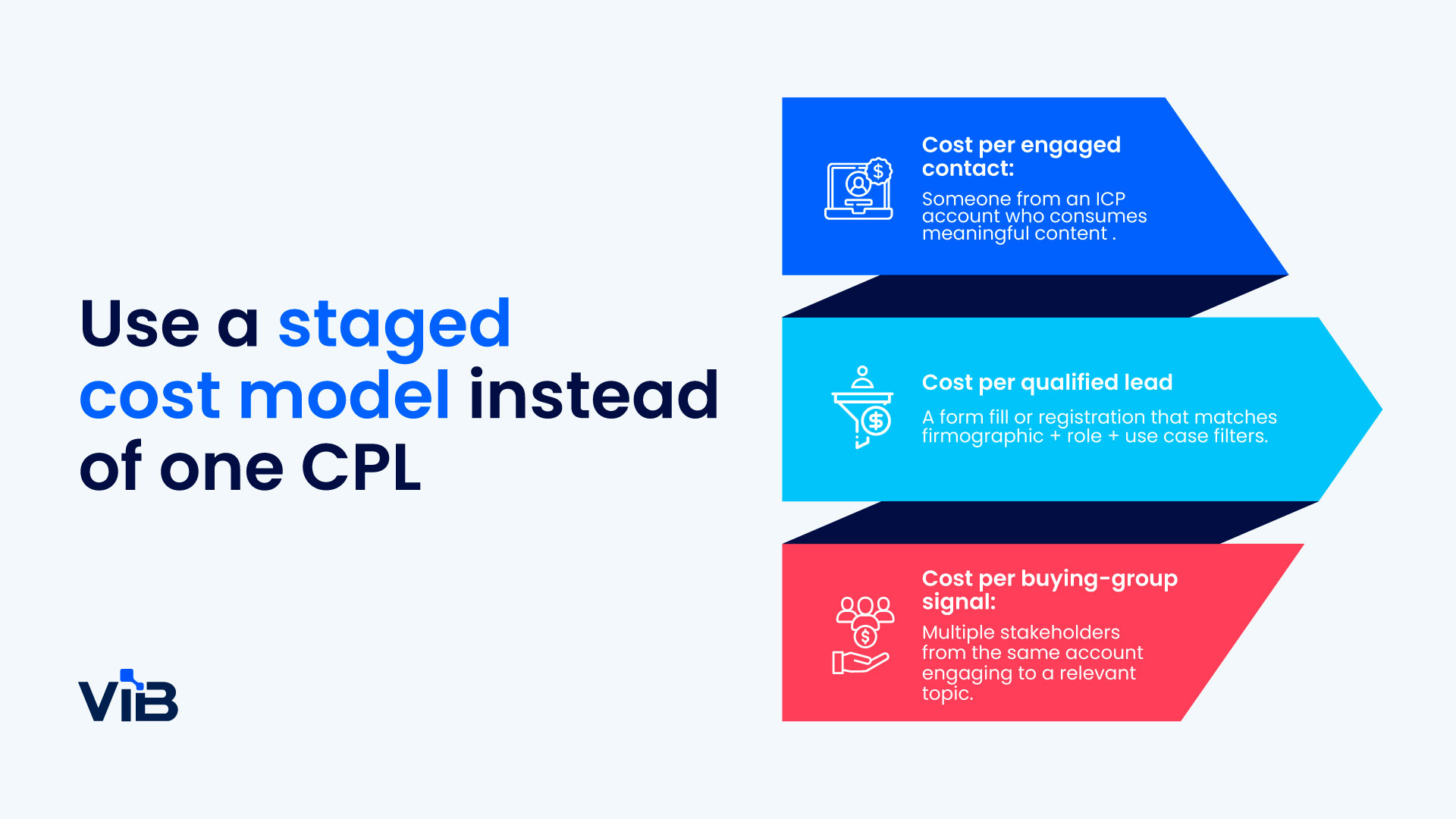
Use a staged cost model instead of one CPL
If you want a cost model that holds up in cybersecurity, break costs into at least three tiers. This is where you’ll spot where spend is leaking.
- Cost per engaged contact: someone from an ICP account who consumes meaningful content (not a bounce or a 10-second view).
- Cost per qualified lead (your definition): a form fill or registration that matches firmographic + role + use case filters.
- Cost per buying-group signal: multiple stakeholders from the same account engaging, or repeat engagement tied to a relevant topic.
Benchmarks: What cybersecurity lead gen costs look like across common channels
You shouldn’t treat benchmarks like targets, but they’re useful as guardrails, especially when leadership asks if your numbers are “normal.”
Here are a few reference points from widely cited industry sources and benchmark roundups. Use them to double-check, then calibrate to your ICP, geos, and offer.
Paid search: high-intent clicks, expensive mistakes
Search is where cybersecurity marketers pay for intent. It’s also where you pay for ambiguity.
For example, Firebrand’s 2024 B2B Google Ads benchmarks list cost per click (CPC) for cybersecurity at $10.44.
That number can be helpful, but it hides the real variance. “MDR,” “EDR,” “SIEM,” “SASE,” “ZTNA,” and “DLP” all behave differently. And competitor conquesting can inflate costs fast without producing the right engagement signals.
LinkedIn: expensive leads, strong control over ICP fit
LinkedIn is often the default for cybersecurity because it gives you job function, seniority, company attributes, and (sometimes) the ability to align with buying roles.
For CPL ranges, Stackmatix lists cybersecurity LinkedIn lead benchmarks broadly in the $90–$200+ territory, depending on setup and offer.
The practical takeaway: LinkedIn can be “high CPL” while still cost-effective for cybersecurity, as long as the leads come from the right accounts and show repeat engagement.
Why you should treat industry CPL tables as directional only
You’ll see benchmark tables claiming a single “average cybersecurity CPL.” Some are useful for a starting point, but many combine very different motions: SMB vs. enterprise, gated assets vs. demo requests, and broad vs account-based targeting.
For example, HubSpot’s CPL benchmark coverage notes a broad average CPL of $84 for B2B across channels, with LinkedIn typically higher than Google.
If you’re running enterprise cybersecurity with strict ICP filters, that cross-industry average won’t map cleanly to your reality. It’s still a useful executive-level reference point when someone expects $25 leads because they saw it in an ecommerce playbook.
How to lower cybersecurity lead generation cost without lowering standards
Lowering security costs is about reducing wasted spend and improving the rate of meaningful engagement from the accounts you care about.
Design your campaign around signals, not just submissions
Stop optimizing only for form submits. Optimize for the behaviors that predict real buying activity.
- Account-level engagement: Repeat visits, multi-asset consumption, return frequency.
- Role alignment: Security leadership vs. adjacent IT roles vs students and consultants.
- Problem alignment: Content consumption tied to your core use cases (for example, “ransomware readiness” vs. “general cybersecurity trends”).
This is also where you can justify higher top-of-funnel CPL when engagement quality is materially better.
Make the offer do the filtering (so the form doesn’t have to)
Examples that tend to reduce junk while improving ICP fit:
- Role-specific briefings (CISO view vs SecOps view) with clear takeaways.
- Evaluation tools (maturity assessments, vendor comparison frameworks) that map to active projects.
- Threat-scenario walkthroughs tied to a realistic environment (industry, stack, and constraints).
Done well, these offers can improve your conversion rate and your downstream engagement rate at the same time. That’s the cleanest path to a healthier cybersecurity lead generation cost.
Tighten search by building “waste controls” first
In paid search, the fastest savings usually come from controlling waste:
- Negative keyword libraries that explicitly block training, jobs, definitions, and research-only intent.
- Match type discipline for high-cost categories, backed by weekly query reviews.
- Landing pages built for one use case, not “everything we do,” so you can measure real fit.
When you do this early, you often see the biggest improvements in cost per qualified lead, even if raw CPL stays flat.
Use LinkedIn formats that trade volume for relevance
If your cybersecurity lead generation cost is spiking on LinkedIn, it’s usually because you’re paying for attention that never turns into credible engagement.
In many B2B programs, lead gen forms can improve conversion rates by reducing friction.
The key is to pair them with assets that pre-qualify. You want the form to be the final step in a short “value proof” sequence, not the first interaction.
Budgeting: How to forecast cybersecurity lead generation cost without fantasy math
Forecasting in cybersecurity gets messy because “a lead” doesn’t behave like a simple funnel step. Your forecast should reflect uncertainty and stage conversion.
Start with a range, then narrow with real inputs
Instead of committing to one CPL target, forecast a band and tie it to assumptions you can validate fast.
- Channel CPL band: Based on your last 2–4 quarters and directional benchmarks.
- Qualification rate: What percent matches your ICP filters?
- Engagement depth rate: What percent show multiple meaningful actions within 14–30 days?
- Account clustering rate: What percent have 2+ stakeholders engaging?
Use “cost per account engaged” as your executive metric
If you only report CPL, you’re setting yourself up for constant channel churn. The moment CPL spikes, the channel gets blamed.
When you report cost per engaged account (or cost per buying-group signal), you can make smarter tradeoffs between volume and fit, which is the real constraint in cybersecurity demand creation.

How to use intent signals to improve budget decisions
Once you accept that cybersecurity lead generation cost is driven by fit and signals, the next question becomes practical: how do you generate enough high-quality engagement signals inside your ICP to guide spend decisions?
This is where an intent-informed planning process can help.
- Use intent signals to prioritize spend: Shift budget toward themes and account segments that are already engaging.
- Align content to real questions: Build briefings and assets around the topics that show repeated attention.
- Improve ICP fit measurement: Score programs on which accounts engage, not just how many people convert.
Conclusion: The real lever behind cybersecurity lead generation cost is signal quality
Cybersecurity lead generation cost is high because attention is expensive, and trust is earned slowly. Benchmarks can help, but they won’t save a program that’s built around the wrong definition of “lead.”
The teams that win treat cost as an outcome of strategy. They build offers that filter, campaigns that optimize for engagement signals, and measurements that reward ICP fit over raw volume.
When you do that, “CPL” stops being a monthly fire drill. It becomes a manageable variable inside a system that produces consistent, high-quality buying signals.


