 Skip to content


If you’re leading marketing for a B2B tech or SaaS company in 2026, you’re probably not short on “channels.” More likely, you’re short on attention, clean measurement, and buyer patience.
McKinsey found that B2B buyers use an average of 10 channels across the journey. That’s not a planning detail. It’s the whole game.
So when it comes down to the best B2B marketing channels, the answer isn’t “LinkedIn and email.” It’s which channels can reliably create the right kind of engagement and buyer signals for your ICP, and how to run them without burning budget or brand trust.
In this list, we’ll focus on what matters now: channel fit, execution patterns, and the real outcomes you can expect (engagement, intent signals, audience growth, and ICP validation).
How to choose the best B2B marketing channels (before you pick any)
Most channel debates fail because teams skip the decision criteria. They pick channels based on what’s trendy, what a peer said worked, or what the sales team wants next week.
In 2025, Gartner reported that digital channels accounted for 61.1% of total marketing spend, and paid online channels were the largest piece of that digital mix. That’s a lot of competition for the same buyer attention.
For practical channel selection, filter every option through four questions:
- Where are buyers doing “rep-free” research? Gartner research shows that 75% of B2B buyers prefer rep-free experiences. That shifts the burden to your content and distribution.
- What signals can the channel produce? Go beyond clicks. Think: topic interest, role fit, account fit, and repeat engagement.
- Can you maintain quality at scale? Many channels work well in small tests but collapse when you ramp up volume.
- Can you measure it without perfect attribution? Silent engagement is real. Your channel plan has to work anyway.
Now, the list.
The list: best B2B marketing channels (ranked by real-world usefulness)
This isn’t a universal ranking. It’s a “most consistently useful” ranking for B2B SaaS teams selling complex products with multi-threaded buying groups.

1) Your website (product pages, solution pages, and comparison pages)
It’s easy to under-invest here because the website feels “done.” But it’s still your highest-control environment, and it often becomes the place buyers use to reconcile everything they’ve heard elsewhere.
McKinsey’s research shows the company website as one of the top touchpoints used across the journey.
Execution that tends to work for experienced teams:
- Build pages for buyer questions, not internal product categories.
- Measure engagement (scroll depth, repeat visits, return time, asset interactions) to create account-level signals.
- Create “proof paths”: security, integration, migration, and ROI narratives that are shareable internally.
2) Email (owned nurture + segmented outbound)
Email keeps earning its spot as a top marketing channel because it’s direct, low-cost to iterate, and highly segmentable. Even as other owned/earned budgets fluctuate, Gartner called out email as a resilient channel in 2025 spend patterns.
But the bar is higher now. If your emails feel generic, buyers opt out mentally long before they unsubscribe.
Use email as a signal engine, not a broadcast engine:
- Segment by “why now” (trigger + role + environment), not by industry alone.
- Use content sequences that map to buying tasks: problem framing, approach options, evaluation criteria, and implementation risk.
- Measure engagement quality: forwards, repeat clicks, site return, content depth, and reply intent.
3) Webinars and virtual events (live + on-demand)
Webinars are still one of the cleanest “high-intent learning” environments you can create. They also generate rich first-party engagement signals if you run them well.
ON24’s 2025 webinar benchmarks reported an average 57% registration-to-attendee conversion and an average 51 minutes of engagement time (based on 2024 data analyzed for the report). That’s serious attention.
Patterns that tend to improve outcomes:
- Teach a decision, not a topic. “How to choose X” beats “What is X.”
- Design for buying groups: include perspectives for security, finance, ops, and the day-to-day owner.
- Set up on-demand and build post-event journeys around the questions asked in-session.
Also, this is a great place for tasteful personality. A well-run webinar with one good poll can outperform a month of ads. 🙂
4) Paid search (high intent capture, not demand creation)
Paid search remains a staple because it captures explicit intent. Gartner’s 2025 spend data highlights search as a leading digital channel by spend share.
What experienced teams do differently:
- Bid on evaluation language (“alternatives,” “reviews,” “A vs. B,” “pricing,” “implementation”) with dedicated landing pages.
- Use search to learn: queries can expose real market framing and competitor adjacency.
- Protect brand search and track impression share by region/segment to spot awareness gaps.
5) LinkedIn (paid + organic, but treated as a distribution system)
LinkedIn is still where many B2B categories get shaped in public. The mistake is treating it as a place to “post content” rather than as a place to distribute specific ideas to specific people.
The execution that holds up:
- Run paid to the job-to-be-done, not the product: “reduce audit time,” “speed up onboarding,” “cut false positives,” etc.
- Use retargeting lightly and refresh creative often. Frequency fatigue is real.
- Use organic for validation: which pains get saved, shared, and DMed internally?
And yes, you can get engagement without impact. Treat “likes” as a directional signal, not a KPI. 👍
6) Partner and ecosystem marketing (integrations, co-marketing, marketplaces)
If you’re in B2B SaaS, your product rarely stands alone. Ecosystems influence trust by reducing perceived risk.
What to prioritize:
- Integration pages that rank and show real workflows.
- Co-webinars with strong role fit (not just “partner logos”).
- Partner-sourced signal sharing: what’s being asked in their sales cycles that touches your category?
7) Content syndication (when you need reach beyond your owned audience)
Content syndication is not a magic distribution button. It’s a way to reach the right professionals where they already spend time, using content as the value exchange.
It works best when you treat it as market education + signal generation, not as a shortcut to revenue reporting.
How to make it work without burning your sales team:
- Syndicate assets that create a point of view: benchmarks, teardown guides, “how to evaluate,” and strong category explainers.
- Qualify for ICP fit based on role, company size, and environment, where appropriate.
- Plan the follow-up before you launch: what does a 2-week nurture look like for this topic?
8) Podcasts (great for trust, harder for measurement)
Podcasts can be a durable channel for awareness and trust, especially in technical categories. The tradeoff is measurement complexity.
A 2025 Advertiser Perceptions study highlights strong interest and usage in podcast advertising. But measurement is still a recurring constraint across the industry.
Make podcasts work by narrowing the goal:
- Use podcasts to own a problem space with a consistent POV.
- Repurpose aggressively into short clips for LinkedIn, email, and your site.
- Track “brand search lift” and direct traffic patterns rather than expecting clean last-touch attribution.
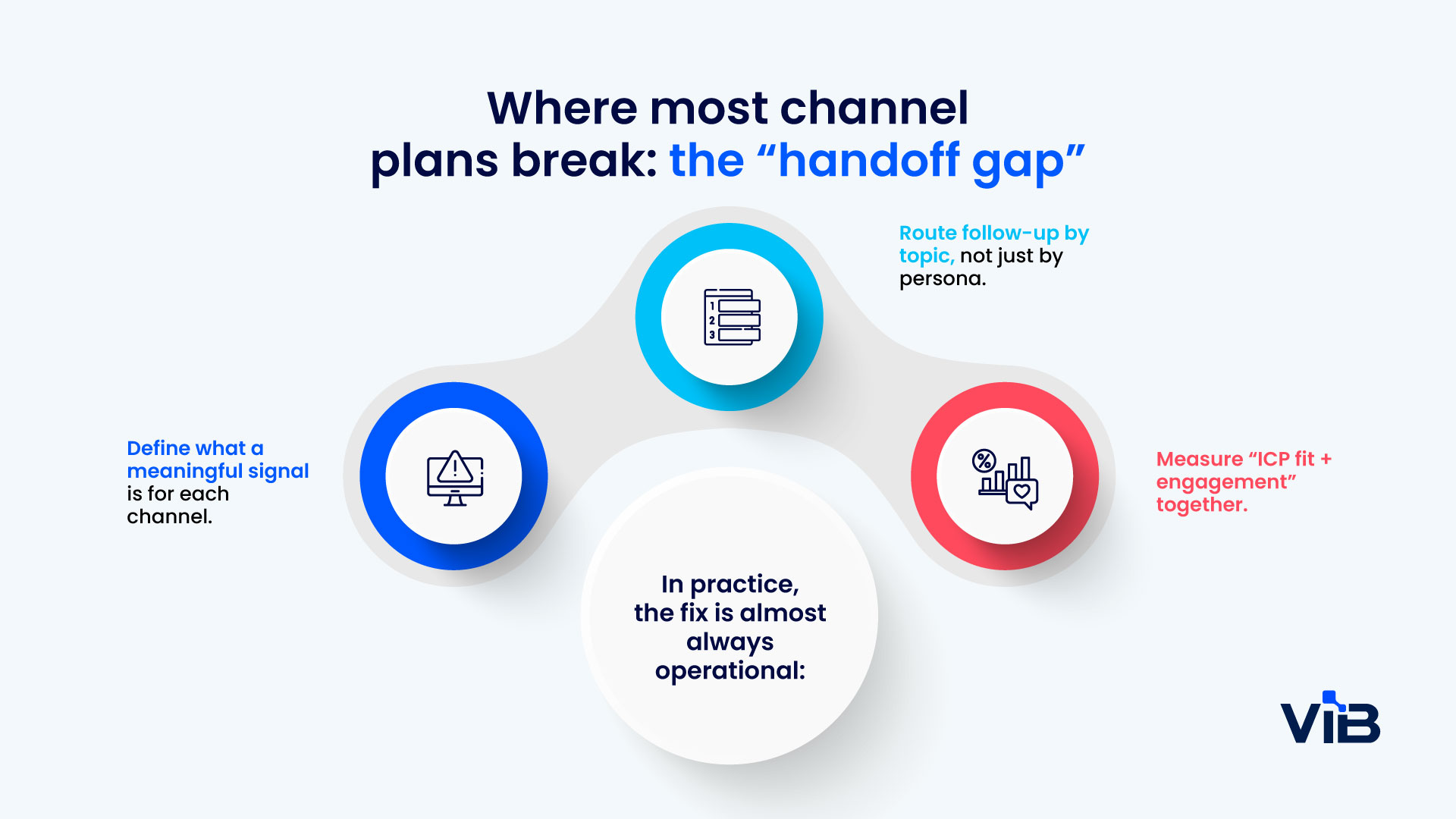
Where most channel plans break: the “handoff gap”
Even strong channel choices fail when there’s a gap between engagement and next steps. That’s where you see the same pattern: marketing generates activity, sales sees “no traction,” and the budget shifts again.
In practice, the fix is almost always operational:
- Define what a meaningful signal is for each channel (not a single global threshold).
- Route follow-up by topic, not just by persona. The topic predicts the next question.
- Measure “ICP fit + engagement” together. Either one alone will mislead you.
This is also where the best B2B marketing channels start to look similar. The winners are the ones you can connect into a coherent journey.
The channel mix most teams should test in 2026 (if they’re serious)
If you’re rebuilding your plan, start with a mix that covers: capture, education, and scalable distribution.
A practical “test mix” looks like this:
- Capture: paid search + high-intent website pages
- Educate: webinars + targeted email sequences
- Distribute: LinkedIn + content syndication (for reach beyond your audience)
That mix won’t solve everything. But it gives you repeatable ways to generate engagement and detect account-level interest.
How ViB fits
If you already have solid positioning and content, the next limiter is usually distribution to the right accounts and roles. That’s where a partner can help, especially when you need scale without sacrificing ICP fit.
ViB focuses on reaching the right tech buyers, driving content engagement, and capturing useful intent signals earlier in the journey.
- ViB Syndication: Useful when you have strong assets but limited reach. It helps put your content in front of relevant tech professionals and generate measurable content engagement and topic-level interest. Add it when organic distribution and paid social are getting expensive or saturated.
- ViB Emails: Useful when you need to amplify a message, offer, or event to new accounts with tighter targeting. It’s a way to drive focused engagement and identify who’s leaning in, without relying on broad, low-context blasts.
- ViB Webinars: Useful when you want webinar-level engagement from the right tech roles and accounts—especially if your in-house list is limited. It can help amplify registration, drive live/on-demand attendance, and capture topic-level intent signals you can route into follow-up.
The practical way to use these is simple: pick one priority topic, one priority segment, and one “next-step” content path. Then measure engagement quality and ICP fit together for 30–45 days.
Conclusion: The best B2B marketing channels are the ones you can connect
The best B2B marketing channels aren’t the flashiest ones. They’re the ones that consistently help you reach the right people, earn attention with useful content, and generate clear signals you can act on.
If you keep your channel plan grounded in buyer behavior (multi-touch, rep-free research, messy buying groups) and you operationalize follow-up around signals, you’ll make smarter bets—and you’ll be able to scale what works.


