 Skip to content


If you are searching for the best B2B email lists for companies in 2026, you are probably not looking for more volume. You are looking for lists that actually perform.
Email is still one of the most reliable B2B channels, but there are some things to look out for this year. Buyers are more selective. Engagement is harder to earn. And outdated lists can do more damage than good.
This article breaks down what “best” really means in 2026, why most B2B email lists underperform, and how experienced marketers are rethinking list quality, sourcing, and usage to drive real results, not just sends. 📩
What makes a B2B email list “the best” in 2026?
In 2026, the best B2B email lists are not the biggest or the cheapest. They are the most relevant, permissioned, and aligned to buying reality.
A strong list today does three things well:
- It reaches the right roles inside the right companies
- It respects buyer consent and expectations
- It supports timing, not just reach
If a list fails on any of those points, performance drops fast.
Why do most B2B email lists stop working?
Many email campaigns struggle because the list itself is the weakest link. B2B data decays quickly. Job changes, role shifts, and inbox abandonment happen constantly. Industry research consistently shows that a typical B2B email list can decay by 20 to 30 percent per year.
That means even lists that were “good” twelve months ago may now be working against you.
Decay shows up as:
- Rising bounce rates
- Flat or declining open rates
- Fewer replies, even when content is strong
At that point, no subject line fix will save your email’s performance.
Buyers tuning out generic outreach
Buyers are more protective of their inboxes than ever. Gartner research shows that many B2B buyers actively avoid vendors that send irrelevant or repetitive outreach.
If your list includes people who did not opt in, or who have no current interest in your category, engagement will drop regardless of how polished your message is.
What types of B2B email lists are companies using today?
Not all B2B email lists are created equal. Understanding the main categories helps clarify where performance comes from:
1) First-party lists still the gold standard
First-party lists include contacts who have opted in directly to hear from your company.
These lists typically perform best because:
- Consent is clear
- Brand recognition exists
- Engagement history provides context
The challenge is scale. First-party lists grow slowly, especially in long B2B buying cycles.
2) Are rented or purchased lists worth the risk?
Traditional rented or purchased lists promise reach, but they come with tradeoffs.
Common issues include:
- Questionable consent
- Low relevance to your ICP
- Higher risk to sender reputation
In 2026, these lists rarely qualify as “best” unless used with extreme care and narrow targeting.
3) Community-based lists are gaining traction
One of the fastest-growing alternatives is community-based or publisher-owned lists.
These lists are built from professionals who have explicitly opted in to receive content, insights, or opportunities through a trusted platform.
When done right, they offer:
- Clear consent
- Better role and firmographic accuracy
- Higher baseline engagement
This model is becoming increasingly attractive as inbox trust declines.
How should companies evaluate the best B2B email lists?

Instead of asking how many contacts you get, experienced teams ask better questions:
Is consent explicit and recent?
Consent should be clear, current, and tied to real expectations.
Ask:
- Did contacts opt in to receive third-party messages?
- When was consent captured?
- Can recipients reasonably expect to hear from brands like yours?
Without this, performance and compliance both suffer.
Does the list reflect buying committees, not just titles?
Modern B2B purchases involve multiple stakeholders.
The best lists include:
- Decision-makers
- Influencers
- Technical evaluators
- Budget owners
If your list only targets one role, deals slow later in the cycle.
Is the list refreshed and validated?
Static lists age quickly.
High-performing programs rely on lists that are:
- Regularly refreshed
- Actively validated
- Cleaned for bounces and inactivity
This protects deliverability and keeps engagement signals meaningful.
How does intent factor into the best B2B email lists?
Relevance alone is not enough. Timing matters.
Many lists fail because they include people who match your ICP, but are not actively buying.
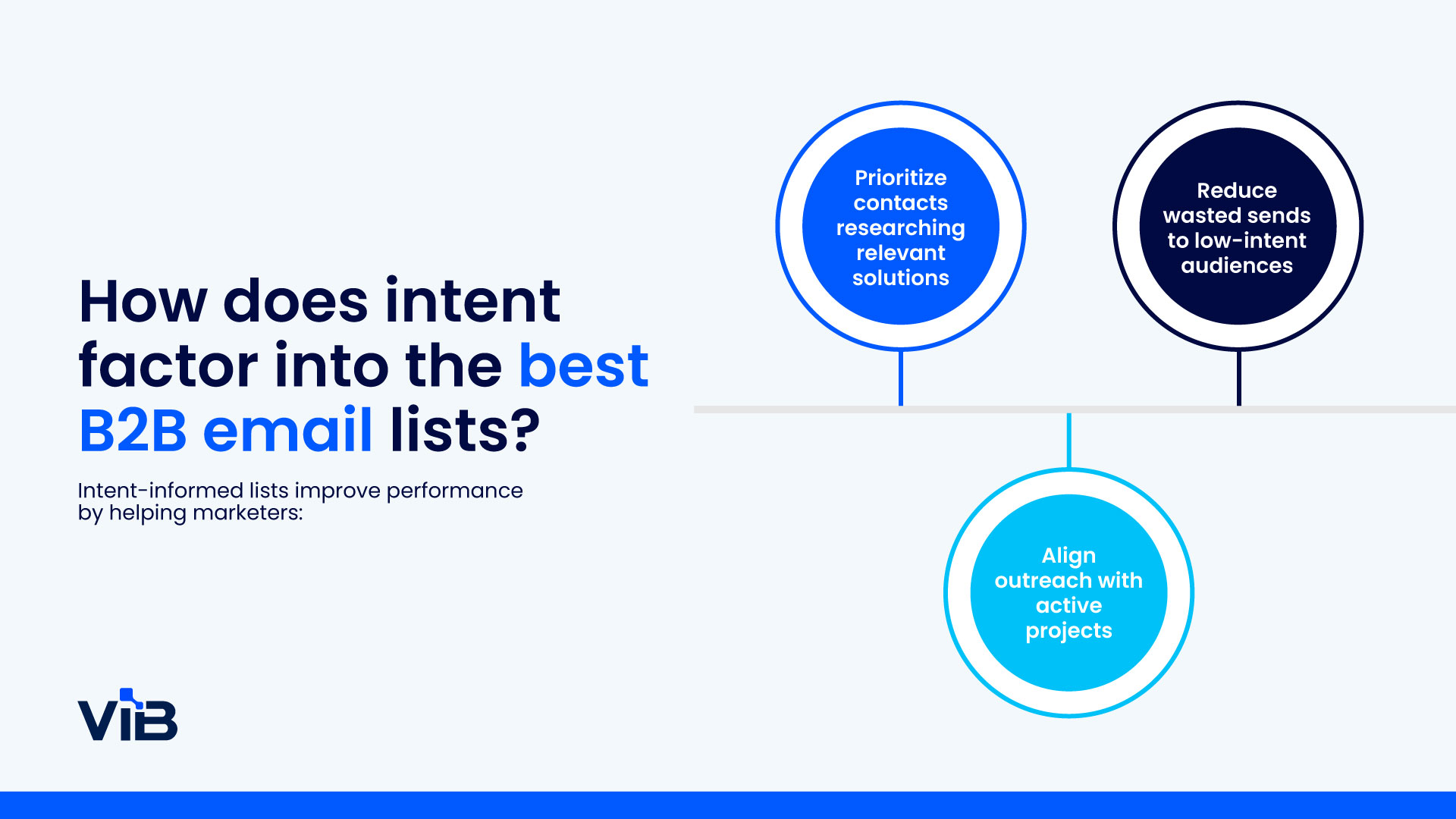
Intent-informed lists improve performance by helping marketers:
- Prioritize contacts researching relevant solutions
- Align outreach with active projects
- Reduce wasted sends to low-intent audiences
This shift from broad targeting to contextual timing is one of the biggest differences between average and top-performing email programs in 2026.
What are realistic performance benchmarks in 2026?
While benchmarks vary by industry, experienced teams watch trends more than absolutes.
Healthy B2B email lists typically show:
- Bounce rates under 2 percent
- Stable or improving open rates
- Engagement that correlates with downstream actions, not just clicks
When metrics slip, it is often a list issue, not a messaging issue.
How should B2B teams use email lists strategically?
The best lists still fail if used poorly. Strategy matters more than list size, because email performance is shaped by how, when, and why messages are sent, not just who receives them.
Are you sending fewer, better messages?
High-performing teams have reduced volume while improving relevance.
Instead of weekly blasts, they focus on:
- Clear value per send
- One primary call to action
- Messages aligned to buyer stage
This protects list health and long-term engagement.
Are you aligning email with other channels?
Email works best when paired with other touchpoints.
Strong demand programs coordinate email with:
- Content syndication
- Webinars and events
- Sales follow-up
This creates consistency without overwhelming buyers.
Where do the best B2B email lists for companies in 2026 come from?
The most effective lists share three traits:
- Permission-based access
- Clear audience definition
- Ongoing engagement signals
Many teams now favor platforms that maintain their own opt-in professional communities, rather than relying solely on static databases.
This approach balances scale with trust.
How ViB fits into a modern B2B email strategy
As email strategies mature, many teams face the same challenge: how to expand reach and improve timing without sacrificing list quality or buyer trust.
How ViB Emails helps you expand your reach effectively
ViB Emails helps teams extend their reach beyond their own database by sending campaigns to opted-in B2B professionals through the ViB Community.
That makes ViB Emails especially effective when teams need to:
- Supplement low inbound volume with fresh, targeted leads
- Promote events, webinars, or virtual experiences to qualified new audiences
- Distribute content assets beyond organic search and owned lists
- Support ABM efforts by reaching contacts inside high-value accounts
Because emails are sent from a trusted community domain, teams avoid many of the deliverability, decay, and reputation issues that come with purchased lists or cold outreach.
Where intent signals can add another layer is timing
When sourced transparently and used responsibly, declared or behavioral intent signals can provide additional context about whether an account may be moving closer to an active evaluation.
These signals can help teams:
- Prioritize follow-up for contacts showing relevant, recent engagement
- Personalize messaging using observed or permission-based context
- Adjust nurture programs based on different levels of apparent readiness
- Enter conversations with useful context while still validating qualification
Combined with ViB Emails, first-party engagement data and trusted external intent sources can help B2B marketers move from broad email distribution to more precise, consent-based, intent-informed engagement. Intent should remain a prioritization input rather than definitive proof that a buyer is ready to purchase.
Final thoughts on choosing the best B2B email lists in 2026
The best B2B email lists for companies in 2026 are not shortcuts. They are strategic assets.
They prioritize consent over convenience, relevance over volume, and timing over frequency. When lists are built and used with those principles in mind, email remains one of the most effective channels in B2B marketing.
For experienced teams, the goal is not to send more email. It is to reach the right buyers, with the right message, at the right moment, and to do it consistently. 🧠


