 Skip to content


If you’re searching for the best B2B contact database, you’re probably past the “we need more leads” phase.
You’re trying to solve a tougher set of problems: shaky deliverability, inconsistent enrichment, mismatched ICP targeting, and handoff friction between marketing ops, demand gen, and sales. And you need a system that holds up under real volume.
The hard truth is that no database “wins” in every segment, region, and motion. The best choice depends on your market, your channels, and how you operationalize data into engagement and buying signals—not just how many records a vendor claims.
Search intent check: what “best B2B contact database” really means in 2026
Most marketers aren’t looking for the largest database. They want the least painful path to reliable targeting and activation.
In practice, the best B2B contact database is the one that helps you do three things consistently:
- Reach the right accounts (ICP match with usable firmographic/technographic depth)
- Reach the right people (role accuracy, seniority, department, buying committee coverage)
- Reach them safely (deliverability, compliance posture, and proofable sourcing)
Why B2B contact data fails in the real world (even when the tool looks great in a demo)
1) Accuracy isn’t one thing
Most teams evaluate accuracy as “does the email bounce?” That’s necessary, but it’s not sufficient.
For experienced B2B marketers, accuracy breaks into at least five practical layers:
- Identity accuracy: Is the person real and currently employed there?
- Role accuracy: Is the title current and meaningful (not inflated, not generic)?
- Seniority accuracy: Can you isolate decision-makers vs. users vs influencers?
- Channel accuracy: email validity, phone validity, LinkedIn match rate.
- Context accuracy: account attributes such as employee count banding, HQ vs. regional office, tech stack signals, etc.
This is why a database can look fine for SDR emailing, but fail for ABM segmentation, routing, or personalization.
2) Deliverability punishes bad data faster than it used to
Even a small increase in invalid addresses can create compounding issues: higher bounces, more spam placement, and fewer future touches landing where you need them.
In 2025 deliverability reporting, DMARC adoption and enforcement remained low across domains (only 18.2% with valid DMARC, and 7.6% enforcing), and list verification was still uncommon (23.6% verifying lists before campaigns). As a result, email providers saw an average decline in inbox placement of 13.9% year over year.
So when you’re evaluating the best B2B contact database, you’re also evaluating whether it helps you reduce risk in outbound and lifecycle email, not just increase volume.
3) Compliance has moved from “legal review” to “ops design”
In regulated markets, the database isn’t just a vendor. It becomes part of your processing chain.
In the U.S., you’re navigating a patchwork (state privacy laws, sector rules, and platform policies) where teams still need a clear purpose, defensible sourcing, and reliable opt-out/suppression. With more states adopting privacy statutes and enforcement activity increasing, the bar keeps rising on how teams document notice, honor consumer rights, and keep outreach aligned to what they can justify operationally.
This impacts more than privacy policy language. It affects what you collect, how long you keep it, how you handle opt-outs, and which activation tactics you can defend.

The evaluation framework: how to choose the best B2B contact database for your motion
Instead of comparing vendors feature by feature, evaluate them against how you actually run go-to-market. Here’s a practical framework that works well for experienced teams.
Start with ICP fit, then design for coverage gaps
The highest hidden cost in contact data is false precision: you can build an audience that appears narrowly targeted but misses a massive percentage of the people you need to influence.
Define your ICP in operational terms (the fields you can actually query), then test coverage across:
- Company size bands that match your pricing model
- Geography (especially EMEA vs NA differences)
- Department coverage (IT, security, finance, product, RevOps, etc.)
- Seniority distribution (Director+ vs Manager-heavy)
- Buying committee adjacency (champions + approvers)
You’re not looking for “perfect.” You’re looking for predictable gaps you can solve with enrichment, community sourcing, events, and first-party capture.
Decide: database vs. enrichment layer (or both)
Some tools behave like searchable databases for outbound list-building. Others are enrichment layers that improve what you already have.
If your growth model leans on inbound, product-led, partners, or community, enrichment can outperform “cold list building” because it improves segmentation and personalization on contacts you’ve already earned.
Require proof through a controlled data bake-off
Demos don’t reveal staleness. Bake-offs do.
Run a structured test across 300–1,000 contacts per vendor pulled from the same ICP slice. Measure:
- Email validity: bounce rate after verification + after send
- Title freshness: percent of roles updated in the last 90 days
- Match rate: percent of accounts matched to your CRM account list
- EMEA handling: opt-out flags, consent signals, suppression behavior
- Deduplication friction: how many collisions with existing contacts
Also measure time-to-activate. If it takes two weeks of ops work to make the data usable, that’s part of the “best” equation.
Score the vendor on “signal generation,” not just contact volume
Experienced marketers win by creating engagement and capturing signals early, then escalating only when fit and interest are clear.
So, evaluate whether the platform supports signal-rich workflows like:
- Job change and hiring triggers
- Topic engagement (content consumed, webinar attendance)
- Account-level surges (intent-like patterns)
- Community participation signals
- First-party capture loops (forms, event registrations, preference centers)
This matters because the “best B2B contact database” in 2026 is increasingly the “best system to create ICP-qualified engagement.”
Practical use cases: how top teams use a best-in-class contact database without burning reputation
Use case 1: ABM audience building that doesn’t collapse under duplicates
When ABM underperforms, it’s often because audiences were built from inconsistent account definitions and partial buying committees.
Fix it by designing a two-step audience:
- Step A (accounts): freeze a target account list with clear inclusion logic.
- Step B (contacts): build “role clusters” per account (economic buyer, technical evaluator, champion, procurement).
Then use your database to fill role clusters with coverage targets (for example, 4–8 contacts per account) rather than “as many as possible.” This helps control frequency and reduces noisy outreach. 👍
Use case 2: Intent-like activation without over-claiming “intent”
“Intent” is messy. Some vendors provide third-party topic surges. Others provide signals such as web engagement, event attendance, or research consumption.
Operationally, the highest-performing teams treat intent as prioritization, not prediction. That keeps your messaging grounded and your measurement honest.
Even some mainstream platforms position “signals” and “buying triggers” as core differentiators, which is a helpful way to think about the category.
Use case 3: Region-aware plays (especially when EMEA is involved)
If you sell in both North America and Europe, you already know that one database rarely performs equally well in both regions.
Some providers emphasize EMEA strength and GDPR posture as differentiators, including features such as phone-verified “direct dials” and compliance workflows.
The advanced move isn’t “pick one tool.” It’s to set region-specific sourcing rules, suppression logic, and channel mix. That’s how you protect deliverability and brand trust while still hitting coverage targets.
A quick note on vendor lists
You’ll see plenty of “top databases” articles naming the usual suspects (ZoomInfo, Apollo, Cognism, Seamless.ai, Clearbit, and others). Many of those lists are useful for building a shortlist, but they don’t reflect your data reality.
They also vary widely in claims and methodology. Treat any accuracy percentages as hypotheses until your bake-off proves them in your ICP, your regions, and your activation channels.
If you want a reality check, you can also scan peer discussions. You’ll often see marketers mentioning quality shifts over time and the need to diversify sources, especially when bounce rates creep up.
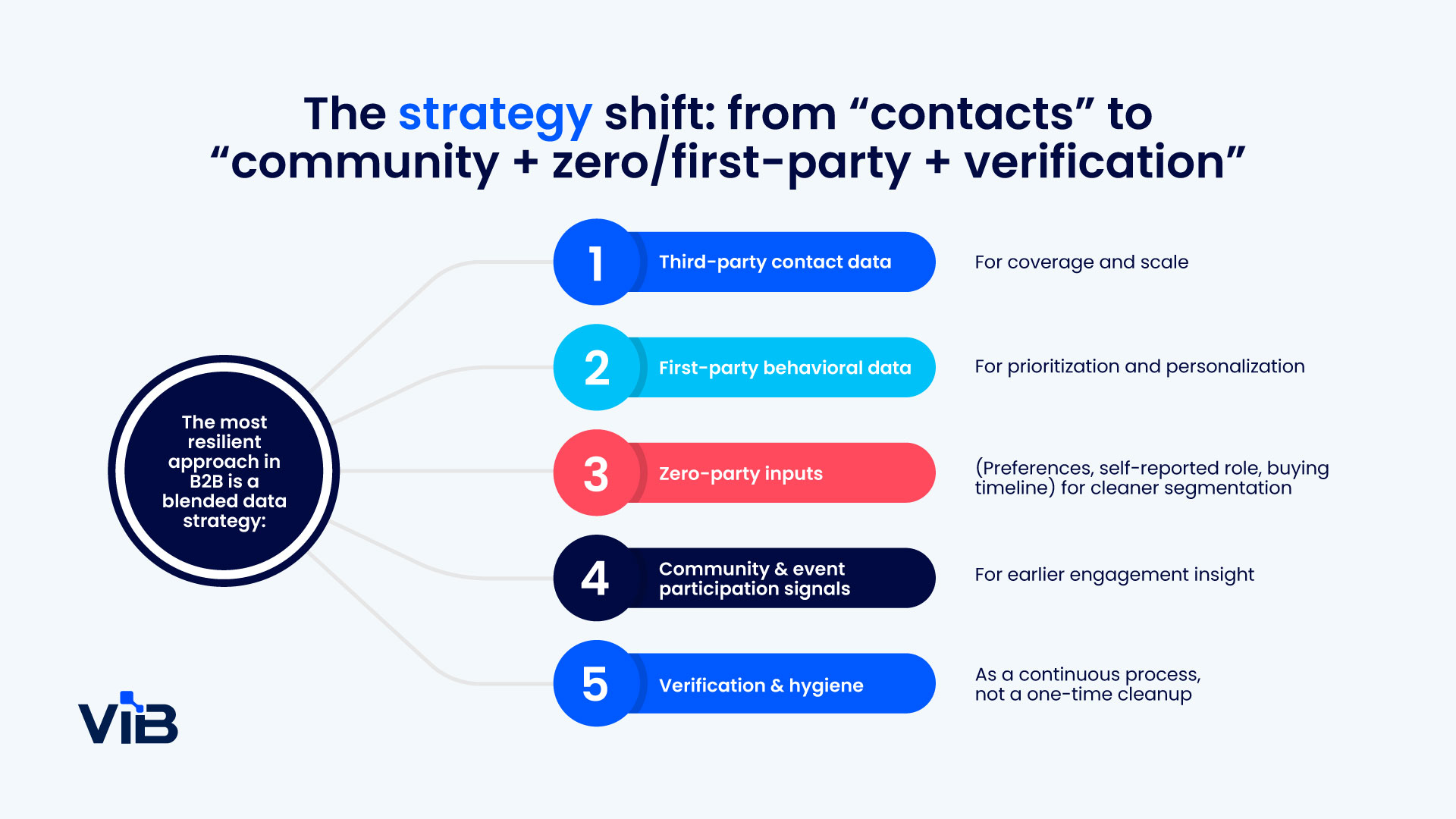
The strategy shift: from “contacts” to “community + zero/first-party + verification”
The most resilient approach in B2B is a blended data strategy:
- Third-party contact data for coverage and scale
- First-party behavioral data for prioritization and personalization
- Zero-party inputs (preferences, self-reported role, buying timeline) for cleaner segmentation
- Community and event participation signals for earlier engagement insight
- Verification and hygiene as a continuous process, not a one-time cleanup
This is how you get value from the best B2B contact database without making it your single point of failure.
It also makes your measurement sharper. Instead of asking “how many contacts did we buy?”, you can ask “how many ICP-matched accounts showed meaningful engagement signals this month?”
Where ViB fits
At some point, most teams hit the limit of what a standalone contact database can do. You can buy more records, but you can’t buy relevance.
This is where ViB fits naturally:
- ViB Emails: activate segmented audiences based on topics and engagement, not just list pulls.
- ViB Webinars: generate high-signal attendance and content engagement, then feed that back into prioritization.
- ViB Appointments: support structured conversations when engagement signals justify it
- ViB Syndication: expand reach while keeping targeting tied to ICP definitions and engagement measurement.
The key is positioning: ViB helps you increase signal density around the contacts and accounts you care about, so your downstream motions are more precise. ✅
Conclusion: define “best” by activation, not acquisition
The best B2B contact database isn’t the one with the loudest claims or the biggest number on a pricing page.
It’s the one that fits your ICP, performs well in your regions, integrates into your workflows, and supports high-quality engagement without compromising deliverability or your compliance posture.
If you treat contact data as just one input—alongside community signals, zero- and first-party data, and continuous verification—you’ll get more consistent performance and clearer prioritization. And you’ll spend a lot less time arguing about whose list is “right.”


