 Skip to content


If you’re searching for a B2B SaaS lead provider, you’re probably trying to solve a few specific problems: inconsistent ICP match, weak buying signals, duplicated records, long lead times, and/or “intent” that doesn’t hold up once you actually activate it.
This guide is built for experienced B2B SaaS marketers who want to compare credible providers side by side. It’s not a vendor brochure. It’s a practical shortlist, with real tradeoffs and the questions that matter when you’re the one on the hook for performance.
How to evaluate a B2B SaaS lead provider (without getting stuck in feature demos)
Most “lead provider” comparisons mix very different categories: contact databases, intent platforms, content syndication networks, and ABM suites. They can all support growth, but they produce different outputs.
Before you compare vendors, get clear on what you’re actually buying.
Start with the output you need: contacts, engagement, or buying signals
Here’s a simple way to classify what most B2B SaaS teams buy:
- Contact data (who): names, roles, verified emails, phone numbers, firmographics, technographics.
- Intent signals (when/what): account- or person-level research behavior and topic spikes that suggest interest.
- Content-based leads (engagement): opted-in people who engaged with a specific asset, message, or offer.
The right B2B SaaS lead provider depends on which gap is hurting you most. If your data is stale, intent won’t save you. If your ICP definition is loose, any vendor will look “bad.”

Use two filters that cut through the noise
These two questions will eliminate most bad fits fast:
- How does the vendor source and verify the data? “Big database” is not a sourcing answer.
- What’s the activation path? Can you route outputs into your MAP/CRM, ad platforms, and ABM workflows quickly?
Top B2B SaaS lead provider options (with pros and cons)
Below are the providers that most often show up in serious B2B SaaS vendor shortlists. They’re grouped by what they’re best known for, but many span categories.
1) ZoomInfo (contact data + enrichment, broad coverage)
ZoomInfo is a good option for teams that need scale: a large contact database, enrichment, and workflow integrations. The platform offers access to 500M+ professional profiles and 100M+ companies.
Best for: Teams that need broad U.S. coverage, standardized firmographics/technographics, and a default “system of record” for prospect data.
Pros
- Strong breadth of contacts and company records (useful when you can’t afford gaps).
- Works well as a foundational dataset for segmentation, territory work, and enrichment.
- Commonly integrated across GTM stacks, which reduces ops friction.
Cons
- “Database size” can be misleading; accuracy and freshness vary by ICP, region, and seniority.
- Cost can be material at scale, especially when multiple teams need seats and exports.
- Still requires list QA processes (deliverability checks, dedupe rules, and recency filters).
2) Apollo (prospecting + outreach workflows, cost-efficient volume)
Apollo positions itself as an all-in-one prospecting and engagement tool. It’s often chosen when teams want contact data and built-in outreach sequences in a single platform.
Best for: Lean teams that need volume prospecting, quick list building, and tight outbound workflows without stitching together too many tools.
Pros
- Unified workflow: find contacts, build lists, run sequences, and sync activity.
- Good fit for mid-market budgets and teams running high-cadence outbound.
- Fast time-to-value for testing new segments and messaging.
Cons
- Data quality can vary more outside core markets and niche ICP slices (plan on verification).
- If you already have a mature outreach/SEP stack, overlap can create redundancy.
3) LinkedIn Sales Navigator (role and org accuracy, list-building)
LinkedIn Sales Navigator isn’t a traditional B2B SaaS lead provider in the “here are emails and phone numbers” sense. But it’s still one of the most reliable sources for current role and company mapping, especially for niche functions and fast-changing orgs.
Best for: Building precise account and persona lists, validating job changes, and supporting ABM list hygiene.
Pros
- Strong for role accuracy and org context (often the ground truth you cross-check against).
- Excellent for building named account lists and buying group hypotheses.
- Pairs well with enrichment providers to append email and phone numbers.
Cons
- Not designed to be your primary exportable contact database.
- Activation typically requires an additional enrichment or outbound tool.
4) Bombora (account-level intent data via Company Surge)
Bombora is one of the best-known intent data providers, with “Company Surge” intent signals based on its data cooperative. Bombora states that it captures behavior from 4.9 million unique domains and 16.6 billion interactions per month across 5,000+ sites.
Best for: ABM teams that want to prioritize accounts showing topic interest and trigger coordinated plays (ads + SDR + nurture) around those topics.
Pros
- Clear story on data sourcing and scale, which helps with stakeholder trust.
- Useful for account prioritization, segmenting by topic interest, and refreshing target account lists.
- Strong ecosystem of integrations and partners.
Cons
- Account-level intent still needs to be translated into buying groups and message-market fit.
- Signal strength varies by category, keyword strategy, and how noisy your market is.
5) Demandbase (ABM platform + intent and account intelligence)
Demandbase is a full ABM platform that includes intent. Their own documentation is refreshingly direct: intent is probabilistic, it uses AI/ML to detect spikes and trends, and it can include up to 13 months of historical intent data depending on availability.
Best for: Mature ABM programs that want orchestration: targeting, measurement, and activation across channels from a centralized account layer.
Pros
- Strong fit for account-centric teams that want a single operating layer for ABM.
- Helpful historical lookback for understanding account interest patterns.
- Intent + ICP modeling can support better audience building and personalization.
Cons
- More platform than “provider,” which can mean longer implementation and more governance.
- Without clean ICP inputs and strong activation plays, teams can end up debating scores instead of acting.
6) 6sense (ABM + intent-driven orchestration)
6sense is another enterprise ABM platform that includes intent modeling and orchestration. In its platform description, 6sense identifies buying signals from keywords and topics.
Best for: Teams that want account identification, stage modeling, and cross-channel activation in one place.
Pros
- Designed for account-based execution, not just reporting.
- Strong at coordinating ads, SDR outreach, and account journeys around shared signals.
Cons
- Requires internal alignment on definitions and stages to avoid “score skepticism.”
- Like other ABM suites, value depends heavily on activation maturity.
7) Informa TechTarget Priority Engine (first-party research intent for B2B tech)
TechTarget’s Priority Engine is widely used in B2B tech for intent based on observed content research behavior. TechTarget positions its “Account Intent Feeds” as powered by first-party, buy-cycle content research and built to identify accounts researching in-market topics weekly.
Best for: Enterprise B2B tech companies where category research behavior is a strong leading indicator and where sellers benefit from topic-level context.
Pros
- Strong alignment to B2B tech buying research signals, with topic granularity.
- Weekly account activity and attributes can support prioritization workflows.
- Integrations into common GTM systems are part of the product story.
Cons
- Not a direct replacement for contact databases; you’ll still need contact capture and buying group mapping.
- Best results tend to come when you have clear segments and messaging aligned to topics.
8) NetLine (content syndication and lead generation network)
NetLine is a major name in content syndication. NetLine states it reaches 125M unique monthly visitors, generates 700K first-party leads per month, and operates across 15K web and publisher properties (with extensive audience filters).
Best for: Teams with strong mid-funnel assets who want to scale content distribution beyond their owned channels and capture net-new opt-ins.
Pros
- Good when you have multiple assets and want to learn which topics and personas resonate most.
- A strong fit for always-on content programs that require consistent output.
- Offers broad network reach and clear scalability for expanding audience exposure.
Cons
- Lead quality depends on asset-topic fit, gating strategy, and how tightly you control targeting.
- You need a solid nurture and routing model, or you’ll treat engaged readers like ready buyers.
9) ViB (Emails and Syndication)
ViB is a B2B SaaS lead provider for marketers who want earlier, measurable engagement from a targeted community of opted-in technology professionals.
ViB’s model is based on its millions-strong, opt-in community of tech professionals, and its programs are designed to target, amplify, and deliver leads tied to fit and engagement.
ViB Emails: amplify one message to a targeted tech audience
ViB Emails is built for times when you already have a message or offer that works, but your database reach is the constraint. ViB will send your email to targeted members of its opt-in tech community, based on your criteria.
Best fit: product launches, event promotion, and campaigns that need a fast, targeted awareness lift with clear audience constraints.
ViB Syndication: content downloads from ICP-matched community members
ViB Syndication promotes an asset to community members who match your ICP, with a qualified download guarantee.
Best fit: When you want engagement you can actually route: asset-level interest paired with persona and firmographic constraints. It also gives your nurture programs better raw material than “cold list + generic sequence.”
A separate consideration: permission-based declared intent
Declared intent data from specialized providers can complement email and content syndication by adding prospect-provided context such as project timing, business priorities, and stakeholder roles.
Best fit: Programs where broad topic intent is too vague and the team needs additional context for account prioritization. Evaluate these providers based on transparency, consent, data freshness, and how well their information supports human qualification.
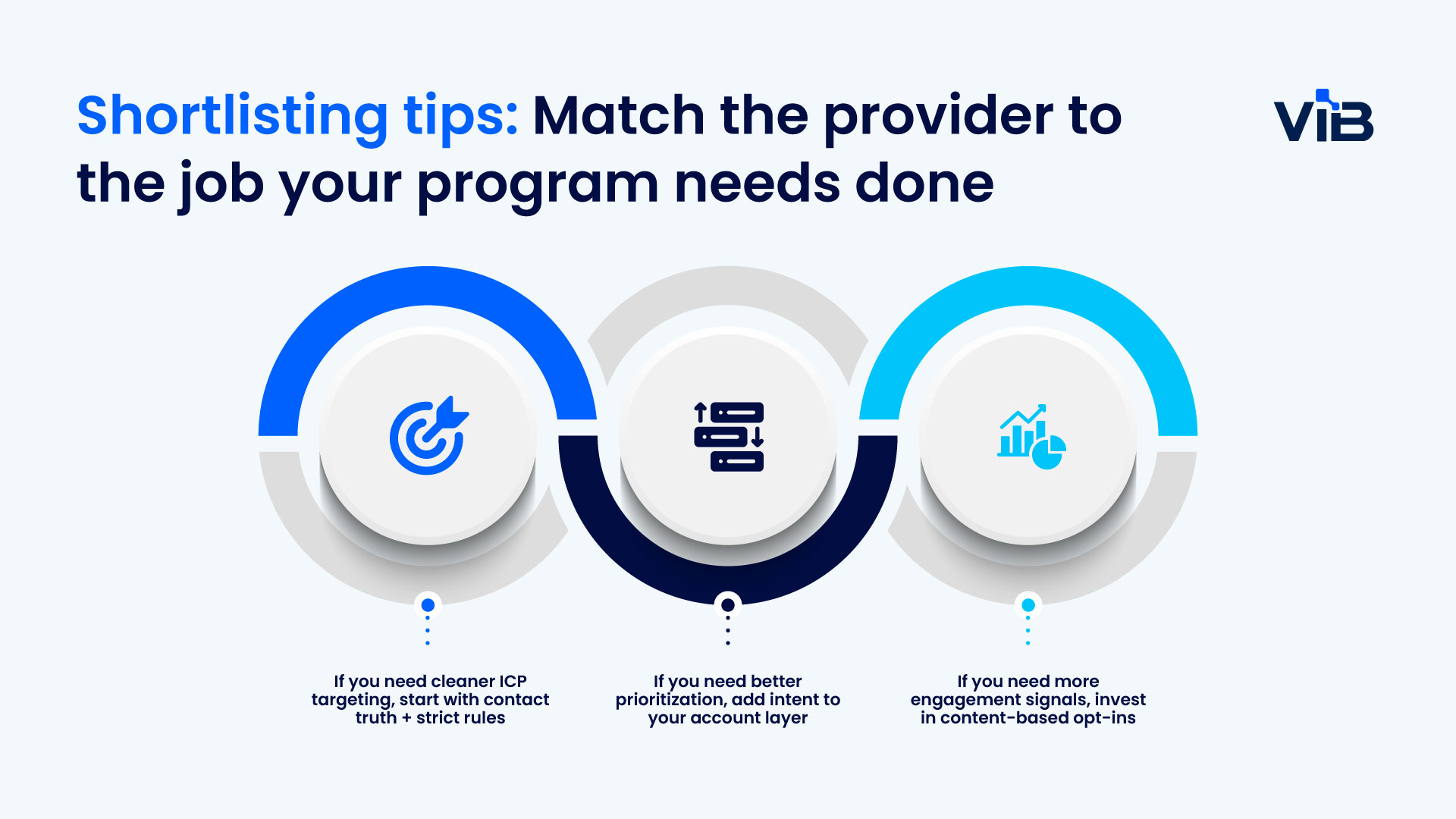
Shortlisting tips: Match the provider to the job your program needs done
Most experienced teams don’t choose one B2B SaaS lead provider. They choose a primary plus one or two complements. Here are practical match patterns that work well in real life.
If you need cleaner ICP targeting, start with contact truth + strict rules
Start with list accuracy and org context, then enrich with a database provider. This reduces “wrong person at the right company” errors.
If you need better prioritization, add intent to your account layer
Intent platforms can tell you which accounts are surging on relevant topics, but your team still needs plays and follow-up.
If you need more engagement signals, invest in content-based opt-ins
Content syndication can be your “net-new engagement engine,” especially when search and paid social are saturated. It works best when you control for persona fit and use genuinely helpful assets, not just branded ones.
Conclusion: choosing the right B2B SaaS lead provider comes down to signal quality and activation
There isn’t a single best B2B SaaS lead provider. There are best fits for specific jobs: building accurate lists, identifying account interest, or generating real engagement you can route and nurture.
If you’re refining a shortlist, prioritize providers that can clearly explain: (1) how their data is sourced, (2) what the signal actually represents, and (3) how you’ll activate it in your existing workflows.
And if your biggest gap is generating earlier engagement and stronger ICP-fit signals from an opted-in tech audience, ViB can help.


