 Skip to content


B2B SaaS inbound marketing used to be simpler. Publish content, rank for a few high-intent keywords, capture form-fills, and nurture people until they are ready.
That model still works sometimes. But it’s far less reliable for most B2B SaaS categories today, especially in competitive markets with crowded SERPs and cautious buyers.
Buyers do more research on their own, stay anonymous longer, and don’t follow your clean funnel stages. Gartner found that 61% of B2B buyers prefer a rep-free experience. That’s a loud signal that “wait for the form-fill” inbound is no longer enough.
This article will focus on what’s changed, what breaks most inbound programs, and how to build an inbound motion that reliably creates engagement, signal generation, and ICP fit.
What “inbound” actually means for B2B SaaS in 2026
In B2B SaaS, inbound marketing isn’t just about SEO and blog posts. It’s the full system that earns attention from the right accounts and turns that attention into measurable buyer signals across channels.
The practical definition most mature teams use looks more like this:
- Market visibility: being present where your ICP learns (search, communities, partners, newsletters, review sites).
- Message-market fit: content that maps to real buying questions, not internal product narratives.
- Signal capture: identifying the accounts and personas engaging, even when they stay anonymous.
- Conversion paths: multiple ways to progress (not only “download the ebook”).
- Follow-through: nurturing that respects the buyer’s pace and supports internal consensus.
Forrester’s research continues to reinforce the same direction: Buyers rely heavily on self-service and autonomous interactions, while still expecting providers to understand their challenges and collaborate when needed.
Inbound that wins now is built to serve that self-serve reality, then convert it into actionable insights for your go-to-market team.

Why B2B SaaS inbound marketing performance stalls (even with good content)
Most inbound stalls aren’t “content quality” problems. They’re systemic problems: weak distribution, unclear ICP targeting, incomplete measurement, or conversion paths that assume buyers will volunteer their identity early.
1) The buyer journey is mostly invisible
If your inbound reporting still centers on form submissions, you’re measuring the smallest slice of the audience. 6sense has reported that only a small percentage of visitors fill out forms (around 3–4% in their benchmark research).
That’s not a reason to remove forms, but it is a reason to stop treating them as the primary indicator of demand.
2) SEO alone can’t carry distribution anymore
In many B2B SaaS categories, search has become both more competitive and more fragmented. Your ICP might discover you through peer recommendations, review sites, LinkedIn commentary, niche newsletters, or vendor comparisons long before they search “best X platform.”
Inbound programs that depend on “rank and wait” tend to over-invest in production and under-invest in getting the right people to actually see it.
3) ICP fit gets diluted as teams chase volume
When targets get aggressive, inbound teams often loosen gating, broaden targeting, and accept low-intent conversions. The result is predictable: engagement metrics look fine, but account quality drops.
Modern inbound needs tighter fit filters, not just more top-of-funnel activity.
A modern inbound framework built around engagement and signals
If you want B2B SaaS inbound marketing to perform in a self-serve environment, build your strategy around three layers:
- Earn attention from the right accounts
- Create meaningful engagement that indicates active evaluation
- Capture and interpret signals so your team can act
Let’s break down what that looks like in practice.
Layer 1: Earn attention with ICP-specific “job-to-be-done” content
Experienced marketers already know to map content to stages. The upgrade is to map content to jobs and constraints inside the account.
For example, “security leader evaluating email security” and “IT leader cleaning up SaaS sprawl” are not just personas. They’re different internal pressures, time horizons, and success criteria.
Practical moves that improve inbound performance without bloating your content calendar:
- Build 3–5 ICP content lanes (by segment + use case), then commit to depth.
- Create one “anchor asset” per lane each quarter: a guide, benchmark, toolkit, or buyer’s checklist.
- Repurpose into decision-shaped pieces: migration plan, evaluation questions, risk checklist, stakeholder brief.
- Optimize for “comparison” and “implementation” searches, not only definitions.
Layer 2: Design engagement that indicates real buying work
Clicks aren’t the goal. Engagement that correlates with evaluation is the goal.
Examples of higher-quality engagement signals for B2B SaaS inbound marketing:
- Multiple visits from the same account to integration, security, pricing, or migration pages
- Consumption of “how it works” and “implementation” content (not just thought leadership)
- Repeat engagement over 2–4 weeks from several roles (admin, manager, director)
- Webinar attendance where questions indicate real operational constraints
The inbound mistake is forcing a “convert now” moment too early. Instead, give buyers more ways to engage that feel safe and useful.
Layer 3: Capture signals without demanding identity
Signal capture is where modern inbound programs separate from traditional content marketing. The goal is to understand who is showing interest and what they care about, even when they don’t fill out a form.
Practical options include:
- Account-level web analytics (to see surges and topic interest by company)
- Content consumption scoring that weighs mid-funnel pages more heavily
- Topic-based intent signals (to understand what problems a buying group is researching)
- Progressive conversion paths (newsletter, webinar, tools) that don’t jump straight to “talk to sales”
This is also where your inbound and ABM motions start to blend. The best teams don’t argue about labels. They build a single demand system and use targeting to decide where to apply pressure.
Where content syndication fits inside B2B SaaS inbound marketing
Content syndication gets a mixed reaction from experienced marketers, and that’s fair. Some programs generate a lot of low-quality activity. Others consistently put strong assets in front of the right buyers and generate measurable engagement you can build on.
The difference is almost always how syndication is run and how it connects back to your inbound system.
Use syndication to solve the “distribution gap,” not to replace inbound
Even great inbound content can underperform if your category is noisy. Syndication can help by placing your best mid-funnel asset in front of a curated audience that matches your ICP.
When it’s done well, syndication supports inbound by:
- Speeding up audience reach for new positioning or new categories
- Creating topic-level engagement signals you can use in nurture
- Helping you validate whether an asset resonates with a specific segment
- Feeding retargeting and follow-up sequences with higher-quality context
Make syndication measurable with “signal-first” outcomes
If you measure syndication only by raw lead counts, you’ll optimize toward the wrong thing. The better approach is to define success using engagement outcomes that align with early-stage inbound goals:
- ICP match rate (job level, function, firmographics, technographics where relevant)
- Asset completion indicators (time, scroll depth where available, repeat visits)
- Downstream engagement lift (return visits, additional content views, webinar sign-ups)
- Account clustering (multiple engaged contacts from the same company over a short window)
Common failure modes (and how to avoid them)
Most syndication and inbound problems are predictable. Here are the ones that show up most often in B2B SaaS inbound marketing teams, plus the fixes that usually work.
Failure mode: You syndicate the wrong asset
If you syndicate a generic ebook, you’ll get generic engagement. High-performing programs typically syndicate assets that help buyers do real work.
Better asset types for engagement quality:
- Evaluation checklists and scorecards
- Security, compliance, or IT readiness guides
- Migration or implementation plans
- ROI model templates (with assumptions stated)
- Stakeholder briefs for internal alignment
Failure mode: Your targeting is too broad to learn anything
If your “ICP” is basically “mid-market to enterprise,” you can’t optimize creative, messaging, or follow-up. Tighten the target, then scale once you see consistent engagement patterns.
Failure mode: You treat the output like a list instead of a learning loop
The best inbound marketers use syndication as a feedback mechanism. Which topics pull? Which titles attract the wrong roles? Which segments engage but don’t come back?
Those insights should change your inbound roadmap, not sit in a spreadsheet.
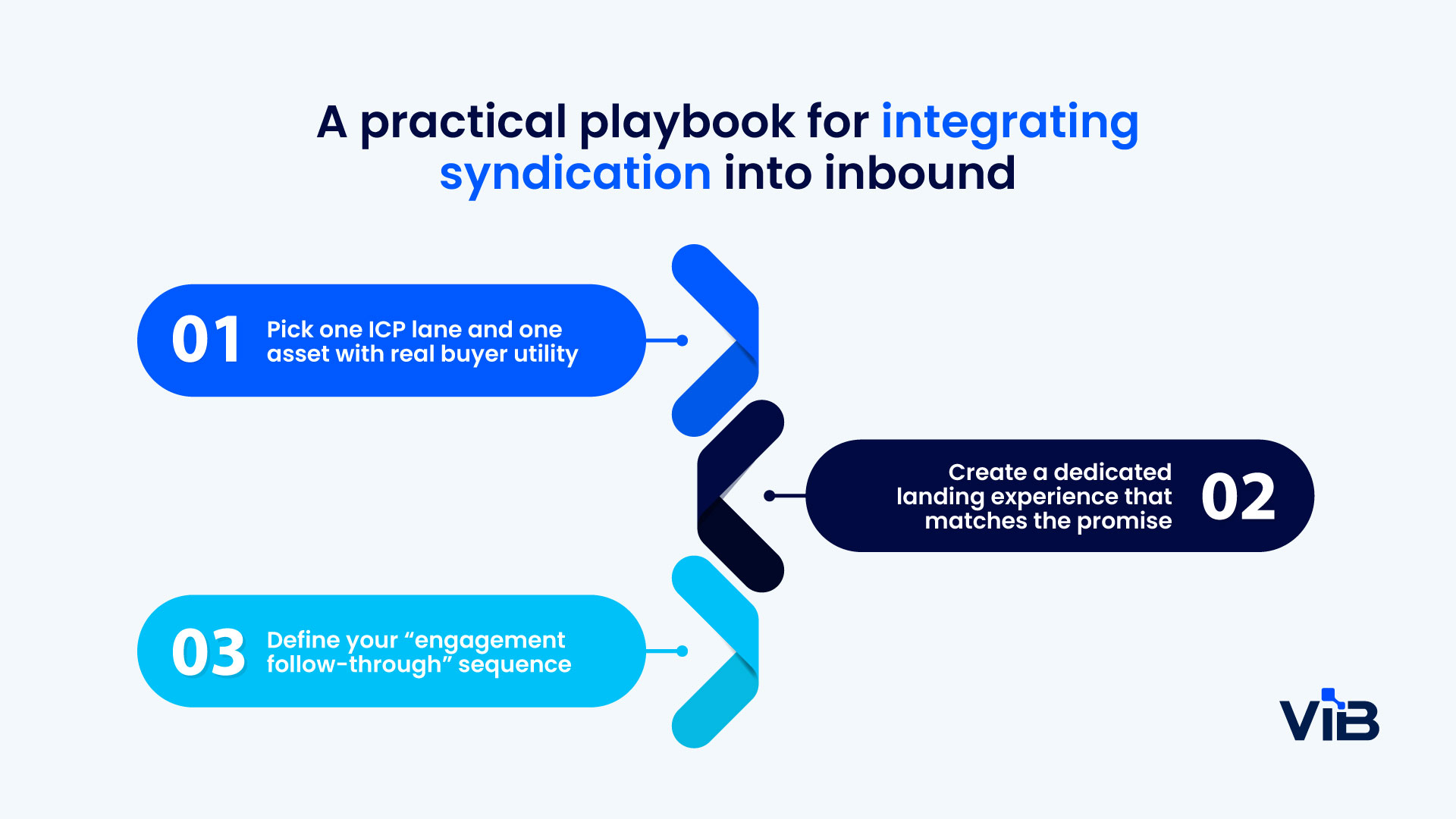
A practical playbook for integrating syndication into inbound
Here’s a proven way to integrate syndication into a B2B SaaS inbound marketing program without creating channel conflict or confusing measurement.
Step 1: Pick one ICP lane and one asset with real buyer utility
Start with a single segment and a single high-value asset. You’re trying to learn what resonates and which signals you can trust.
Step 2: Create a dedicated landing experience that matches the promise
Don’t send syndication traffic to a generic resource library. Build a focused page that reiterates the problem, clarifies who it’s for, and previews the takeaways.
Step 3: Define your “engagement follow-through” sequence
Your follow-up shouldn’t assume the buyer is ready for a product conversation. It should help them keep moving.
Examples:
- Send a related implementation guide 5–7 days later
- Invite them to a short expert webinar on the same problem
- Offer a tool: checklist, template, or short assessment
- Retarget to comparison and integration content
Solution: Using ViB Syndication to strengthen inbound distribution and ICP-fit engagement
If your B2B SaaS inbound marketing program is strong on content but weak on consistent reach, this is where a focused syndication partner can help.
ViB Syndication is built to support earlier-journey outcomes: getting the right content in front of the right tech audiences, generating measurable engagement, and delivering leads that match agreed targeting requirements.
Where ViB Syndication fits best in the strategy
ViB Syndication tends to fit best when you’re trying to:
- Accelerate distribution of a strong mid-funnel asset to a specific ICP segment
- Validate messaging for a new category, use case, or vertical
- Increase account-level engagement while your SEO and paid social ramp
- Improve lead quality consistency with clear qualification requirements
How it works at a practical level
At a high level, ViB Syndication lets you provide an asset plus targeting criteria (role, seniority, company size, and other ICP attributes). ViB then promotes the asset to matching members of its community and delivers the resulting leads that meet the defined requirements.
The important part is how you operationalize it inside inbound:
- Choose one asset tied to a real buying job (not a broad brand piece).
- Align targeting to your ICP lane so the engagement tells you something useful.
- Build a follow-through nurture that continues the same topic thread.
- Review engagement patterns monthly and use them to refine content and segmentation.
Conclusion: inbound that wins now is built for self-serve buyers
B2B SaaS inbound marketing still works. But the winning version is not “publish and gate.” It’s a signal-driven system that earns attention, creates real engagement, and captures intent without demanding identity too early.
That shift is aligned with what major research firms and buyer studies keep showing: buyers prefer self-service, do extensive research on their own, and make progress long before they talk to vendors.
If your team is already investing in high-quality content, the next leverage point is distribution and ICP-fit engagement. Used thoughtfully, content syndication can be a practical way to close the reach gap and generate stronger early signals—especially when it’s integrated into your inbound measurement and nurture system.


