 Skip to content


The B2B buyer journey continues to move further away from vendor-controlled channels. Buyers spend more time self-educating, and they do it across more places than your team can cover with owned distribution alone.
According to Martal Group, today’s B2B buyers use 10 or more digital touchpoints before connecting with a salesperson.
And according to Worldwide Business Research, 90% of B2B say online content has a “moderate to major” impact on the final purchase decision.
Content syndication can reliably put you into that consumption set—but only if you run it like a system that’s tuned for your ICP and your follow-up motion.
In B2B SaaS, you’re rarely trying to get someone to buy after one asset. You’re trying to get the right people to notice you, learn something useful, and raise their hand in a way your team can trust.
That’s why the strongest B2B SaaS content syndication strategy isn’t built around volume. It’s built around signal quality: who engaged, what they engaged with, and whether that engagement maps to your ICP and near-term priorities.
This article is written for experienced B2B SaaS marketers who’ve already run paid social, search, and nurture. We’ll focus on what changes when you treat syndication as a controlled, measurable signal engine rather than a one-off lead source.
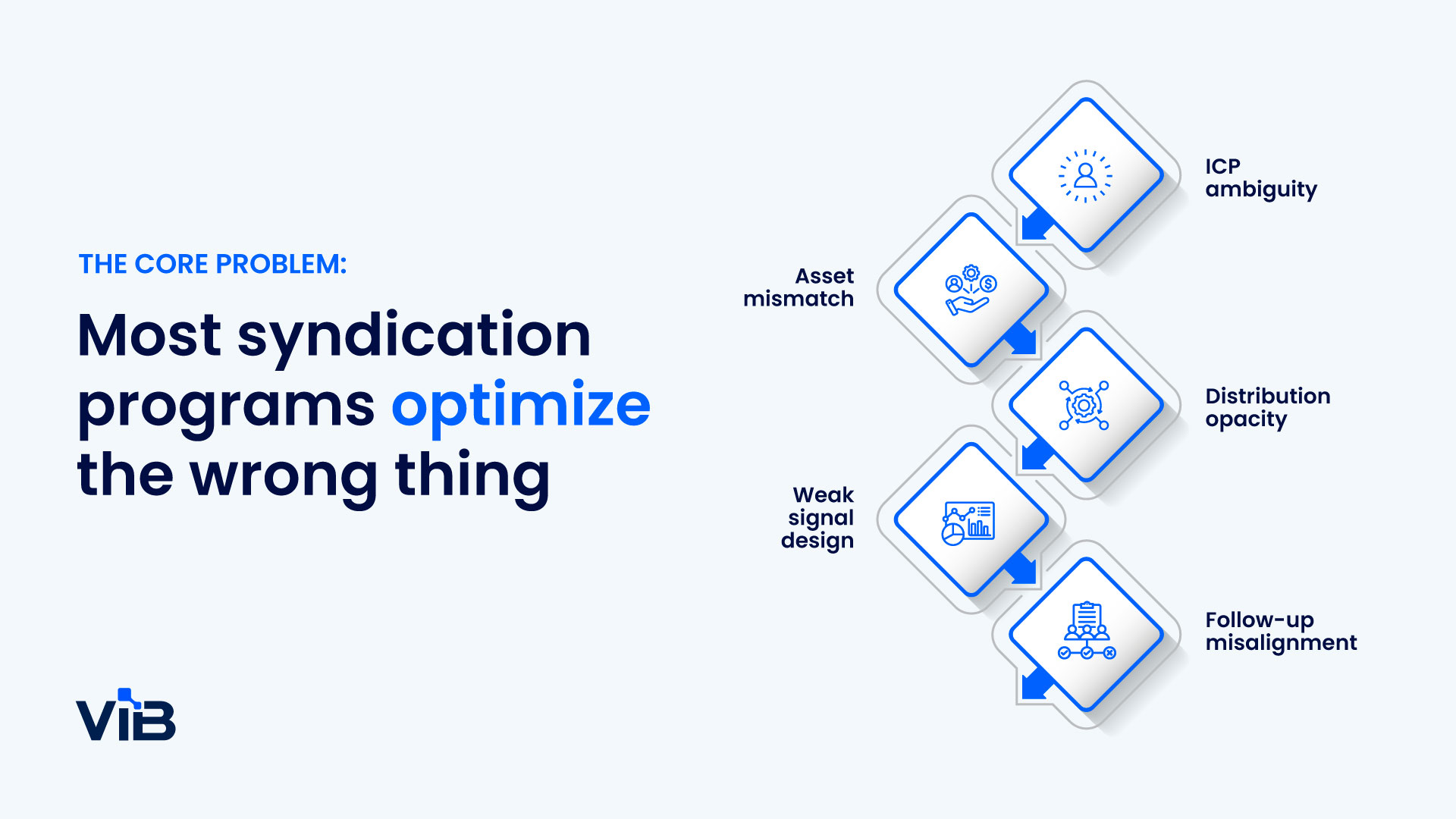
The core problem: Most syndication programs optimize the wrong thing
Most teams say they want quality, but their program design still rewards quantity.
Here’s what that looks like in practice: you buy a broad audience, gate a generic asset, and report success based on CPL and form fills. Then sales (or SDRs) complain the list “isn’t good,” marketing lowers the bar to hit numbers, and the program becomes a recurring argument.
When a B2B SaaS content syndication strategy underperforms, it’s usually because of one (or more) of these issues:
- ICP ambiguity: Targeting is based solely on firmographics, without role context, problem context, or disqualifiers.
- Asset mismatch: The content is either too top-level to create a meaningful signal or too product-heavy for cold audiences.
- Distribution opacity: You can’t clearly explain where the audience came from and why they were a fit.
- Weak signal design: The form collects contact details but not buying context.
- Follow-up misalignment: The next touch assumes high intent, so recipients disengage fast.
If you’re already strong in paid and lifecycle, the fastest win is usually better engagement signals that your team can segment, score, and act on without burning trust.
What “good” looks like: Syndication as signal generation
Think of syndication as a way to manufacture consistent exposure to a relevant audience and capture verifiable engagement.
A well-run program does three jobs at once:
- Expands reach into the right accounts and roles beyond your owned channels.
- Captures declared and behavioral signals you can use for segmentation.
- Improves downstream performance by giving sales and lifecycle marketing something specific to reference.
This framing keeps the program honest. You’re not trying to “win the deal” with a PDF. You’re trying to create enough relevance and context that the next touchpoint performs better.
Choose KPIs that match the job
If you track only CPL, you’ll inevitably buy cheaper audiences and lower-intent clicks. Instead, align reporting to outcomes that reflect engagement and fit.
Useful KPI layers for experienced teams:
- Fit rate: Percent of contacts matching your role + company filters after normalization and enrichment.
- Engagement depth: Asset completion (when available), repeat visits, or multi-asset consumption over 14–30 days.
- Follow-up efficiency: Reply rate and meeting acceptance rate from context-aware outreach (not generic sequences).
- Account lift: Increase in web engagement from targeted accounts during the program window.
You can still track CPL. Just don’t let it run the program.
How to design your B2B SaaS content syndication strategy (step by step)
Below is a practical build sequence that tends to work well for B2B SaaS teams selling complex products with multi-stakeholder evaluation.
Step 1: Tighten the ICP definition using “must-have” and “must-not” filters
Firmographics are not enough. In SaaS, two companies of the same size can have completely different toolchains, maturity, and urgency.
Before you launch, document:
- Must-have signals: tech environment, team structure, compliance needs, deployment model, and trigger events.
- Must-not filters: excluded verticals, toolchain conflicts, segments you don’t serve well, and regions you can’t support.
- Role clusters: economic buyer, technical buyer, day-to-day operator, and “influencer” roles.
This is also where you decide if you’re running an account-first approach (ABM list) or a persona-first approach (role and segment targeting). Don’t blend them without a reason.
Step 2: Match assets to the “10+ touchpoints” reality
If buyers typically consume 10+ content pieces before they’re open to a sales conversation, your syndication plan shouldn’t rely on a single flagship asset.
Instead, build an asset ladder that creates a progressive signal:
- Problem framing: benchmarks, “what changed” explainers, cost-of-status-quo narratives.
- Evaluation support: requirements checklists, security review guides, migration planning, buyer’s guides.
- Proof and specificity: technical deep dives, implementation notes, quantified outcomes (when you can substantiate them).
A simple rule: Each asset should answer one hard question your buyers ask internally. If it doesn’t, it won’t produce a strong signal.
Step 3: Design the form to capture context
Follow-up depends on relevance, so your form needs to capture enough context to personalize that follow-up.
For experienced teams, that typically means adding 1–3 fields that clarify fit and use case, such as:
- Primary initiative (picklist that matches your core use cases)
- Environment (cloud/on-prem/hybrid, or relevant tech stack options)
- Time horizon (not “buying timeline,” but “priority this quarter / this half / later”)
Be careful with too many fields. The goal is better segmentation, not added friction.
Step 4: Find and vet syndication partners
“Syndication partner selection” is easier said than done. Finding the right fit determines signal quality, brand risk, and whether your follow-up motion works at all.
A practical way to find candidates is to start with where your ICP already learns, then work backward to partners who can prove opt-in, context, and control:
- Communities and professional networks: opt-in membership audiences (often stronger for technical roles).
- Publisher and newsletter ecosystems: outlets that already publish to your ICP, not generic “IT decision maker” lists.
- Event/webinar co-marketing networks: useful if your buyers engage more in live formats, and you can reuse the content on demand.
- Intent + syndication hybrids: can work when you have a clear account list and strict suppression requirements.
Once you have a shortlist, qualify partners like you would qualify any performance channel. Ask direct questions before you commit to spending:
- How is the audience built, and how do they opt in?
- Is it a static list rental model, a content network model, or a community model?
- Can you suppress existing customers, partners, competitors, and students?
- Can you control frequency and fatigue?
- Can you see performance by segment, asset, and role?
This is where many programs quietly fail. If you can’t explain the audience, you can’t defend the outcome.
Step 5: Run a “partner pilot” before you scale spend
Before you commit to a quarter-long buy, run a controlled pilot designed to answer one question: Does this partner produce ICP fit engagement signals that convert in your follow-up motion?
A solid pilot design for experienced teams:
- 1–2 assets mapped to one role cluster (don’t test everything at once).
- Strict suppression (customers, open opps, partners, competitors, internal domains).
- Fit + engagement reporting (match rate, job-level distribution, and any depth metrics the partner can provide).
- Downstream checkpoint at 7–14 days (reply rate, meeting rate, and account lift on your target list).
If a partner can’t support basic transparency and control during a pilot, it will not improve when you scale.
Step 6: Build a follow-up motion that matches the signal
Most teams over-rotate on speed-to-lead and under-rotate on message-to-signal fit.
Fast follow-up is helpful, but only if the outreach reflects what the person actually did. Referencing the specific asset and offering the next logical resource often outperforms a generic “wanted to connect” note.
Practical follow-up structure:
- Day 0–2: deliver the asset, plus one closely related resource (not a product pitch).
- Day 3–7: a short “helpful check-in” with a question tied to the form’s context field.
- Day 7–21: route based on engagement: higher-engagement contacts get an invite to a deeper piece (webinar, workshop, assessment); lower-engagement contacts move into a slower nurture.
This is also where you align with sales on what “ready” means. If your org treats every syndication contact as urgent, your program will get noisier over time.

Common failure modes (and how to fix them without killing volume)
Even mature teams run into the same syndication traps. The difference is how quickly they diagnose and correct them.
Failure mode: “We got leads, but nobody responds”
This usually means your follow-up assumes intent that the engagement didn’t prove.
Fix: create two tracks. One for high-engagement (multi-asset, high fit) and one for single-touch engagement. Your outreach should feel consistent with what they experienced.
Failure mode: “CPL looks great, but the fit is bad”
Cheap audiences are rarely the ones you want for complex SaaS.
Fix: pay for tighter targeting and stronger suppression. Then measure fit rate as a primary KPI, not an afterthought.
Failure mode: “It works for one asset, then falls off”
That’s audience fatigue or asset mismatch.
Fix: rotate assets by role and problem. Also, cap frequency and refresh creative and landing copy. Your syndication partner should support this kind of control.
Where ViB Syndication fits into a modern content syndication strategy
If your strategy is built around engagement signals and ICP fit, the syndication partner you choose matters as much as the asset you promote.
ViB Syndication is designed for B2B technology and SaaS teams that want to distribute content to qualified tech professionals. Leads come directly from the ViB Community—a large network of technology decision-makers and influencers who voluntarily join and opt in to specific programs, such as syndicated content downloads.
Here’s how we support your B2B SaaS content syndication strategy:
- Audience relevance: Reach tech audiences in a context where they’re actively consuming professional content, rather than passively encountering ads.
- Signal capture: Align assets to the “10+ touchpoints” window, so you can see which topics and assets draw real attention.
- Program control for experienced teams: Run syndication as a repeatable motion you can tune by ICP, role cluster, and content theme over time.
Conclusion: Build the program you can defend
A high-performing B2B SaaS content syndication strategy should act as a disciplined distribution and signal engine.
When you define ICP tightly, ladder assets across real buyer questions, capture context in the form, and follow up in a way that matches the engagement, syndication becomes a reliable way to expand reach and improve the quality of your go-to-market conversations.
The goal isn’t just more names. It’s clearer signals, better segmentation, and stronger ICP alignment that you can operationalize across paid, lifecycle, and sales motions.


