 Skip to content


If you’re shopping for a B2B email marketing service in 2026, you’re probably looking for more than just someone who can send more emails. You’re looking for a way to reliably create engagement, validate ICP fit, and generate buyer signals your team can actually use.
And you’re doing it in a reality where deliverability rules are tighter, inbox attention spans are shorter, and attribution is messier. Email still works, but the bar is higher than it was even 18 months ago.
This guide is for experienced B2B tech and SaaS marketers who need an email program (or partner) that performs under today’s constraints. We’ll cover what to demand from a service, how to evaluate vendor quality beyond vanity metrics, and the playbooks that create measurable engagement and intent signals over time.
Why B2B email marketing is more complicated than ever
Five years ago, a B2B email marketing service often meant: “We need templates, a cadence, and a list.” Now, most teams already have an ESP, decent automation, and an internal opinion on copy and design.
What’s changed is the combination of (1) stricter sender requirements and (2) higher expectations from buyers. Gmail and Yahoo introduced bulk-sender requirements starting in February 2024, including authentication requirements and easier unsubscribe options, while Google also emphasized keeping spam complaint rates low.
Microsoft took similar measures for high-volume senders in May 2025.
What’s more, B2B buyers are increasingly conducting most (up to 70%) of the buyer journey on their own before ever contacting a vendor. Most also have preferred vendors and specific purchase requirements mapped out.
Simply put, a B2B email marketing service can’t just be about “execution.” It has to protect deliverability, improve list quality, and help your team show up credibly early in the journey, when attention and trust are still up for grabs.
What to evaluate in a B2B email marketing service (beyond “open rate”)
Open rate benchmarks are useful context, but they can’t define your strategy. For example, MailerLite’s 2025 benchmarks report an average open rate of 43.46% but an average click rate of 2.09% across industries.
Benchmarks help you spot something broken, but they don’t tell you whether your email program is creating meaningful buying signals or just training people to ignore you.
1) Deliverability posture (not just “we have SPF”)
A serious B2B email marketing service should be able to explain, in plain terms, how they manage deliverability risk across:
- Authentication: SPF, DKIM, and DMARC alignment expectations (and who owns what).
- Complaint-rate control: processes to reduce spam complaints and suppress risky segments before a big send.
- Unsubscribe mechanics: one-click unsubscribe support and fast processing
- List acquisition governance: how opt-in, consent, and permission are handled (and documented).
If a vendor can’t clearly articulate this, you’re just taking on deliverability and reputation risk.
2) Audience strategy: segmentation that reflects real buying committees
In B2B tech, “IT Director” isn’t a segment. It’s a job title that can sit in wildly different org contexts. A strong service should help you segment in ways that match how deals are evaluated:
- Firmographics (industry, company size, region) plus tech environment indicators when available
- Role in evaluation (economic buyer, technical evaluator, influencer, user)
- Operating reality (maturity stage, compliance requirements, growth vs. efficiency mandate)
- Buying horizon signals (active project vs. “monitoring the space”)
This is where experienced teams win. As your message gets more specific and your CTAs become more honest, engagement becomes easier to earn.
3) Measurement tied to engagement and signal generation
If your reporting stops at opens, clicks, and form fills, you’ll miss what matters: whether email is creating usable signals that shape what happens next.
Ask your service partner how they collect data and report on:
- Engaged account clusters: which accounts show repeated engagement over multiple touches
- Topic-level resonance: which themes correlate with downstream actions (demo views, pricing page visits, webinar attendance)
- Time to first meaningful action: how quickly specific segments move from cold to raising their hand
- Signal quality: repeat engagement vs. one-off clicks
Those insights can help you tune messaging, prioritize segments, and reduce wasted follow-up.
The core challenges a B2B email marketing service should solve
Most B2B SaaS teams don’t fail because they can’t write an email. They fail because their system isn’t built for today’s constraints.
Challenge 1: You’re optimizing for the wrong “conversion”
In early-stage demand work, the win isn’t always a form fill. Sometimes it’s a pattern of engagement that tells you, “This segment cares about this problem, and they’re leaning in.”
If your service pushes aggressive gating at every touchpoint, you’ll often inflate your lead count while reducing trust. A better model uses a mix of:
- Ungated, high-credibility assets (comparison guides, technical explainers, implementation checklists)
- Lightly gated assets where the value is obvious (benchmarks, templates, research summaries)
- Event-based engagement that surfaces intent naturally (webinars, roundtables, short expert sessions)
The goal is to create a steady stream of behavioral signals you can act on. That’s the difference between “we sent emails” and “we learned something useful.”
Challenge 2: Your database isn’t big enough (or isn’t fresh enough)
Even strong brands hit saturation. You mail the same contacts, engagement drops, and you start debating whether the problem is subject lines or “market conditions.”
Often, it’s simpler: You’ve run out of new, relevant people to talk to in your ICP. Data decay and role changes don’t help either.
A capable B2B email marketing service should have a clear point of view on audience expansion that doesn’t wreck deliverability. That can include partnerships, community-based audiences, or tightly governed co-marketing—done with consent and quality controls.
Challenge 3: Your emails are too product-centered for the stage you’re targeting
People don’t want “a platform overview” early in the buying journey. They want help making a decision, avoiding risk, and defending the choice internally.
So your best emails often look like: useful guidance, credible proof, and an easy next step. Not a pitch. 🙂

Advanced strategies that actually move engagement (and create intent signals)
Here are the plays that tend to work well for experienced SaaS teams when email performance plateaus. If your B2B email marketing service doesn’t push for these, they’re probably optimizing for activity, not outcomes.
Strategy 1: Build “problem-first” tracks, not product tracks
Instead of a single nurture stream for “All Leads,” build 3–5 tracks aligned to the problems your ICP self-identifies with. Each track should have:
- A clear “why change” narrative (what breaks if they do nothing)
- A decision framework (how teams evaluate options)
- Risk reducers (implementation reality, security/compliance, change management)
- Role-specific versions (technical evaluator vs exec sponsor)
When you do this well, engagement becomes a segmentation tool. People tell you what they care about by what they click, save, and forward.
Strategy 2: Use webinars as an email engagement engine, not a one-off event
Webinars work best when they’re built for relevance. The mistake is treating the webinar as the “thing” and the email as just the invite.
A better approach looks like this:
- Pre-event: 2–3 emails that test angles (pain point vs. benchmark vs. teardown)
- During event week: last-mile reminders that restate outcomes, not agenda
- Post-event: content remix by persona (summary, clips, FAQ follow-up, related guide)
- Signal capture: segment follow-up based on questions asked and content consumed
That’s how a webinar becomes a multi-touch signal generator. It’s also how you keep unsubscribes from spiking: your follow-up feels tailored, not repetitive.
Strategy 3: Treat deliverability as a growth constraint (because it is)
Deliverability isn’t a technical checkbox. It’s the constraint that shapes how aggressively you can scale. Under Google/Yahoo bulk-sender guidance, spam complaint rate management is explicitly a priority.
Practical improvements that tend to show results fast:
- Sunset policies that suppress contacts with no engagement after a defined window
- Preference centers that let people reduce frequency instead of unsubscribing
- Segment-specific sending patterns (your “hot” segment can handle more than your “cold” segment)
- Regular creative refreshes to avoid repetitive signals to mailbox providers
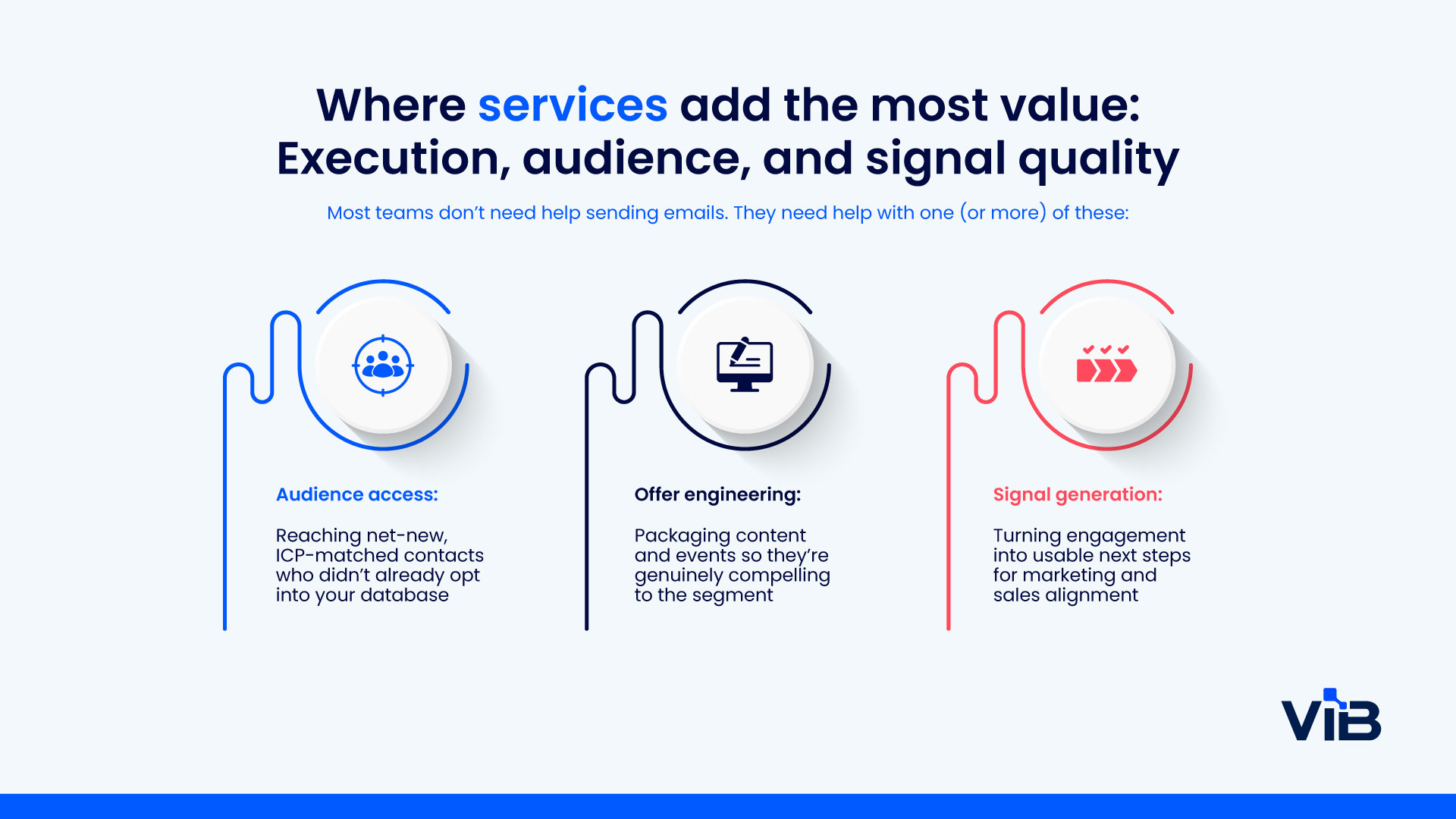
Where services add the most value: Execution, audience, and signal quality
Most teams don’t need help sending emails. They need help with one (or more) of these:
- Audience access: reaching net-new, ICP-matched contacts who didn’t already opt into your database
- Offer engineering: packaging content and events so they’re genuinely compelling to the segment
- Signal generation: turning engagement into usable next steps for marketing and sales alignment
For example, community-based audiences can be a strong fit when your house list is saturated, but you still need targeted reach without “spray and pray.”
That’s also where a partner like ViB fits naturally.
ViB Emails: amplifying proven messages to an ICP-matched audience
When you already have working creative (a strong webinar invite, a benchmark report, a clear “how to evaluate” guide), the bottleneck is often distribution.
ViB Emails is designed to send your email to targeted members of the ViB community that match your criteria. That’s useful when your internal list is tapped out and you want engagement from net-new people who match your ICP.
How it supports your strategy:
- Audience expansion: reach new contacts without relying only on your database
- Message validation: test whether a theme resonates outside your existing list
- Event acceleration: drive webinar registrations from the right segments
Using explicit intent signals when timing matters
Engagement is valuable, but sometimes you also need clearer indicators of active evaluation, such as timelines, business priorities, budget parameters, and stakeholder roles.
Explicit or declared intent data can provide additional context when it is collected transparently, with appropriate consent, and directly from prospects. These signals should be used as prioritization inputs—not as definitive proof that an account is ready to buy.
How it can support your strategy:
- Combine email and content engagement with permission-based declared intent from trusted sources to identify accounts that may be closer to an active evaluation
- Improve ICP clarity by comparing which segments report stronger urgency, ownership, and project relevance
- Give your team better first-touch context so follow-up is timely and relevant
Conclusion: Choose a B2B email marketing service that earns attention and produces usable signals
The best B2B email marketing service isn’t the one that sends the most campaigns. It’s the one that helps you earn attention in a tougher inbox, protect deliverability, and turn engagement into signals your team can act on.
Start your evaluation with deliverability rigor and segmentation depth. Then look hard at how the service thinks about audience expansion and signal quality.
When you need targeted reach beyond your house list, ViB Emails can help expand distribution to ICP-matched audiences. When you need a clearer view of which accounts may be actively evaluating, complement email engagement with transparent, permission-based intent sources and human qualification.


