 Skip to content

Email marketing for B2B is less forgiving than it was even 18 months ago.
Inbox providers are tightening rules, buying groups are doing more research without talking to reps, and your list is probably a blend of true ICP, adjacent roles, and “looked-right-at-the-time” leads. So the bar is higher: you need relevance, signal capture, and clean execution—not just a higher send volume.
In this guide, we’ll focus on what’s working now: building an engagement engine that generates usable intent signals and improves ICP fit over time, while protecting deliverability and brand trust.
What role does email marketing play in inbound strategy?
Email marketing acts as the connective layer between content and audience.
Instead of treating each asset as a standalone effort, email allows marketers to sequence content, reinforce messaging, and maintain visibility over time. It turns inbound from a one-time interaction into an ongoing relationship.
In a strong inbound strategy, email supports multiple stages of the buyer journey:
- Introducing educational content to new audiences
- Reinforcing key ideas through follow-up messaging
- Driving repeat engagement with related resources
- Maintaining visibility across longer decision cycles
This consistency is what allows inbound programs to build momentum rather than reset with each campaign.

The modern B2B email marketing framework
B2B email marketing performance no longer comes from isolated campaigns. It comes from systems that consistently deliver relevant messages, capture engagement signals, and improve targeting over time.
High-performing teams tend to align around five core components:
1) Segmentation built around buying groups
Basic segmentation is no longer enough. Effective programs combine firmographics, role, engagement history, and intent signals to reflect how buying decisions actually happen.
Instead of treating contacts as static personas, leading teams group audiences based on their role in evaluation—economic buyers, technical validators, operators, and internal champions. This allows messaging to align with real decision criteria, rather than just job titles.
2) Personalization that reflects context, not just data
Personalization today is less about inserting tokens and more about aligning messaging to the reader’s situation.
That includes:
- Role-specific framing
- Dynamic content based on segment
- Behavior-triggered follow-ups
Short, focused emails that clearly connect to a specific challenge consistently outperform broader, generic messaging.
3) Lifecycle-driven execution
Performance comes from coordinated flows, not one-off sends.
Effective programs build email sequences around key engagement triggers such as:
- Content downloads
- Webinar participation
- Repeated site activity
These flows adapt based on behavior, making communication feel relevant without requiring constant manual intervention.
4) Measurement tied to real engagement signals
Opens and clicks provide directional insight, but they don’t tell the full story.
Stronger programs focus on:
- Account-level engagement
- Repeat interactions over time
- Topic-level interest
- Movement toward meaningful actions
This shifts email from a reporting channel to a decision-making tool.
5) Deliverability as a strategic constraint
Even the best messaging fails if it never reaches the inbox.
Modern email programs treat deliverability as a core part of strategy, not a technical afterthought. That includes maintaining list hygiene, monitoring complaint rates, supporting one-click unsubscribe, and ensuring proper authentication.
When these elements are aligned, email becomes more than a communication channel. It becomes a system for continuously improving audience understanding, engagement quality, and downstream performance.
Content that earns attention in 2026 inboxes
The biggest reason B2B emails get ignored is that they read as if they were written to satisfy internal stakeholders rather than to help the reader make progress. If you want B2B email marketing to drive consistent engagement, shift from “announcements” to “decision support.”
For experienced marketers, this is the fastest way to make emails skimmable while still valuable:
- Point of view: a specific take on what’s changing (deliverability rules, evaluation patterns, implementation pitfalls)
- Proof: one strong example, a short clip, or a single metric you can stand behind
- Next step: a content asset that matches intent (not always “book a demo”)
This format also makes performance analysis cleaner. You can see which POVs produce repeat engagement and which offers attract the wrong audience.
Stop forcing “the” CTA
In buying groups, intent shows up unevenly. One person might scour three emails and never click. Another will click once and forward internally.
Consider offering two clear paths in mid-funnel emails:
- Learn: a guide, benchmark, teardown, or short webinar.
- Validate: a technical brief, checklist, security overview, or implementation plan.
This is how you keep engagement high without forcing the reader into a decision they’re not ready to make.
Targeted email marketing for B2B traffic recovery
If your organic traffic has taken a hit recently, you’re not alone.
When traffic drops, many teams default to an SEO-only response: fix technical issues, refresh content, consolidate pages, improve internal linking, publish more.
Those actions matter. But if your recovery plan only optimizes pages, you’re ignoring the reality that your audience is distributed across roles, priorities, and timelines. You need a channel that can re-engage multiple stakeholders inside the right accounts, repeatedly, with message control.
Email is still one of the most direct ways to do that, especially when it’s targeted and integrated with your account strategy.
Step 1: Start with a recovery diagnosis
Before making changes, experienced teams align on a few fundamentals:
- Where the drop actually occurred
- What’s still working, even if volume is lower
- Whether engagement declined evenly or unevenly across audiences
- Which channels can realistically deliver results in the next 30 days
This isn’t a deep audit. It’s a short, directional reset that prevents wasted effort later.

Step 2: Fix reach before you fix messaging
Confirm you meet Gmail/Yahoo expectations for authentication and unsubscribe UX. Then monitor the complaint rate and placement like performance metrics.
Step 3: Rebuild segmentation around ICP fit and intent themes
Build segments that reflect how buyers evaluate, not how your org charts accounts.
Examples: “Security-led evaluators,” “RevOps process fixers,” “Data warehouse modernization,” “Cost-control mandates,” and “Integration complexity.”
Step 4: Publish a newsletter that’s designed to create measurable choices
Make it easy for readers to self-select what they care about through modular link blocks and light preference capture.
Step 5: Use automation only where it strengthens relevance
Gate automations behind engagement. Suppress automations for low-engagement cohorts. Run reactivation separately.
What to send when you’re rebuilding engagement (without sounding like a nurture bot)
Traffic recovery emails tend to fail for one reason: they try to “convert” too early. If the buyer discovers you via search, they aren’t ready for a hard ask anyway.
Instead, build a sequence that earns the next click and generates usable signals. Here are formats that work well for experienced audiences:
1) “Decision memo” emails (fast, opinionated, skimmable)
Write a short internal-style memo: the decision, the trade-offs, and the recommended path. Keep it grounded and specific.
Add one clear link to a deeper page that matches the memo. Bonus if it’s a page you’re actively refreshing for SEO. This is how email supports traffic recovery in both directions.
2) “What changed in 2026” updates (when your category moves fast)
Experienced marketers respond to fresh context. If you can summarize what changed in regulations, platform capabilities, security expectations, or implementation patterns, you’ll earn attention.
Keep it practical. Avoid prediction theater. Link to a checklist or a compact guide, not a 4,000-word manifesto.
3) “Common failure modes” (the email version of a great postmortem)
Pick one painful scenario and walk through it: what teams try, what breaks, and what to do instead. This format generates high-quality clicks by filtering for people with genuine urgency.
It also sets up strong on-site behavior signals because readers tend to visit supporting pages (integration docs, security pages, architecture posts). That can help your broader recovery effort over time.
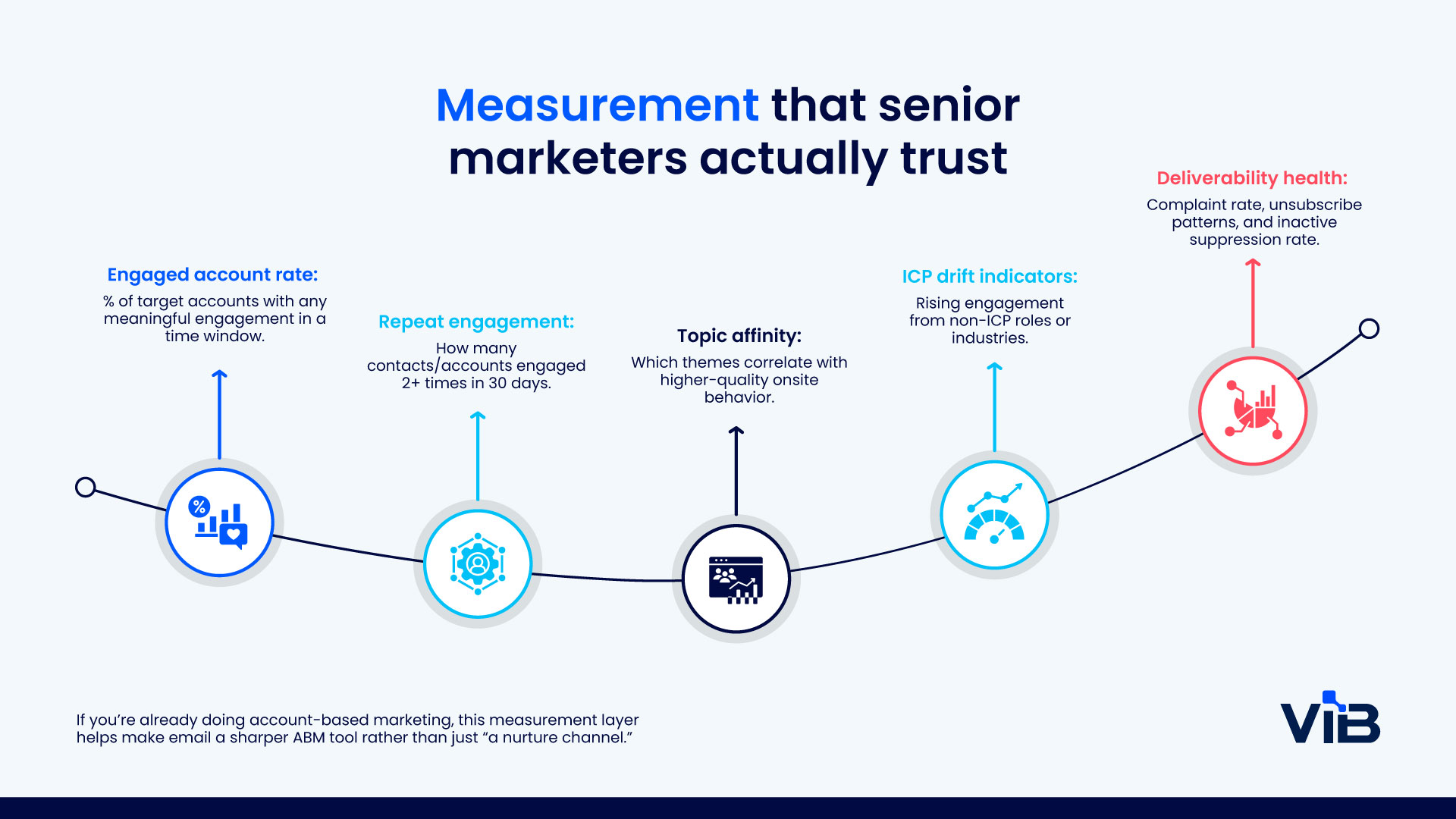
Measurement that senior marketers actually trust
Once your program is in place, measurement should guide decisions—not just report activity. For B2B teams, an actionable measurement model includes:
- Engaged account rate: % of target accounts with any meaningful engagement in a time window
- Repeat engagement: how many contacts/accounts engaged 2+ times in 30 days
- Topic affinity: which themes correlate with higher-quality onsite behavior
- ICP drift indicators: rising engagement from non-ICP roles or industries
- Deliverability health: complaint rate, unsubscribe patterns, and inactive suppression rate
If you’re already doing account-based marketing, this measurement layer helps make email a sharper ABM tool rather than just “a nurture channel.”
A realistic way to scale engagement: research-led email plus intent signals
Scaling email marketing for B2B usually fails when teams try to scale volume over relevance.
A more durable pattern is research-led programming:
- Publish a strong point of view (survey results, benchmark analysis, or expert interviews).
- Package it into multiple email angles by persona and evaluation job.
- Use engagement to identify which accounts are leaning in.
- Feed those signals into retargeting, SDR prioritization, and next-best content.
Building and maintaining a high-quality B2B email list
Even the best strategy breaks down if your audience quality isn’t there. Email collection has become more complex as buyer behavior and privacy expectations have evolved.
Conversion rates on traditional forms have declined, attention is more fragmented, and professionals are more selective about sharing their information. At the same time, internal databases degrade quickly as roles change and engagement drops.
This creates a situation where teams may continue collecting emails but still struggle to build a reliable audience.
What makes an email worth collecting?
Not all email addresses contribute equally to marketing performance.
A high-quality email contact is defined by more than just a valid address. It reflects alignment with your audience and a clear signal of interest in relevant topics.
Strong email collection strategies prioritize:
- Fit with your ideal customer profile
- Demonstrated interest in industry topics
- Accurate and current professional data
- Likelihood of ongoing engagement
When these factors are present, email becomes a consistent channel rather than an unpredictable one.

What should marketers prioritize when collecting emails today?
Collecting emails effectively requires more than adding new channels. It requires a shift in focus.
The most effective strategies prioritize:
- Relevance over raw volume
- Audience alignment over broad reach
- Consistent distribution over one-time campaigns
- Insight into engagement and intent
These principles help ensure that email collection supports broader marketing goals rather than operating in isolation.
Why do most B2B email lists stop working?
Many email campaigns struggle because the list itself is the weakest link. B2B data decays quickly. Job changes, role shifts, and inbox abandonment happen constantly. Industry research consistently shows that a typical B2B email list can decay by 20 to 30 percent per year.
That means even lists that were “good” twelve months ago may now be working against you.
Decay shows up as:
- Rising bounce rates
- Flat or declining open rates
- Fewer replies, even when content is strong
At that point, no subject line fix will save your email’s performance.
Are rented or purchased lists worth the risk?
Traditional rented or purchased lists promise reach, but they come with tradeoffs.
Common issues include:
- Questionable consent
- Low relevance to your ICP
- Higher risk to sender reputation
In 2026, these lists rarely qualify as “best” unless used with extreme care and narrow targeting.
First-party lists still the gold standard
First-party lists include contacts who have opted in directly to hear from your company.
These lists typically perform best because:
- Consent is clear
- Brand recognition exists
- Engagement history provides context
The challenge is scale. First-party lists grow slowly, especially in long B2B buying cycles.
How to evaluate the best B2B email lists and services
Instead of asking how many contacts you get, experienced teams ask better questions:
Is consent explicit and recent?
Consent should be clear, current, and tied to real expectations.
Ask:
- Did contacts opt in to receive third-party messages?
- When was consent captured?
- Can recipients reasonably expect to hear from brands like yours?
Without this, performance and compliance both suffer.
Does the list reflect buying committees, not just titles?
In B2B tech, “IT Director” isn’t a segment. It’s a job title that can sit in wildly different org contexts. A strong service should help you segment in ways that match how deals are evaluated:
- Firmographics (industry, company size, region) plus tech environment indicators when available
- Role in evaluation (economic buyer, technical evaluator, influencer, user)
- Operating reality (maturity stage, compliance requirements, growth vs. efficiency mandate)
- Buying horizon signals (active project vs. “monitoring the space”)
This is where experienced teams win. As your message gets more specific and your CTAs become more honest, engagement becomes easier to earn.
Is the list refreshed and validated?
A serious B2B email marketing service should be able to explain, in plain terms, how they manage deliverability risk across:
- Authentication: SPF, DKIM, and DMARC alignment expectations (and who owns what).
- Complaint-rate control: processes to reduce spam complaints and suppress risky segments before a big send.
- Unsubscribe mechanics: one-click unsubscribe support and fast processing
- List acquisition governance: how opt-in, consent, and permission are handled (and documented).
If a vendor can’t clearly articulate this, you’re just taking on deliverability and reputation risk.
Is measurement tied to engagement and signal generation?
If your reporting stops at opens, clicks, and form fills, you’ll miss what matters: whether email is creating usable signals that shape what happens next.
Ask your service partner how they collect data and report on:
- Engaged account clusters: which accounts show repeated engagement over multiple touches
- Topic-level resonance: which themes correlate with downstream actions (demo views, pricing page visits, webinar attendance)
- Time to first meaningful action: how quickly specific segments move from cold to raising their hand
- Signal quality: repeat engagement vs. one-off clicks
Those insights can help you tune messaging, prioritize segments, and reduce wasted follow-up.
How should B2B teams use email lists strategically?
The best lists still fail if used poorly. Strategy matters more than list size, because email performance is shaped by how, when, and why messages are sent, not just who receives them.
Are you sending fewer, better messages?
High-performing teams have reduced volume while improving relevance.
Instead of weekly blasts, they focus on:
- Clear value per send
- One primary call to action
- Messages aligned to buyer stage
This protects list health and long-term engagement.
Are you aligning email with other channels?
Email works best when paired with other touchpoints.
Strong demand programs coordinate email with:
- Content syndication
- Webinars and events
- Sales follow-up
This creates consistency without overwhelming buyers.
What should you be measuring to evaluate list performance?

Open rates alone are no longer enough.
Advanced teams track:
- Engagement trends by segment – How different roles, industries, and account tiers respond over time. This helps you spot which segments are gaining momentum and which are going cold.
- Conversion into meaningful action – Movement beyond clicks, such as event registrations, content downloads, meeting requests, or replies that signal real buying interest.
- List decay and refresh rates – How quickly contacts go inactive, bounce, or unsubscribe, and how often new, qualified contacts are added to keep the list healthy.
These metrics reveal whether your list strategy is improving or quietly eroding.
The advanced email journey patterns that work when traffic is unstable
Let’s get practical. Below are email marketing customer journeys built for traffic recovery that tend to perform well in B2B tech.

Pattern 1: The “topic cluster” journey (for category education and ICP fit)
This is the email equivalent of a content cluster strategy, but with a key upgrade: You can branch by engagement and progressively narrow the audience.
- Email 1 introduces the cluster and offers 2–3 deep paths (not 10 topics)
- Email 2 follows the chosen path with a “how to evaluate” asset
- Email 3 provides a peer benchmark or internal justification toolkit
- Email 4 invites a low-friction next step (webinar, assessment, Q&A, or curated comparisons)
Why it helps with traffic recovery: It shifts your measurement from “who visited the site?” to “who is actively exploring this problem space?” That’s a better early signal than raw visits.
Pattern 2: The “trigger + proof” journey (for problem urgency)
When traffic drops, you often lose “high-intent” moments that surface through search terms. Trigger-based journeys help rebuild urgency using other inputs.
Good triggers in B2B tech tend to be operational rather than demographic. Examples include:
- New compliance requirement or audit cycle
- Migration deadlines (cloud, data platform, security stack)
- Tool consolidation or vendor renewal windows
- Hiring signals that imply scale or complexity
Then pair each trigger with “proof” content that reduces perceived risk: implementation notes, evaluation criteria, pitfalls, and what success looks like in year one.
This is also where a well-placed emoji can be useful for humanizing the message without making it feel fluffy.
For example: “If you’re staring at renewal dates right now, you’re not the only one.”
Pattern 3: The “multi-stakeholder” journey (for buying team coverage)
Build journeys that intentionally support the buying team. That means parallel tracks by role, each anchored to a shared narrative:
- Practitioner track: workflows, technical constraints, rollout plans
- Leader track: risk, resourcing, KPIs, decision criteria
- Finance/procurement track: total cost drivers, vendor risk questions, contracting prep
This is one of the fastest ways to improve engagement quality because your emails stop being “brand updates” and turn into useful inputs for real decision-makers.
Best targeted email marketing services to stabilize B2B traffic
Targeted email marketing services help close that distribution gap by giving you an external lane—publisher lists, communities, opt-in partner audiences, or dedicated sends—to put the right message in front of the right ICP slice on a predictable cadence.
The most common provider types B2B tech teams shortlist are:
- Tech professional communities (high relevance, strong engagement; great for consistent, qualified sessions)
- B2B publisher newsletter networks (broad reach; strong for steady sponsorship-driven traffic)
- Intent/data-driven ABM distribution partners (best when you need account and tech-fit controls)
- Content syndication networks (best when you need volume + contact capture, with quality safeguards)
- Vertical specialists (e.g., security, cloud, data, DevOps, ITSM) that can target deep job-function segments
The win isn’t “high opens.” The win is repeatable, attributable site traffic from the right audience—on a schedule you can plan around.
Rule of thumb: If a provider can’t clearly explain who the audience is, how they opted in, and what “targeting” actually means, it’s not built for stability—it’s built for volume.
Top 5 targeted email marketing vendors for stabilizing B2B traffic
Below are five widely used vendor options B2B tech teams consider when they want predictable, schedulable traffic from external email distribution. Each one maps to a different strategy (community sends, newsletter sponsorships, intent-driven targeting, or content syndication).
1) ViB Emails
What it is: ViB Emails sends your campaign to thousands of targeted high-tech prospects in its community to amplify your message, offer, or event.
- Pros: Tech-audience alignment; ICP targeting; schedulable sends; straightforward “bring your HTML + landing page” execution for fast test cycles.
- Cons: Specializes in the B2B tech community; may not be a good fit for other B2B segments.
When it’s a great fit: You want to smooth out traffic between launches by running monthly/biweekly sends to relevant tech segments and iterating on angles that drive repeat engaged sessions (not just clicks).
2) Demandbase (Advertising + intent-driven account targeting)
What it is: An ABM platform typically used to identify, prioritize, and engage target accounts across channels using firmographic and intent signals. While not an “email blast” vendor, it’s often shortlisted for traffic stabilization when the primary KPI is repeat visits and engagement from a specific account list.
- Pros: Strong account controls; good for smoothing traffic from strategic accounts; pairs well with always-on content promotion and retargeting.
- Cons: Not a pure email distribution product; setup and measurement can be heavier than newsletter sponsorships; can be cost-prohibitive for smaller programs.
3) RollWorks (ABM for teams that want account-focused consistency)
What it is: An ABM platform commonly used for account targeting and engagement across channels. Like Demandbase, it’s not primarily an email-list vendor, but it’s frequently used to stabilize traffic quality by keeping your brand in front of specific accounts continuously.
Key details to confirm: targeting granularity, account matching coverage in your regions, reporting by account segment, and how you’ll coordinate ABM “air cover” with periodic email distributions.
- Pros: Account-centric measurement; strong for always-on awareness and repeat visits; can complement email programs by sustaining demand between sends.
- Cons: Not a direct email sponsorship/blast provider; results depend on creative, audience selection, and your ability to keep landing pages aligned with account intent.
4) NetLine (Content syndication network)
Best for: When you want distribution plus potential contact capture (registrations) and are willing to manage lead-quality controls tightly.
What it is: A B2B content syndication network used to promote gated assets (and sometimes ungated content) to opt-in audiences across its distribution. Often used to drive a steadier flow of content consumption while also generating contacts.
Key details to confirm: lead/registration validation methods, suppression options (customers/competitors), field requirements, refund/replacement policy for bad data, and how traffic vs. lead goals are balanced.
- Pros: Can combine traffic and measurable capture; scalable volume; useful for always-on asset promotion across multiple personas.
- Cons: Quality varies by segment and asset; can over-index on form fills vs. true engagement; requires strong routing/nurture to convert into stable pipeline signals.
5) LaunchBit (Newsletter sponsorship marketplace)
What it is: A marketplace/platform used to buy newsletter sponsorship placements across publisher and creator newsletters. This model can be effective for traffic stability because it allows you to reserve recurring placements and diversify across multiple “watering holes.”
Key details to confirm: newsletter vetting standards, audience transparency (subscriber makeup, engagement), brand adjacency controls, whether placements are fixed or auction-based, and what post-campaign reporting you receive.
- Pros: Good for building a repeatable cadence; diversification across newsletters can reduce volatility; typically strong brand-safe placement context when chosen carefully.
- Cons: Performance varies widely across individual newsletters; you may need multiple tests to identify stable “winners”; some placements optimize for clicks rather than deep on-site engagement.
Questions to ask targeted email marketing service providers (use this as a buying checklist)
To keep the focus on traffic stabilization (not vanity metrics), use questions that reveal audience quality, targeting control, and repeatability.
Audience sourcing and consent
- How is the list built (first-party subscribers, partners, co-reg, events)?
- What is the consent model, and how do subscribers opt out?
- How do you manage list hygiene (bounces, inactivity, role changes)?
- Can you explain what “targeted” means operationally (filters available, minimum counts, exclusions)?
Targeting and fit (B2B tech specifics)
- Can you target by job function + seniority (e.g., security leadership vs. practitioners)?
- Can you target by industry, company size, and region?
- Do you support technographics or “tech context” targeting (where relevant)?
- Can you apply account lists (ABM) or exclude current customers/competitors?
Execution, creative, and brand control
- Is this a dedicated send, a newsletter placement, or a native unit?
- Do you use the HTML we provide, or do you rebuild from copy?
- Do you enforce creative requirements (CAN-SPAM/GDPR language, disclaimers, design constraints)?
- Will you share past examples of sponsor placements so we can assess brand adjacency?
Measurement and traffic quality (not just leads)
- What reporting do we get (opens/clicks, device, geo, segment-level performance)?
- Can you pass UTM parameters consistently and on all links?
- Do you provide post-campaign insights (top-performing subject lines, CTA placement learnings, segment deltas)?
- What does “success” look like for your best B2B tech clients beyond CTR (engaged sessions, return visits, content depth)?
Cadence and repeatability (the stability test)
- Can we reserve slots in advance (e.g., monthly/biweekly) to smooth traffic?
- How do you prevent audience fatigue if we run multiple sends?
- What’s your recommended testing plan (segments, creative variants, landing pages) before we scale?
- Are there volume discounts or packages for always-on programs?
Common pitfalls when buying targeted email marketing services (and how to avoid them)
- Buying reach over relevance: Massive sends to loosely defined audiences create noisy traffic that doesn’t return.
- Over-optimizing to CTR: Clicky creative can inflate sessions but reduce on-site engagement (and hurt stability long-term).
- No plan for repeat runs: One send can spike traffic; stability comes from repeatable placements and learnings.
- Weak landing page alignment: “Good email + generic landing page” often produces single-page sessions and low return intent.
- Unclear tracking: If UTM discipline is inconsistent, you can’t learn what’s actually stabilizing traffic.

The 30-day traffic recovery checklist for B2B marketers
If your goal is to regain visibility with active buyers, restore engagement that converts, and rebuild momentum without introducing new complexity, the 30-day traffic recovery checklist can help.
It’s built around recovery principles that work—especially when paired with targeted email marketing:
- A clear sequence of decisions so teams know what to assess first, what to act on next, and what to pause
- A defined 30-day scope that keeps recovery focused and prevents each quarter from turning into an endless reset
- Guardrails that stop knee-jerk reactions like launching new campaigns or switching channels too early
- A practical framework that shows how email can stabilize traffic before growth resumes
- The checklist is designed for execution under pressure—using email and other dependable channels to restore control without adding complexity.
The 30-day traffic recovery checklist is designed to help teams move faster with confidence, without spinning up new workflows or second-guessing every decision.
👉 Download the 30-day traffic recovery checklist and put a structured recovery plan in motion.
Conclusion: Make email your engagement and signal engine
Email marketing for B2B is still one of the best ways to earn attention and learn what your market cares about. But the playbook has changed.
Winning teams treat deliverability as a strategic constraint, segment around buying-group “jobs,” and measure what matters: repeat engagement, account-level signals, and ICP fit over time.
When you pair that strategy with research-led content and tighter distribution, email stops being a channel you “use.” It becomes the system that helps your go-to-market team focus on the right accounts, with the right message, at the right time.


