 Skip to content


If you’re struggling to generate demand for B2B tech or SaaS, you’re probably not dealing with a “lead problem.”
You’re dealing with a buying group coordination problem, a timing problem, and an attention problem all at once.
That’s because buyers spend a small portion of their purchase journey meeting suppliers, and buying groups typically include six to 10 decision makers with independently gathered information that has to be reconciled.
So the B2B demand generation tactics that win in 2026 look less like “more MQLs” and more like orchestrating the right message to the right roles, at the right moment, across the channels buyers will actually tolerate.
Why most B2B demand generation tactics stall in 2026
Most marketing strategy plans still assume a linear journey: awareness, consideration, form fill, SDR, meeting, deal.
But today’s buyers don’t move in a clean line, and they don’t want to be “handled” early.
Gartner reported that 61% of B2B buyers prefer a rep-free buying experience, and 73% actively avoid suppliers that send irrelevant outreach.
Even sophisticated teams with good creative and solid ops tend to get stuck in predictable places.
- Signal blindness: treating all “engagement” as equal, then pushing accounts to sales with no intent validation.
- Role mismatch: one narrative for the whole account, even though finance, security, and the day-to-day champion need different proof.
- Funnel friction: conversion paths that make sense to marketers but not to buyers (gated content that doesn’t match urgency, follow-up that ignores context, etc.).
Fixing these isn’t about adding more channels. It’s about designing a system where every tactic has a job, a trigger, and a measurable output.

Build your demand gen around buying groups, not leads
Account-based” data doesn’t tell you everything you need to know. The real advantage comes from buying-group clarity: who needs to agree, what each role is afraid of, and what proof removes friction.
Gartner also notes that buying groups can be diverse (often spanning multiple functions) and that conflict within the group is common. In one survey, 74% of B2B buyer teams dealt with “unhealthy conflict,” and groups that reached consensus were more likely to report a high-quality deal.
A practical way to map the buying group fast
You don’t need a six-week research project to get leverage. You need a reusable internal model that makes campaigns sharper.
- Champion: owns the problem, needs fast time-to-value and credibility.
- Economic buyer: needs risk framing, ROI realism, and downside protection.
- Technical approver (security/IT): needs architecture fit and implementation confidence.
- Operator/end user: needs workflow impact, adoption, and “day 30” reality.
Then build a content matrix where each asset has one primary role, one primary objection, and one conversion step.
B2B demand generation tactics that consistently create buying momentum
Below are B2B demand generation tactics that work well for experienced teams because they’re designed to do one of three things: uncover real intent, shape consensus, or convert interest into a sales-worthy next step.
1) Use intent to prioritize when to spend (not just who)
Most teams “do ABM” by picking accounts and running plays uniformly.
Better teams use intent as a throttle: different spend levels and different asks depending on where the account is in problem discovery.
One reason this matters: 6sense found that 89% B2B buyers prefer to research independently and 75% avoid sellers until later. If you don’t time outreach to real buying signals, you burn brand and budget.
What to do this quarter: Define 3 intent tiers (low, mid, high). Pre-assign the channel mix and CTA for each tier.
2) Run email like a sequencing product, not a newsletter
Email still performs, but only when it’s built around decision progress.
For buying groups, the trick is to sequence by role and stage, then measure downstream behaviors (site paths, return visits, demo assist) instead of opens.
High-performing approach: Design a 10–14-day “micro-journey” that does one job, such as moving an account from problem-aware to solution-shortlisting.
- Email 1: perspective shift (why status quo fails)
- Email 2: proof (data, teardown, or benchmark)
- Email 3: implementation reality (timeline, resourcing)
- Email 4: buying-group enablement (internal checklist, comparison grid)
Keep each email to one idea. One link. One next step. 🙂
3) Syndicate content to fill the top of the ICP, then score for readiness
Content syndication gets a bad reputation when it’s treated like a volume lead faucet.
Used well, it’s a controlled way to expand reach inside a tight ICP, then identify accounts showing early engagement that can be nurtured into real intent.
To keep quality high, align on: target functions, seniority bands, disqualifying filters, and acceptable follow-up windows before you launch.
4) Webinars that create intent (not just attendees)
ON24’s 2025 Webinar Benchmarks report shows an average conversion rate of 57% from registrations to attendees and an average engagement of 51 minutes. That’s real attention if you earn it.
Design the webinar for consensus-building
The most effective webinars do two things well: validate the problem and reduce perceived risk.
- Segment the narrative: 10 minutes for the business case, 10 minutes for the technical reality, 10 minutes for rollout/adoption.
- Make it easy to share internally: provide a post-event “decision packet” (recording, slides, checklist, FAQ).
- Offer two CTAs: one for high intent (meeting) and one for mid intent (assessment, benchmark, or teardown).
And yes, keep it human. Buyers are tired of generic, over-produced sessions. 🔎
5) Appointment setting that doesn’t poison the well
Given that buyers avoid irrelevant outreach, appointment programs have to be tightly aligned to context: what the account has consumed, what intent signals exist, and what the “right meeting” even means for that segment.
Better approach: Define “appointment quality” with sales before launch. For example: required role, required pain, required timeline band, and required next step after the call.
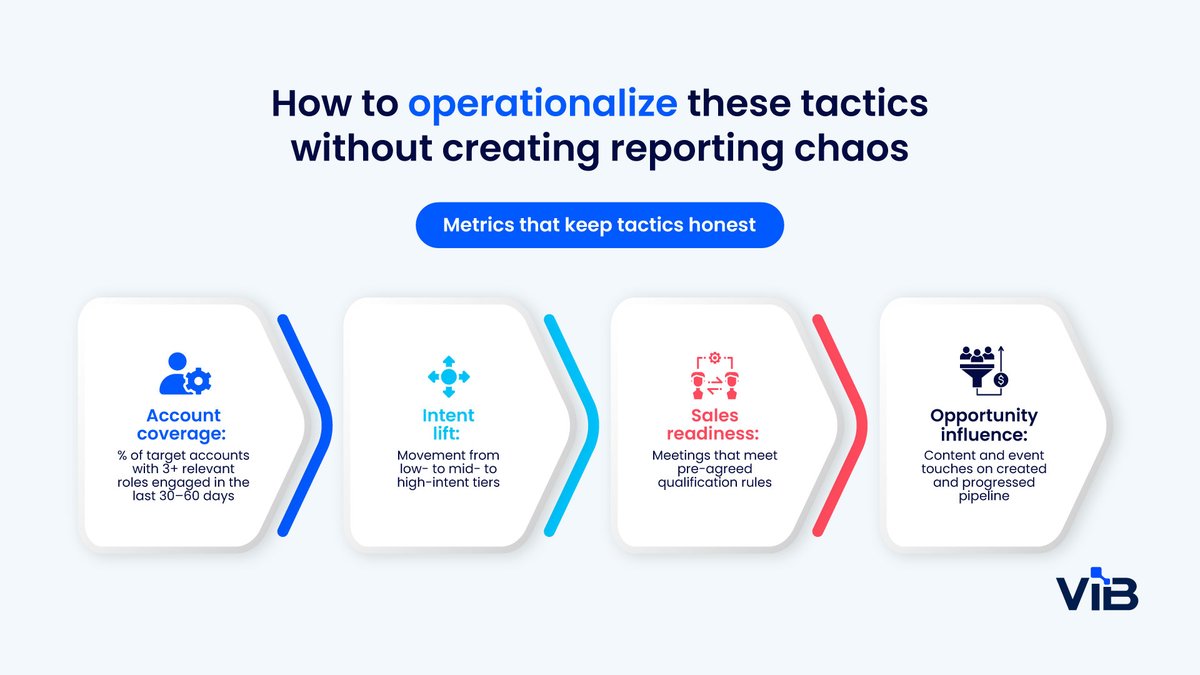
How to operationalize these tactics without creating reporting chaos
If your dashboard is still lead-first, your team will keep making lead-first decisions.
For experienced marketers, the unlock is building an account and buying group measurement layer on top of existing systems, not replacing everything.
Metrics that keep tactics honest
- Account coverage: % of target accounts with 3+ relevant roles engaged in the last 30–60 days
- Intent lift: movement from low- to mid- to high-intent tiers
- Sales readiness: meetings that meet pre-agreed qualification rules
- Opportunity influence: content and event touches tied to opportunity creation and progression, with clear attribution rules.
Common scenarios and the best tactic mix
These aren’t “one size fits all.” But they’re realistic patterns that SaaS marketers run into.
Scenario: You have awareness, but demand is inconsistent
Prioritize intent-based routing and conversion paths that match readiness.
- Deal/keyword intent to tier accounts
- Role-based email micro-journeys
- Webinars with two CTAs (assessment vs meeting)
Scenario: You’re generating leads, but sales says “not real”
Fix qualification and buying-group coverage before you add more spend.
- Tighten ICP filters for syndication
- Require multiple-role engagement for appointment outreach
- Use post-webinar decision packets to drive internal sharing
Scenario: Enterprise cycles are long and multi-threading is weak
Shift from “lead nurture” to “consensus nurture.” Build content that helps champions align the room.
- Buying group enablement assets (checklists, internal pitch deck, security FAQ)
- Executive-friendly webinars (short, direct, risk-focused)
- Appointment offers framed as working sessions, not demos
Where ViB fits: Turning strategy into consistent execution
If your strategy is sound but execution is the bottleneck, this is where specialized partners earn their keep.
ViB supports these B2B demand generation tactics by making the core motions easier to run with consistency, quality control, and measurable outcomes.
ViB Emails: Use role-based email programs to move accounts through micro-stages, not just to “nurture leads.”
ViB Appointments: Convert validated interest into meetings with the right roles, using qualification rules that protect sales time and brand trust.
ViB Syndication: Expand reach inside your ICP, then use engagement and fit signals to identify which accounts to nurture versus escalate.
ViB Webinars: Run webinars designed to build buying-group consensus, with post-event assets and conversion paths aligned to readiness.


