If you’re running demand gen for B2B tech or SaaS in 2026, the challenge isn’t clicks. It’s earning attention and alignment inside buying groups where stakeholders may not even agree on the problem yet. Most buyers do their research independently and form preferences long before engaging sales.
Studies show that the majority of B2B buyers want to self-educate and actively avoid irrelevant outreach, which means generic demand gen does more harm than good.
That’s why demand gen today isn’t about “more leads.” It’s about creating repeatable strategies that help buying teams educate themselves,💡align internally, and move forward with less friction.
What’s changed: demand gen is now a buying group alignment problem
Most B2B demand gen programs still act like one person buys software. That mismatch shows up everywhere: low-converting MQLs, stalled opportunities, “no decision,” and SDRs chasing ghosts. Gartner found 74% of B2B buyer teams experience “unhealthy conflict” during the decision process.
That matters because conflict is a demand gen design problem. Your strategy either reduce uncertainty across stakeholders, or they create more objections to reconcile.
The hidden failure mode: “personalization” that fractures the room
A lot of teams over-optimize persona streams and under-optimize “shared truth.” Gartner highlights that buying groups can range from five to 16 people across as many as four functions.
If your b2b demand gen strategy only arm a single champion, you may actually amplify internal disagreement. The more complex the deal, the more your program needs assets designed for cross-functional alignment.
How to choose the right b2b demand generation strategy (a practical decision framework)
Experienced teams don’t ask, “What channels should we run?” They ask, “What job must our program do in the next 90 days?”
Here’s a framework that keeps strategies tied to outcomes instead of habits:
Create category demand: Make the problem feel urgent and broadly understood.
High-performing demand generation strategy (and how advanced teams run them)
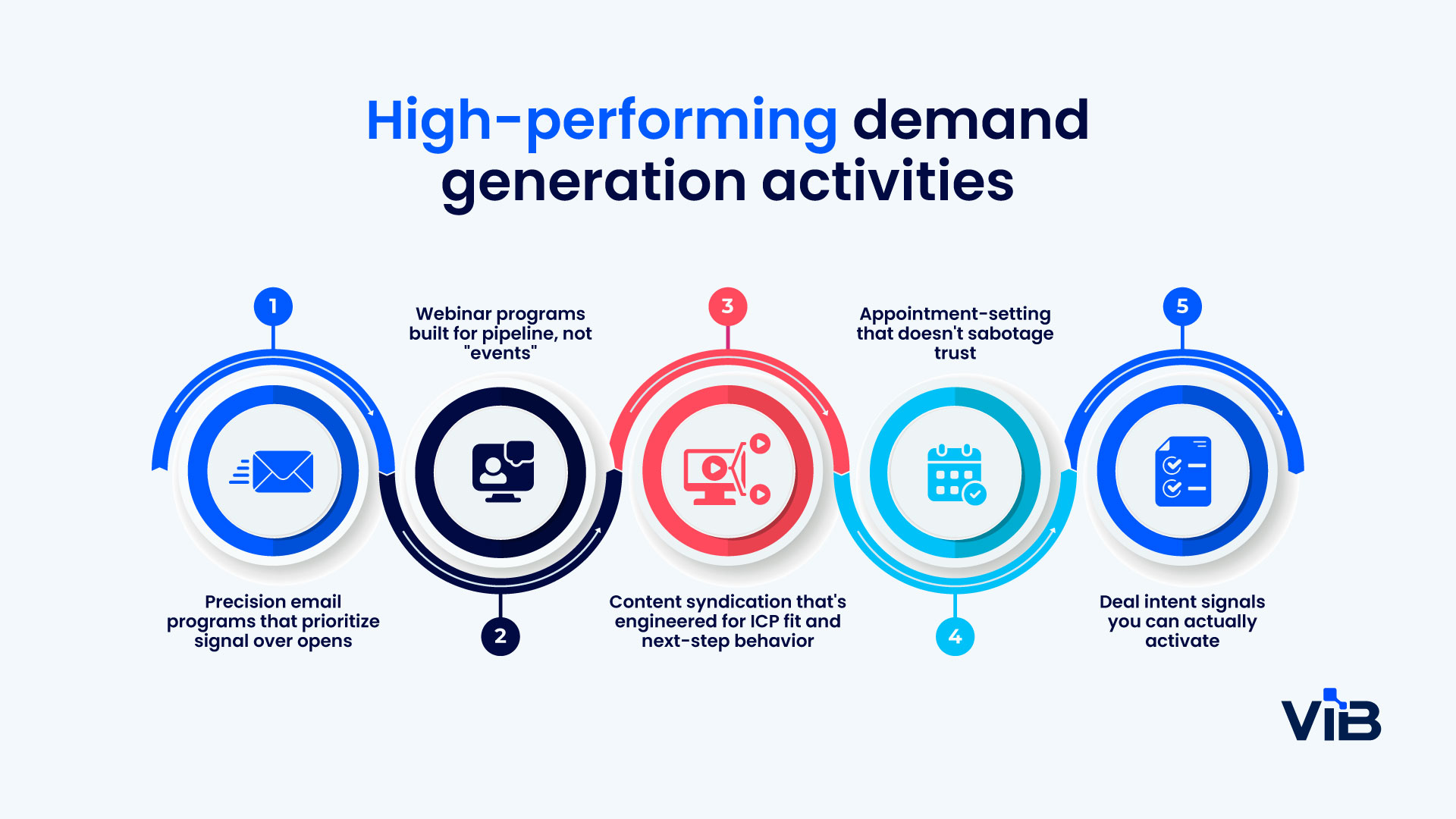
1) Precision email programs that prioritize signal over opens
Email still works, but the KPI stack has changed. Opens are noisy due to privacy behavior, so advanced teams obsess over downstream signal: replies, meeting rate, and pipeline touched.
Design “buying group” 👥email threads (CFO/Finance lens + Security/IT lens + Ops lens) around one shared narrative.
Ship proof packages: 1-page ROI model, implementation plan, and risk checklist. These forward well internally.
Measure intent with multi-asset engagement (e.g., pricing page + security doc + webinar questions), not single clicks.
2) Webinar programs built for demand gen, not “events”
Webinars are one of the few scalable formats where you can create real depth fast. But the win isn’t attendance. It’s capturing first-party engagement that helps you qualify, segment, and route follow-up.
How advanced teams turn webinars into demand gen engines:
Run “decision enablement” sessions: implementation, security, migration, and TCO clinics outperform generic thought leadership late-stage.
Build stakeholder breakouts: same topic, different Q&A lanes (IT, Finance, RevOps). This reduces buying group conflict.
Exploit on-demand: treat the recording as an always-on asset with ongoing syndication and nurture.
3) Content syndication that’s engineered for ICP fit and next-step behavior
Content syndication has a reputation problem because many programs optimize for lead volume, not relevance. That’s not a channel flaw. It’s a program design flaw.
To make syndication work for experienced teams, treat it like distribution for a specific conversion job:
Top-of-funnel: distribute category education tied to a measurable pain (cost of downtime, audit burden, rep productivity loss).
The operational trick: require a next-step that creates signal (e.g., “Get the spreadsheet,” “Request the checklist,” “See the security controls”). Then score accounts, not individuals.
4) Appointment-setting that doesn’t sabotage trust
Appointments can accelerate a buyer’s journey, but only when the buyer’s context is respected. Remember Gartner’s “irrelevant outreach” warning: buyers actively avoid it.
High-integrity appointment programs share three traits:
Clear expectations: topic, agenda, and outcomes are set before the call.
Right stakeholder: the meeting is mapped to a real role in the buying group, not “anyone in IT.”
Context transfer: SDR/AEs receive the engagement history and stated priorities, not just a calendar invite.
When done right, appointments become the bridge between self-serve research and seller-assisted decision-making.
5) Buying signals you can actually activate
Most “intent” stacks produce lots of noise because they’re built on broad consumption signals. The intent that moves revenue is explicit and recent: buyers requesting pricing context, asking implementation questions, or engaging deeply with decision assets.
One practical way to upgrade your intent motion is to define “actionable intent” as a thresholded sequence across channels, for example:
Visited pricing/security pages within 7 days
Downloaded a requirements or evaluation asset
Multiple stakeholders from the same account engaged
Then route based on account stage. Don’t treat a new account and a late-stage account the same, even if the signal looks similar.
Common demand gen challenges (and how to fix them without “more volume”)
Challenge: your MQLs aren’t converting
Often this is an asset problem, not a lead problem. If you’re only offering awareness content, you’ll capture curiosity, not evaluation. Swap in assets that help people buy: checklists, templates, ROI tools, and implementation playbooks.
Challenge: ABM is “working” but pipeline is stalling
Stalls usually mean internal conflict. Buying groups that reach consensus are 2.5x more likely to report a high-quality deal. Your job is to create consensus content that aligns functions around shared outcomes.
Challenge: your outreach is getting colder
That’s consistent with the broader buyer preference to do self-serve research. The fix isn’t “better subject lines.” It’s tighter ICP targeting and relevance that’s obvious within one sentence.
This is also where a single mention of a partner like ViB can fit naturally: some teams use third-party communities and curated audiences to reach hard-to-access technical buyers without defaulting to spray-and-pray.
How to measure demand generation strategy like an experienced team
If you want demand gen to keep budget, you need metrics that match how revenue happens. That means moving from lead-centric reporting to account and opportunity-centric reporting.
A practical measurement stack:
Account coverage: engaged accounts by tier, plus stakeholder depth (how many roles).
Buying group engagement: multi-stakeholder activity within a time window.
Pipeline creation: new opportunities influenced by demand gen strategy.
Velocity: stage-to-stage time for influenced deals vs. non-influenced deals.
Efficiency: cost per opportunity created (not cost per lead).
Keep it simple, but keep it honest. If an activity can’t be tied to the buyer journey within a quarter or two, it probably belongs in brand, not demand.
Where ViB fits: operationalizing these strategies without bloating your team
At some point, the constraint isn’t strategy. It’s execution capacity: promotion, targeting, list quality, consistent attendance, and reliable meeting flow.
Post-Meeting Intelligence is a survey-based service that gathers unbiased feedback from prospects after your sales meetings. It’s available exclusively as an add-on to ViB Appointments. This service helps fill post-meeting data gaps, answering key questions like:
Which product or service features resonated most with the prospect?
How could the sales call have been improved?
What hurdles might prevent closing the deal?
What next steps align with the prospect’s pace and interest?
Does the prospect have the budget for our solution?
Instead of leaving your sales reps to guess after the call, ViB acts as a neutral third party to survey the prospect. We gather first-hand data to close the feedback loop—giving you clear insights to refine your approach and boost your chances of winning the deal.
ViB uses a pay-per-qualified-meeting-held pricing model—meaning you only pay for completed appointments with leads who fit your targeting criteria.
Unlike fee-for-service providers, there’s no risk of paying for no-shows or getting stuck with a retainer fee for low meeting volume. You only pay for successful meetings. That’s part of our core values as a trusted demand generation partner—and we deliver on it through our unique community-based approach.
ViB Deal Intent does the qualification all for you — helping you skip the lengthy nurturing process. And with comprehensive deal intent at your fingertips, you can personalize your approach and enter conversations fully informed, increasing your chances of closing deals faster.
In particular, if you’re a startup or have a smaller market presence, ViB Deal intent can help to uncover net new accounts and projects that you might not have been organically invited to, ultimately accelerating your prospecting efforts.
We’re glad you asked! Both of these solutions generate qualified sales leads and appointments, and tap into the same ViB Community.
However, unlike ViB Appointments, ViB Deal Intent is a more mid to bottom-of-funnel sales lead generation service, as there are additional steps to confirm that the lead is in an active project, and to derive comprehensive deal intent. This enables a deeper level of personalization and produces valuable original data.
ViB Deal intent provides explicit intent data from zero-party data sources. In other words, it’s really our process of generating pre-qualified business opportunity leads, and the results you get, that differentiate us from other B2B sales leads generation companies and intent data providers. Here’s how we’d sum it up:
Leads are self-verified to be in a confirmed project in your intent category, and in the next 6-12 months. In other words, they have told us that they are actively seeking solutions like yours.
There’s full consent. Every prospect delivered will have agreed to be contacted by solution providers like you! This means they’re more likely to be genuinely interested, and likely to convert into opportunities.
At ViB, we take pride in being more affordable and marketer-friendly than major B2B market research companies and analyst firms.
For example, all surveys are 100% customizable to fit your sales and marketing objectives. Any data we produce is entirely yours to keep and repurpose to, so you can power your pipeline with thought leadership content.
Our specialty is in IT market research, with a focus on the niche tech industry. With our tech-based ViB Community, we’re able to find respondents that meet your exact targeting requirements to be your research participants.
And our favorite perk — our methodology is simpler and more efficient, so we don’t have to charge six-digit price tags like standard analyst firms and survey research companies.
We have lots to share! Check out our compilation of market research report examples, created by B2B tech marketers like you. Or you can download some of our highlights:
Typically, yes. Top tier firms like Garter and IDC can cost anywhere from $80,000-$250,000, while mid-tier firms charge $30,000-$60,000 for a report. That’s usually because of the cost of branding and a highly complex research process.
Thankfully, there’s a much more affordable option — ViB Research — which sits around $17,500-$25,000. We’re able to tap into a ready community of high tech profiles that make up your targeted survey respondents. Plus, we offer a simplified but collaborative process with lead generation in mind. That’s how we transfer cost-savings to marketers who have so much to gain from conducting custom research.
B2B research goes a long way in contributing to higher quality and quantity of leads. For example, research gives you an in-depth understanding of your prospects’ needs and market trends, so you can create precisely targeted strategies that bring up your conversion rates. Plus, a single research study has massive repurposing potential. We’re talking over 10 assets created, and up to $5 million in pipeline.
As for Qualtrics, it’s a versatile tool that allows you to design a range of quantitative and qualitative questions and supports many types of survey formats. Plus, it’s easy to edit and analyze findings, making it a great choice for our research needs.
We get it, choosing the best B2B content syndication services provider can feel like a maze. So let’s break it down.
There are quite a few ways ViB Syndication stands out from other B2B content syndication platforms. For one, other platforms primarily use a native advertising model that targets a general audience of readers segmented by vague readership patterns like location, time, and browser type. Meanwhile, ViB’s audience is made up of tech end users who have opted in to receive content that matches their business needs. Each user is carefully targeted, using a range of B2B customer segmentation strategies like firmographics and psychographics (interests).
Another key difference is our pricing model. With ViB, we follow a pay-per-qualified-download model. It’s a more specific type of pay-per-lead model, where you only pay for the leads that meet your criteria. This is different from other platforms that function more like ads and use a pay-per-click or pay-per-impression model. Our approach ensures that you get the most out of your investment and only pay for qualified leads that are actually interested in your content. No wasted clicks or impressions here!
Lastly, paid content syndication vendors might require you to use complex bidding platforms, which could take some time to onboard. With ViB, we’ll simply need your asset, targeting criteria and lead goal, and we’ll handle the rest so you can focus on what you do best.
ViB Syndication uses a unique approach, where we generate leads from our community of tech end users. Essentially, our leads are members of our ViB Community, where they come to discover new tech and tell us about their interests and contact details.
By using this community-based approach, we’re able to provide you with contact data that is self-verified and directly from the source (zero-party data). Our community members choose to receive content that aligns with their interests and business needs. Through ViB Syndication, we then promote your content to them until we reach your qualified lead guarantee. So rest assured, you’ll generate engaged and qualified leads who are genuinely interested in what you have to offer. It’s a win-win!
Free content syndication requires you to pitch your content to relevant publications and websites, hoping they mention it, extract content, give you credit, or even place a backlink. You can also republish your content on sites you own, which counts as a free syndication strategy.
Paid content syndication removes all that extra effort and “risk”, by having an external partner promote your content for a fee. Ps. you can also see more on the blog: Free vs. Paid Content Syndication — Which Works Best for B2B Tech Companies?
Outsourced sales development representatives (SDRs), sometimes called business development representatives (BDRs), need to pitch your brand and solution to prospective clients, and then manually qualify leads—a process that leaves room for error. Outsourcing to SDRs can be especially challenging for high-tech companies. Training often takes weeks, as SDRs need to understand complex solutions and communicate technical details accurately. This can be time-consuming and costly, increasing the risk of setting meetings with prospects who don’t understand your brand or solution.
Common issues with outsourced SDRs include:
Struggling to understand niche tech solutions and relay technical details
Misrepresenting your brand
Delivering leads that don’t match your targeting criteria or buyer personas
Long onboarding and training timelines
Fee-for-service pricing models that charge regardless of results
ViB Appointments is different. We tap into a community of millions of high-tech professionals. Our platform-driven approach puts you in control of your message and targeting—without the need to train SDRs on your product. You can launch in days, not months. Plus, our pay-per-completed meeting model lowers your risk—you only pay for successful appointments.
At ViB, we don’t rely on cold calling at all!
Traditional B2B cold calling services gather contact data from various sources like company directories, business databases, trade shows, industry events, social media, and referrals. They may also buy or rent targeted lead lists from B2B data providers. Reps then use cold outreach to manually qualify prospects and set up meetings.
ViB takes a different approach. Our community-based model taps into a network of millions of high-tech decision makers to source qualified, targeted prospects. We promote your solution on our community portal, where members voluntarily opt in to meet with you. Because they self-qualify—without any hard selling—they’re typically more interested, leading to higher conversion rates.
That’s the best part. Our contacts are self-verified, meaning they’ve given us their information voluntarily, and opted-in to receive emails that align with their interests and business needs. This zero-party data approach keeps our data accurate, relevant and compliant.
Quality and speed! We rely on our engaged ViB Community instead of public and possibly sketchy sources on the web that could contain non-compliant B2B data lists.
Plus, instead of selling B2B contact lists, we take a white-glove approach to help you run each email campaign. This helps you skip all the steps around list cleaning, brand training, launching campaigns, and worrying about email sender domain reputation, which is a common concern when buying lead lists from B2B data providers. You’ll simply go straight to seeing engaged email leads.
We’re all about getting you the most qualified B2B contacts. We source our contact information directly from our ViB Community of tech professionals who have opted in to receive emails that match their interests or business.
You may also like:
Best cybersecurity content promotion services (2026)
 Skip to content