B2B Lead Generation, B2B Marketing, Marketing Strategy
ViB Editorial
Table of Contents
Table of Contents
The shift from Q4 chaos to Q1 planning always brings the same question for B2B tech marketers: “What needs to change next year?”
This is your chance to refresh your demand-generation strategy with a clearer picture of what your buyers want, where they spend time, and how they signal intent. With a few strategic updates, you can walk into 2026 with a plan that feels simpler, more predictable, and more aligned to revenue goals.
Small changes to how you approach B2B demand generation can create an outsized impact on results.
This guide walks through the exact steps you can take right now to elevate your 2026 strategy—supported by data, intent insight, and smarter content distribution. 🚀
Start with a clear-eyed review of your 2025 performance
Most teams review KPIs at year-end. Fewer teams look beyond the metrics to the story behind them. Before you build anything for 2026, take a deeper look at:
Where quality engagement actually came from
Was your strongest engagement from a specific content format, audience segment, or distribution channel? Often, marketers assume their content calendar drove pipeline, when in reality, only a handful of assets pulled most of the weight.
What stalled or underperformed
Instead of labeling something a failure, look for content that didn’t reach the right people, offers that were too early/late for the buying stage, and channels that lacked amplification.
Underperformance is usually a visibility problem, not a content problem.
This is precisely why 2026 plans need stronger intent foundations and more predictable distribution to ensure your content actually gets seen.
Reassess your ICP and buying committee for 2026
Buyer dynamics have shifted. Technical buyers are gaining more influence, buying groups are larger, and budgets require more internal alignment than ever.
Going into 2026, your ICP may need a refresh, especially if you expanded into new verticals, launched new products, or saw changes in your win/loss patterns.
To stay competitive, you need to understand not only who your buyers are, but who is actively in-market.
How intent data helps refine your ICP
Instead of guessing who’s ready to buy, intent data helps you:
This is where ViB Deal Intent becomes a planning advantage. With verified data from tech buyers, marketers can refine their ICP with real signals, not assumptions, so they focus 2026 campaigns on accounts most likely to convert.
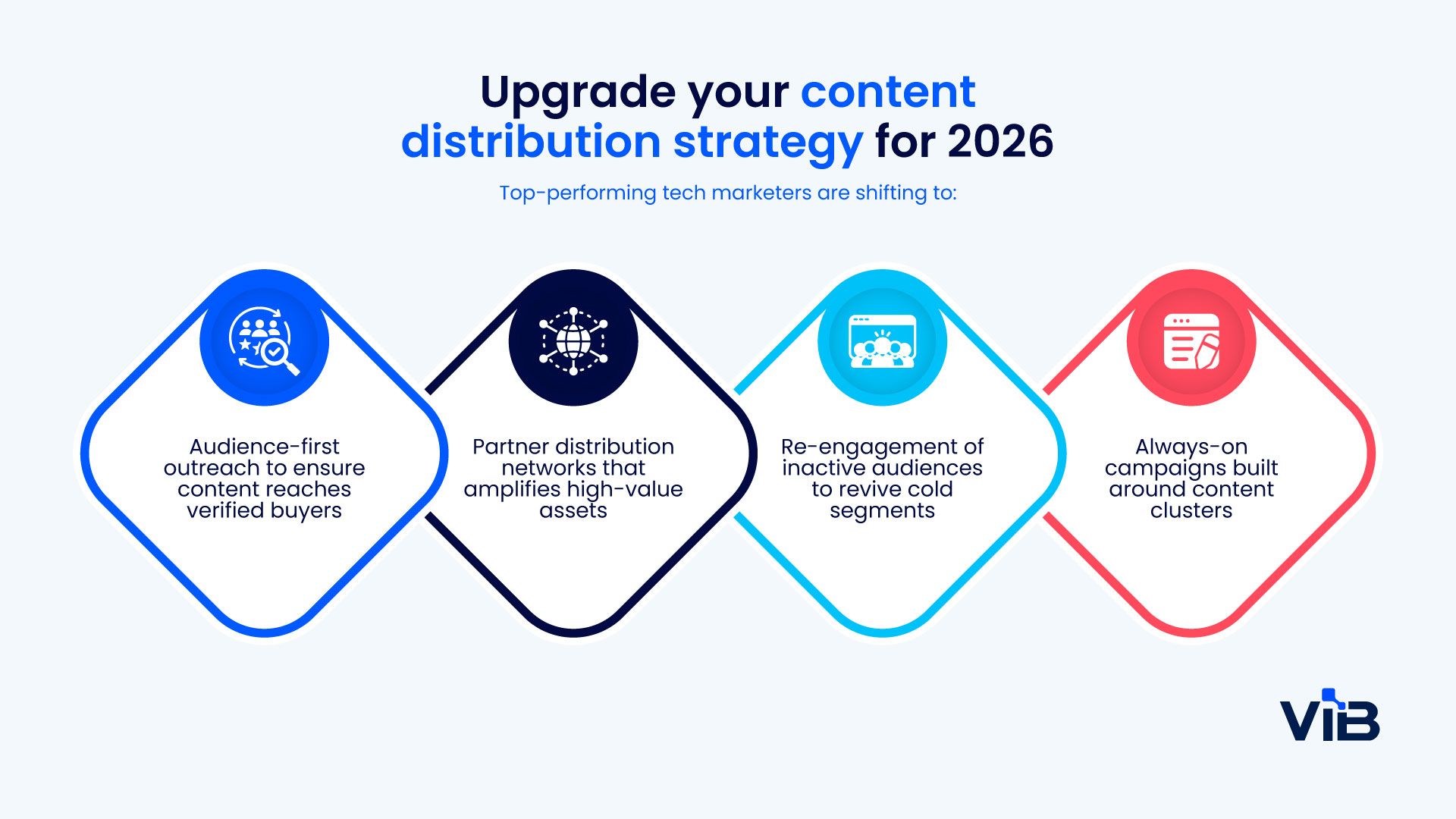
Upgrade your content distribution strategy for 2026
Organic reach is declining. Competition for buyer attention is increasing. And publishing content is no longer enough to stay visible. Even excellent content underperforms if buyers never discover it.
To keep your B2B demand generation engine healthy in 2026, distribution must take center stage.
Qualified traffic continues even when organic dips
Your content calendar gets predictable amplification
Your team gets more visibility without extra bandwidth
Instead of hoping your content finds buyers, you know exactly who you’re reaching and why they’re engaging.
Operationalize your intent data (instead of just collecting it)
Many teams invest in intent tools but fail to integrate them into daily execution. For 2026 planning, intent must shift from a passive dashboard metric to an active, decision-making layer.
This gives marketers a more precise starting point for Q1—and a faster way to activate insight-driven campaigns.
Build a multi-channel demand engine that works even with a small team
Not every team has a large content department or a full-time operations engine. That’s why 2026 requires a smarter, leaner system. A modern demand-gen engine should be built around:
1. A predictable traffic layer
Something that continually brings qualified visitors to your content—even when internal resources are low.
2. A distribution mechanism that extends reach
Think of this as your “amplification arm,” pushing high-impact assets into the right inboxes and feeds.
3. Intent-driven prioritization
Let intent narrow your focus so you invest resources in the warmest audience segments.
4. A repurposing system
Turn one strong asset into a full set of social posts, email offers, syndication placements, webinar topics, and ABM touchpoints.
With a repeatable structure, even lean teams can produce big-league demand-gen results.
A quick 2026 demand-gen checklist 🧭
Use this list to finalize your Q1 and annual plan:
Create repeatable reporting for multi-channel visibility
A strong 2026 plan shouldn’t feel complicated—it should feel focused.
The bottom line: 2026 belongs to marketers who plan with intent
The most successful teams next year will be those who refresh their ICP, operationalize intent data, prioritize distribution, and lean into partnerships that simplify demand gen.
Post-Meeting Intelligence is a survey-based service that gathers unbiased feedback from prospects after your sales meetings. It’s available exclusively as an add-on to ViB Appointments. This service helps fill post-meeting data gaps, answering key questions like:
Which product or service features resonated most with the prospect?
How could the sales call have been improved?
What hurdles might prevent closing the deal?
What next steps align with the prospect’s pace and interest?
Does the prospect have the budget for our solution?
Instead of leaving your sales reps to guess after the call, ViB acts as a neutral third party to survey the prospect. We gather first-hand data to close the feedback loop—giving you clear insights to refine your approach and boost your chances of winning the deal.
ViB uses a pay-per-qualified-meeting-held pricing model—meaning you only pay for completed appointments with leads who fit your targeting criteria.
Unlike fee-for-service providers, there’s no risk of paying for no-shows or getting stuck with a retainer fee for low meeting volume. You only pay for successful meetings. That’s part of our core values as a trusted demand generation partner—and we deliver on it through our unique community-based approach.
We get it, choosing the best B2B content syndication services provider can feel like a maze. So let’s break it down.
There are quite a few ways ViB Syndication stands out from other B2B content syndication platforms. For one, other platforms primarily use a native advertising model that targets a general audience of readers segmented by vague readership patterns like location, time, and browser type. Meanwhile, ViB’s audience is made up of tech end users who have opted in to receive content that matches their business needs. Each user is carefully targeted, using a range of B2B customer segmentation strategies like firmographics and psychographics (interests).
Another key difference is our pricing model. With ViB, we follow a pay-per-qualified-download model. It’s a more specific type of pay-per-lead model, where you only pay for the leads that meet your criteria. This is different from other platforms that function more like ads and use a pay-per-click or pay-per-impression model. Our approach ensures that you get the most out of your investment and only pay for qualified leads that are actually interested in your content. No wasted clicks or impressions here!
Lastly, paid content syndication vendors might require you to use complex bidding platforms, which could take some time to onboard. With ViB, we’ll simply need your asset, targeting criteria and lead goal, and we’ll handle the rest so you can focus on what you do best.
ViB Syndication uses a unique approach, where we generate leads from our community of tech end users. Essentially, our leads are members of our ViB Community, where they come to discover new tech and tell us about their interests and contact details.
By using this community-based approach, we’re able to provide you with contact data that is self-verified and directly from the source (zero-party data). Our community members choose to receive content that aligns with their interests and business needs. Through ViB Syndication, we then promote your content to them until we reach your qualified lead guarantee. So rest assured, you’ll generate engaged and qualified leads who are genuinely interested in what you have to offer. It’s a win-win!
Free content syndication requires you to pitch your content to relevant publications and websites, hoping they mention it, extract content, give you credit, or even place a backlink. You can also republish your content on sites you own, which counts as a free syndication strategy.
Paid content syndication removes all that extra effort and “risk”, by having an external partner promote your content for a fee. Ps. you can also see more on the blog: Free vs. Paid Content Syndication — Which Works Best for B2B Tech Companies?
Outsourced sales development representatives (SDRs), sometimes called business development representatives (BDRs), need to pitch your brand and solution to prospective clients, and then manually qualify leads—a process that leaves room for error. Outsourcing to SDRs can be especially challenging for high-tech companies. Training often takes weeks, as SDRs need to understand complex solutions and communicate technical details accurately. This can be time-consuming and costly, increasing the risk of setting meetings with prospects who don’t understand your brand or solution.
Common issues with outsourced SDRs include:
Struggling to understand niche tech solutions and relay technical details
Misrepresenting your brand
Delivering leads that don’t match your targeting criteria or buyer personas
Long onboarding and training timelines
Fee-for-service pricing models that charge regardless of results
ViB Appointments is different. We tap into a community of millions of high-tech professionals. Our platform-driven approach puts you in control of your message and targeting—without the need to train SDRs on your product. You can launch in days, not months. Plus, our pay-per-completed meeting model lowers your risk—you only pay for successful appointments.
At ViB, we don’t rely on cold calling at all!
Traditional B2B cold calling services gather contact data from various sources like company directories, business databases, trade shows, industry events, social media, and referrals. They may also buy or rent targeted lead lists from B2B data providers. Reps then use cold outreach to manually qualify prospects and set up meetings.
ViB takes a different approach. Our community-based model taps into a network of millions of high-tech decision makers to source qualified, targeted prospects. We promote your solution on our community portal, where members voluntarily opt in to meet with you. Because they self-qualify—without any hard selling—they’re typically more interested, leading to higher conversion rates.
That’s the best part. Our contacts are self-verified, meaning they’ve given us their information voluntarily, and opted-in to receive emails that align with their interests and business needs. This zero-party data approach keeps our data accurate, relevant and compliant.
Quality and speed! We rely on our engaged ViB Community instead of public and possibly sketchy sources on the web that could contain non-compliant B2B data lists.
Plus, instead of selling B2B contact lists, we take a white-glove approach to help you run each email campaign. This helps you skip all the steps around list cleaning, brand training, launching campaigns, and worrying about email sender domain reputation, which is a common concern when buying lead lists from B2B data providers. You’ll simply go straight to seeing engaged email leads.
We’re all about getting you the most qualified B2B contacts. We source our contact information directly from our ViB Community of tech professionals who have opted in to receive emails that match their interests or business.
You may also like:
Best cybersecurity content promotion services (2026)
 Skip to content