 Skip to content


Email marketing remains one of the most dependable channels for connecting with decision-makers, nurturing long buying cycles, and driving conversions that matter. But, today the inbox is more crowded, privacy rules have tightened, buyers are more cautious, and generic blasts can do more harm for your brand.
As a seasoned B2B marketer, you’re not here for surface-level tips. You want email strategies that elevate engagement, increase responsiveness, and actually influence buying group alignment.
You want outcomes.
In this blog, we’ll walk through what works in 2026, why it works, and how elite teams are adapting strategy to match the complexity of today’s buyers. Then we’ll explore how a modern email outreach solution like ViB Emails fits naturally into that advanced strategy as a practical extension of your efforts.
Why do B2B emails still work in 2026?
Email continues to outperform many paid channels on ROI because it’s direct, persistent, and contextual when approached correctly.
Research consistently shows that email remains one of the highest-return marketing channels when executed with relevance and discipline. That return is not driven by volume, but by precision and trust. 🎯
What’s changed is how buyers engage with email:
- Decision-makers expect relevance, not frequency.
- Buying groups require messaging that helps internal alignment.
- Privacy regulations limit broad tracking, raising the bar on strategy.
- Inbox placement and sender reputation now require active management.
The 2026 best practices for B2B email marketing focus on precision, buyer alignment, and systems that scale relevance instead of volume.
What makes B2B email fundamentally different?
Most experienced marketers understand the difference instinctively, but it’s worth grounding the strategy in reality.
B2B email marketing operates under different conditions:
- Buying cycles are longer and more complex.
- Multiple stakeholders influence the decision.
- Content must support evaluation, not impulse.
Messages need to educate, validate, and reinforce value over time. One email rarely closes a deal. Instead, email acts as connective tissue across the buyer journey.
What actually drives email engagement in 2026?
High-performing B2B email programs are built on four strategic pillars.
1) Advanced segmentation strategy
Segmentation is no longer optional, and basic segmentation is no longer enough.
Effective programs layer multiple signals together:
- Firmographics like industry and company size
- Role and seniority within the buying group
- Engagement history across content and campaigns
- Intent indicators where available
This approach reduces wasted sends and increases relevance. Fewer emails, better results.
2) Privacy-safe personalization
Privacy constraints haven’t eliminated personalization, they’ve made it more intentional.
Strong personalization today focuses on:
- Role-specific framing
- Dynamic content blocks by segment
- Behavior-triggered follow-ups
Short, contextual emails consistently outperform long, generic messages. Buyers respond when the message clearly connects to their challenges.
3) Lifecycle-driven email flows
In B2B, performance comes from systems, not isolated campaigns.
Top teams build lifecycle email flows triggered by actions such as:
- Content downloads
- Webinar attendance
- Key page visits
- Repeated engagement patterns
These sequences feel human because they respond to behavior, not assumptions.
4) Outcome-focused measurement
Vanity metrics still have a place, but they no longer tell the full story.
Advanced teams track:
- Engagement quality by segment
- Movement into qualified conversations
- Downstream conversion signals
These metrics connect email activity to real business outcomes.

So, what are the 2026 best practices for b2b email marketing that actually work
Experienced marketers are refining execution around a few key practices.
1) List hygiene and deliverability protection 📧
List quality directly impacts deliverability and brand trust. Removing inactive contacts protects inbox placement and improves engagement, but list quality is about more than activity alone.
In B2B, people change roles and responsibilities frequently, so contacts that once fit your ICP may no longer be relevant. Even when they do, many are not in an active buying or research phase, which makes otherwise strong emails feel mistimed.
High-performing teams continuously monitor engagement signals and use them to filter, segment, and adjust cadence, ensuring messages reach contacts who are both relevant and receptive.
2) Cadence discipline
More emails do not equal more impact.
Most B2B programs still perform best with a measured cadence, adjusted based on engagement signals. Relevance always beats frequency.
3) Role-driven subject line strategy
Subject lines perform best when they clearly signal relevance to a role or challenge. Vague promotional language gets ignored. Specific, contextual framing gets opened.
4) Intent-aligned messaging
Messages should evolve as buyers move through their journey.
- Early emails educate and frame the problem.
- Mid-stage emails highlight differentiation and use cases.
- Later emails reinforce confidence with proof points.
Alignment reduces friction and increases momentum.
5) Deliverability as a strategic asset
Technical fundamentals like SPF, DKIM, and DMARC protect sender reputation. Poor deliverability undermines even the strongest messaging.
In 2026, deliverability is brand protection.
6) Continuous testing and optimization
Subject lines, send timing, and message framing are still worth testing. Small improvements compound over time and improve downstream performance.
How does email support account-based strategies?
Email plays a critical role in ABM when executed thoughtfully.
Rather than broadcasting messages, ABM-aligned email delivers tailored content to specific roles within target accounts. Each persona receives messaging aligned to their priorities, whether that’s ROI, technical feasibility, or operational impact.
This approach supports internal consensus and strengthens alignment between marketing and sales.
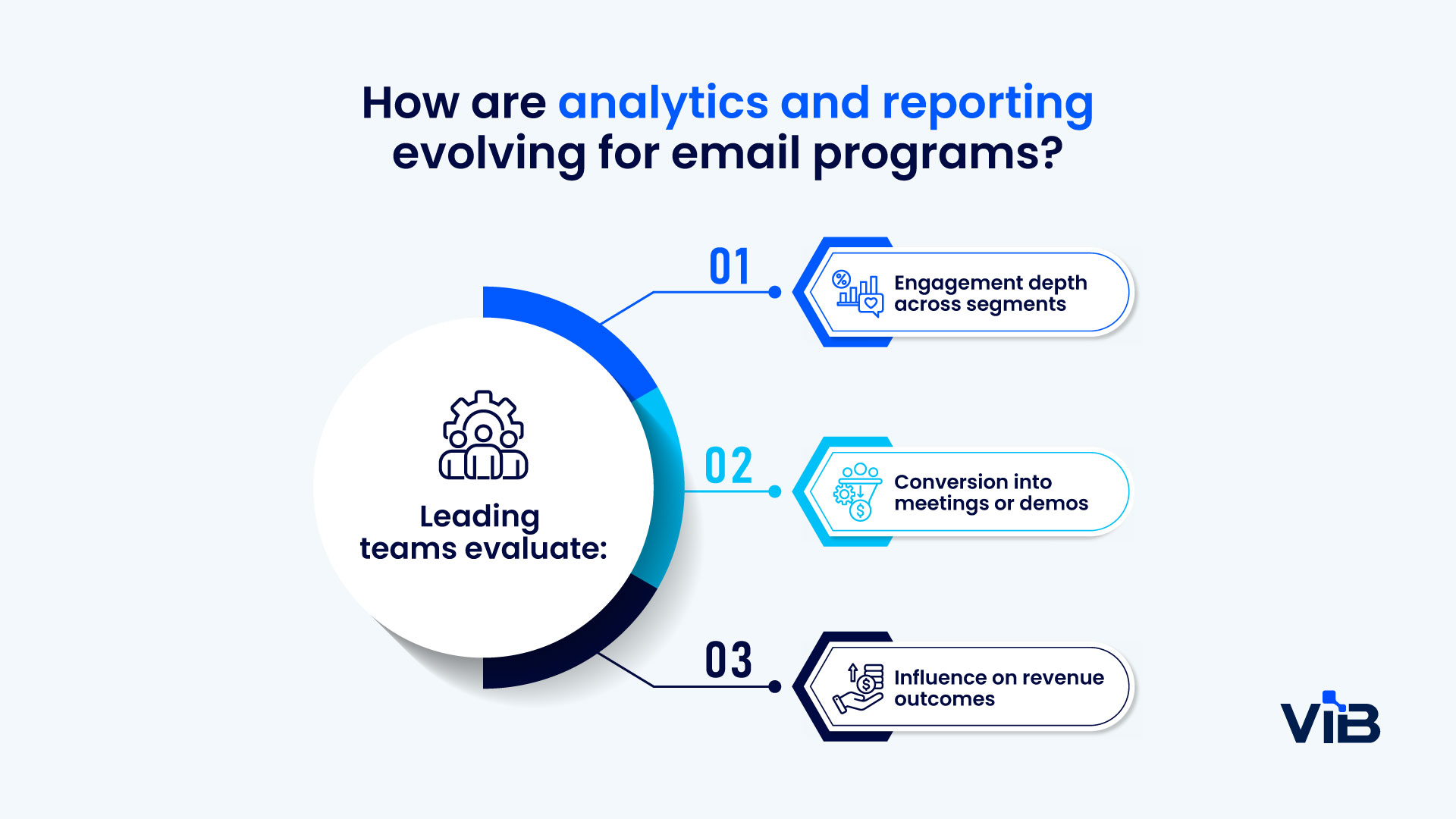
How are analytics and reporting evolving for email programs?
Modern reporting focuses on quality and influence.
- Engagement depth across segments
- Conversion into meetings or demos
- Influence on revenue outcomes
Email performance is no longer measured in isolation, but as part of a broader demand engine.
How are advanced teams expanding their email audience?
One of the biggest constraints in B2B email is audience scale. Internal lists grow slowly, and traditional purchased lists often underperform.
Many teams now supplement owned lists with targeted email amplification that reaches relevant professionals without sacrificing deliverability or relevance.
This is where execution often breaks down, unless the right infrastructure is in place.
How does ViB Emails fit into a modern email strategy?
Once strategy and execution are aligned, the next question is reach.
ViB Emails is designed to help B2B tech marketers extend high-performing email campaigns beyond their internal lists while maintaining quality and relevance.
Rather than managing list acquisition and infrastructure internally, marketers can use ViB Emails to:
- Reach a curated, opted-in audience of B2B tech professionals
- Avoid deliverability risks tied to new or rented lists
- Target by role, industry, and seniority
- Gain engagement insights that inform future campaigns
ViB Emails works best as a complement to your existing email program. It supports the same best practices discussed throughout this guide, applied at greater scale.
What should you take away from 2026 best practices?
The strongest B2B email programs are built on clarity and discipline.
- They prioritize relevance over reach.
- They guide buyers instead of pushing offers.
- They measure outcomes, not just activity. 📈
These principles reflect the best practices for B2B email marketing that high-performing teams are using to protect deliverability, improve engagement quality, and support longer buying cycles.
When strategy is paired with the right execution support, email remains one of the most reliable channels for influencing buying decisions.
If your team is focused on improving engagement and expanding reach without compromising trust, ViB Emails can be a natural next step in evolving your email strategy.


